View from the Green Room: Bohemian magic
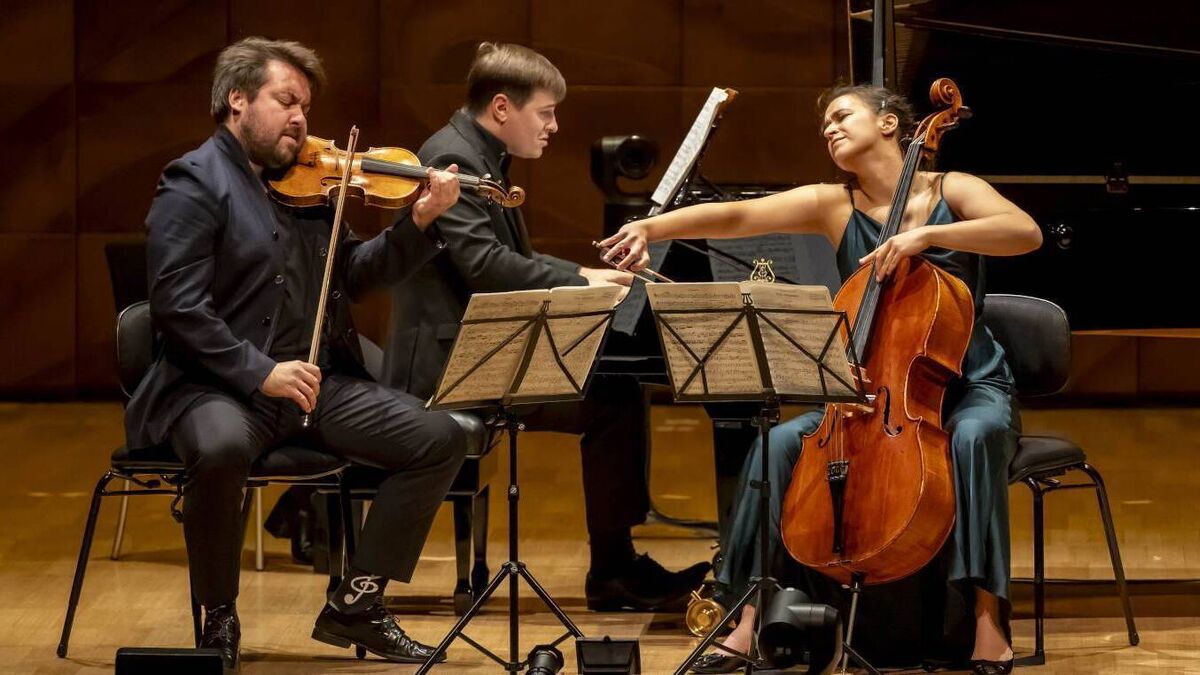
Trio Bohémo
Tonight is the last of the spring concerts for Waterford-Music’s season and what a concert Trio Bohémo performed. The large attendance gave a well-deserved standing ovation to the Trio for an emotion-packed programme that brings sustained applause all night.
Czechia group Trio Bohémo is recognised now as a real force on the international classical music scene with appearances all over Europe and Australia where they have received multiple awards. Their 2024 album, featuring works by Shubert and Smetana, was named ‘Debut Album of the Year’. The Trio features Matouš PÄruška on violin, Kristina Vocetková on cello and Jan Vojtek on piano and are recognised for the intensity, energy and emotion of their performances.
Certainly, The Large Room witnessed a performance tonight that was punchy, intense and packed with emotion.
British composer Dame Judith Weir (born 1954) was appointed Master of the King’s Music in 2014 and was the first woman to hold this office. Her ‘O Viridissima’ was inspired by Rhineland abbess Hildegard of Bingen (1098-1179). It’s a complex but immensely engaging composition that, despite its brevity, is full of texture and contrast. A rich, full-bodied melody on cello fills the room despite subtle bass chords from the piano sounding somewhat ominous.
The Beethoven Piano Trio No. 3 is a real crowd-pleaser, although Haydn advised against publishing for fear of its complexity and because it was so different. He needn’t have feared because the trios, published in 1795, were a big hit with the buying public and announced a new composer on the block.
Elements of the drama of the Beethoven Fifth appear in the energy and power of the opening Allegro. The Andante gives us a time-out with its gentle piano theme and restrained strings entry. A boisterous Minuet that’s full of attack would prove an impossible gig to dance to. Incredibly, despite the contrast between the melody of the strings and the piano’s unstoppable downward scales, there is never a hint of tension here. The furious, driving closing returns to the intense opening mood and a finale with a difference.
There’s an eerie undertone to Amanda Feely’s ‘Gone to Earth’ that’s created by insistent repetition of deep piano chords over constant attempts to create melody from strings. The tension and sense of danger that’s created by repeated single notes from the piano mirrors the composer’s desire to capture the ominous threat of two men’s desire to take what they feel is their own from a woman. Feely’s brief composition is dangerous, intimidating and brilliant.
Shubert’s Notturno in E-flat major is a beautifully crafted delight. A gentle harp-like opening from strings gives way to a flow of demanding piano phrases that grow in intensity and inject energy and passion into the piece.
The Ravel Piano Trio opens with a dazzling piano attack that shakes the Large Room’s audience. Ravel’s Piano Trio was born in that idyllic summer of 1914; that last glimpse of the old world before the slaughter in the trenches changed everything.
The outbreak of the Great War changed all that. Ravel, like so many millions of others, was seized with patriotic fervour and, though he was manifestly unfit for active service, he grimly set about the business of joining the armed forces. But first he had to finish the Trio: ‘I am working with the certainty, the lucidity of a madman… I have done five months work in five weeks.’
It’s genius work from the Trio Bohémo. Dazzling piano attack, a constant feel of improvisation, pumping energy, warm, deep, earthy solos from cello, piercing melodies from fiddle, gritty irregular rhythms in a Basque dance, plinkity-plonk pizzicato over devil-bass piano chords all make for a massive, melodic, triumphant rhapsody.
A triumphant trumpet-like conclusion sends us out into the night with that magical feeling of having witnessed something special from Trio Bohémo.