View from the Green Room: I want to dance, Kate, I want to dance
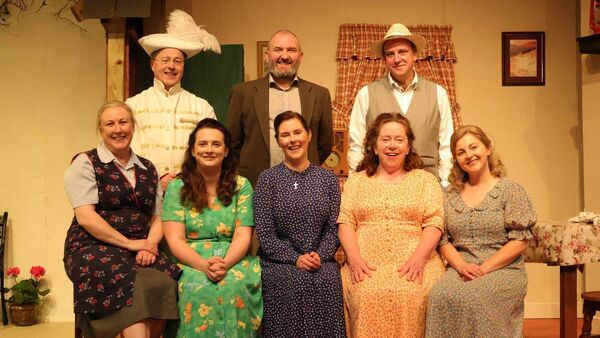
The cast of Dancing at Lughnasa.
Whenever I see Brian Friel’s ‘Dancing at Lughnasa’ I am filled with anger and sorrow in equal measure that the de Valera state not merely condoned the appalling treatment of women, but actively promoted it. Friel’s iconic tale of five sisters, all victims of the post-colonial state, was well told by Brewery Lane Theatre to a full house last week.
Set in Friel’s Ballybeg - small town, small mentality - the five sisters are utterly dependent on their sister’s small salary as a local teacher to maintain them. The return of Fr Jack from the leper colony changes everything. Jack has gone native in Uganda and connects with their pagan ways. He is now an embarrassment to the church and this is 1936.
His return in disgrace leads to Kate’s dismissal from the local school by the local parish priest. Guilt by association and punishment for an entire family. Church and state in total harmony. North Korea now does the same to families if one member falls foul of the regime.
Friel’s script asks us to remember where we were, what we were, and warns against repeating that experience.
Director Maria Clancy makes the brave decision to opt for accents and the entire production sizzles under her care. Well thought out, it was picture-perfect. If five sisters are going to live together, the simple décor of kitchen and yard is always going to be spotless and feminine. A Marconi radio that doesn’t always work is a nod to a changing world as music spins from a raucous reel to Cole Porter classics.
Performances throughout are a joy and the interpretation of the actors was beautifully understated - as it should have been.
Barry Comerford owns the stage as he ambles and narrates his way through the generational history of the five Mundy sisters and, by extension, the social history of living in Dev’s fledgling Irish Free State. Friel’s final curtain speech for Michael in Act 1, however, reveals what happens the Mundy sisters in the end and takes from the drama. It’s never a good idea when the audience is ahead of the author.
Suzanne Shine is superb as the weary, "teacherly" teacher Kate, who cannot allow herself to ever forget her sense of duty… "God, I am a righteous bitch, amn’t I?"
Her role as matriarch of the family seems to wear her out and her gradual loss of presence and authority as events pan out is beautifully understated. Her face carries the weariness of a woman who has seen one dawn too many.
Pat Quinn Bolger gives a very moving performance as Aggie, the eldest and most caring of the sisters, who is constantly kind and concerned - an invisible presence that maintains the family.
Julie LaFontaine as Maggie, the man-and-cigarette-hunter, is full of fun and brings a sense of joy to the role - if I had brought a packet of Woodbines, I would have left them for her.
Sheenagh Raggett is a delight as the flighty Christina who loves a feckless rogue but is also a loving mother to Michael.
Jayne Tennyson is a delight as the simple sister Rosie, who is never afraid to assert her own independence. She exists somewhere between the rational and the not-quite-so; the audience loved her.
John O’Driscoll as Father Jack catches the mood well as the pagan, unchristian world he celebrates turns out to be a more caring and loving land than Donegal in the thirties.
These two characters represent the ‘significant others’ - the simple minds with a cosmic understanding that expresses truth and insight.
Colm Power as Christina’s lover Gerry Evans is an interesting mix of principle, blather and daring-do with a spot-on Welsh accent. He joins the Communist Brigade to fight Franco as an adventurer and is injured falling off his bicycle. Heroes should be made of sterner stuff.
When Agnes declared: "I want to dance Kate. I want to dance," everyone in the audience knows exactly what she means. Sometimes words are not enough. The Mundy girls want a life and the glorious moment in Lughnasa when the sisters dance is a primal scream for a world that is falling apart. Kate loses her job because her brother, a priest, has gone native; her loss of income leads to the break-up of the family, with Agnes and Rose dying homeless and destitute in London.
One year later de Valera placed the family as the modular unit of society in his 1937 Constitution. Clearly the Mundys did not feature in his vision of post-colonial Ireland. Ultimately, Michael takes the boat, repudiating a state that allowed such injustice. Over one million people took the boat between the thirties and the fifties.
Director Maria Clancy and her cast give us a sensitive, thought-provoking two hours of theatre that is both moving and joyful. I love the subtle hints of a society approaching change - the radio, the picture-house, American classic songs - that speak of a different way of living.
Iconic plays such as Lughnasa deserve as much.