Phoenix: Going big - Waterford's regional ambition
Waterford Port development is a litmus test of government support.
Waterford Chamber recently released a 50-year strategic development plan for the Waterford region with an indicative cost of €50 billion.
The involvement of Dr Ray Griffin of SETU, who has, with colleagues in the university, been at the forefront of publishing the annual South East Economic Monitor (SEEM), is very positive.
SEEM has catalogued government investment in this region over several years and it is widely understood to be like plutonium in official circles. It's anathema to them, because it’s the truth and they hate it. The report uses government’s own figures to highlight the grossly inequitable investment disparity between this region and other, more politically favoured regions. You can find the latest SEEM report for 25/26 at senser.ie.
Understandably, the headline cost of the plan was greeted with ridicule in some areas, but so what. We have to set out our stall despite a history of being fobbed off with crumbs and inequitable allocation. The public record as detailed extensively in SEEM proves that, but more to the point, have you ever heard any Waterford politician trying to disprove it? It is written in stone.
The inequitable share of state investment coming to this area is a fact of life and no amount of blather from politicians of any shade about “working in the background” will ever conceal that. When you consider that state investment is the prime driver of private investment, and by definition a multiplier of that investment, you can see how important it is.
It is a matter of public record that no new building was erected at SETU/WIT Waterford for the 20 years between 2006 and 2026. A new engineering building promised and with outline planning permission was cancelled by the Fine Gael government in 2011.
It is worth pointing out to the cynics among you that while SETU Waterford was being starved of state investment, TU Dublin was building a new €1 billion campus at Grangegorman. This, in a city with four other universities!
Everyone has heard of the National Children’s Hospital and its runaway building costs of at least €2.5 billion. Builder BAM has, I understand, a claim in for “extras” on that site amounting to almost another €1 billion. The money is there when Government decides to support things.
Ambition also has to be present and there is no reason why that characteristic should be the sole preserve of our one-time peer cities. Limerick and Galway have both seen a huge influx of IDA-supported FDI jobs with an average of 1,000 new jobs each, for each of the past five years. Such investment is almost unbelievable from our perspective. Can you imagine what 4,000 new jobs in Waterford city would mean, or 1,000 new jobs in Dungarvan?
It is worth repeating again that nothing will ever happen without state support. The omens on that do not look good for us based on recent form, but eventually you must believe that national planners will see sense.
The South East is relatively undeveloped and has massive potential, not least from its favourable location vis-a-vis UK and Europe, yet the thrust of state development is along the Cork/Limerick/Galway corridor as an economic counterweight to Dublin.
Galway city, long the poster child for “Save the West” and all the emotional baggage that contains, has had a tidal wave of state support and investment over the past 50 years, coming from being less than 60% the size of Waterford city to now being 1.5 times our size. Galway was not officially recognised as a city until 1990, so you can see the impact of state support. Their success, by the way, shows that Irish regional policy works when it is implemented and supported.
Galway has a small port. Because it falls below the 1,000,000 cargo ton annual threshold required to be categorized as a "main statistical port" by the Central Statistics Office, its cargo handling data is supplied on an annual rather than quarterly basis. The port primarily acts as a regional hub handling specific imports and exports, totaling 312,000 tons of cargo in 2025 (CSO). Small size did not diminish the ambitions of Galway port. It recently received planning permission from An Coimisiún Pleanála for a proposed New Port of Galway consisting of 23.89 hectares of land reclamation extending 935m out to sea, providing 660m of quay berth to 12m below Chart Datum (C.D.) depth, serviced by an 8m below C.D. channel depth. The cost of the proposal is thought to be circa €300m.
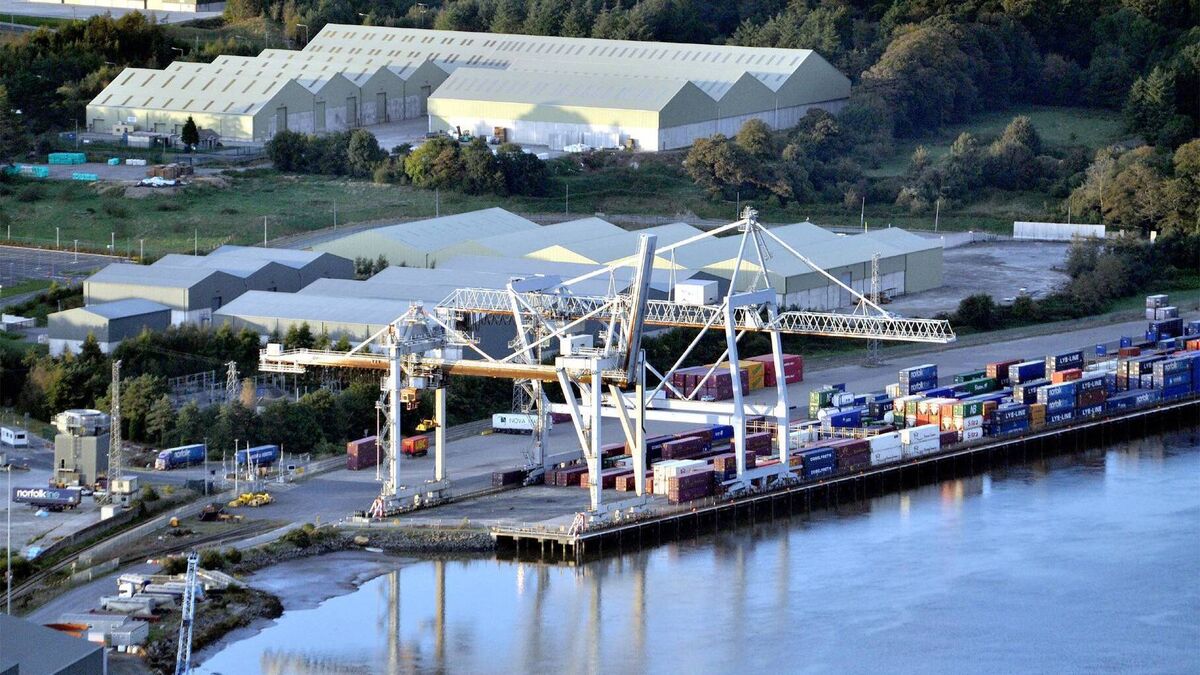
Meanwhile, the Port of Waterford handled 2.4m (2,400,000) tons of cargo in 2025 according to CSO data. That’s eight times the Galway tonnage. Waterford Port lodged a direct planning application in September 2025 with An Coimisiún Pleanála for a €40 million quay and wharf extension at Belview, to create a specialized Offshore Renewable Energy (ORE) terminal. Key infrastructure components are a 250-metre reinforced concrete wharf extension, roughly 1.3 hectares of land reclamation, two quayside ORE operator support facilities featuring warehousing, yard space, and crane installations, and a dedicated 1.8-hectare biodiversity enhancement area etc.
A decision on the Waterford Port expansion proposal has not yet been received.
The (July 2026) revised National Ports Policy proposes removing the previous Tier 1 and Tier 2 Port distinction, bringing Dublin, Cork, Shannon Foynes, Waterford and Rosslare together as “Ports of National Significance” with Galway and other smaller ports designated as “regional significance”.
Government restrictions on exchequer funding for ports means Galway cannot access state capital or unlock matching European Union funding. Galway local representatives and port officials have lobbied Government intensely to review this so that public funding can be accessed for their project. It will be interesting to see how far Galway political influence (Sean Canney TD in Dept. of Transport, watch that space!) stretches and the extent to which the Waterford project, should planning be forthcoming, will be supported by Government under the new national policy.
Galway political push is formidable, which probably explains the difference in scale between their port development plans and ours. They expect support and think big, we expect…?
Waterford Port development is a litmus test of government support. The outcome will determine the extent of government support for Waterford Chamber’s 50-year plan.