Fr Liam Power: Story of the Tuam Babies is far more complex than we imagined
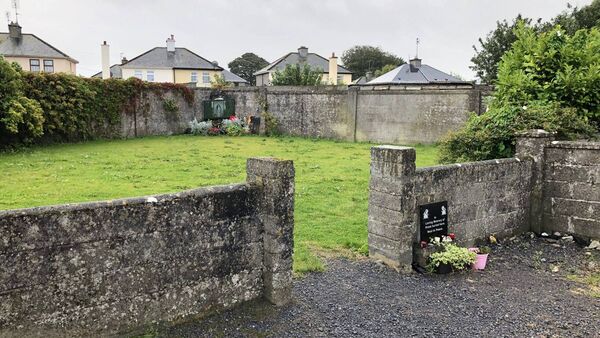
View of a grave site at the Bon Secours Mother and Baby Home in Tuam, Galway.
In April 2014, journalist Alison O’Reilly published a story in the Irish Mail on Sunday about the Mother and Baby Home in Tuam. She reported on the research conducted by local historian Catherine Corless. Her research uncovered very high infant mortality rates in the home, which was run by the Bon Secours Sisters [over 800 babies died in the institution], which operated from 1925 until it closed in 1961.
She also discovered there were no records of burials, even though death certificates had been issued for the babies. Corless claimed they were buried in unmarked graves within a former septic tank. She examined the death certificates and found causes of death, which included TB, flu, measles and marasmus or malnutrition.
O’Reilly’s story provoked massive outrage at home and abroad. It became the catalyst for an avalanche of stories detailing the horrendous conditions in Tuam Mother and Baby Home, claiming that children were starved there and their bodies dumped in a septic tank. The story of Tuam became, in the words of journalist Michael Duggan, “perhaps the single most notorious example of the institutionalised cruelties and depravities of Catholic Ireland” with the Bon Secour Sisters being subjected to sustained and sometimes savage attack. He said, “the nuns of Tuam have become a byword in Ireland of horror-film levels of cruelty and neglect.”
The Government felt compelled to respond and set up a Commission of Inquiry into the governance and practices of Mother and Baby Homes since the foundation of the State.
The report was published in 2021 and set out in graphic detail the abuse suffered by pregnant women who were virtually incarcerated in these institutions. The suffering was reinforced by social attitudes to women who became pregnant outside of marriage; they were stigmatised, ostracised and rejected.
However, I recently came across an article by the above-mentioned Michael Duggan, which was published by the Tablet in February. I was perplexed and when I read it I became quite angry as it appears that the Bon Secours nuns have been victims of a grave injustice. I reread the chapter on the Tuam Mother and Baby Home in the report by the Commission of Investigation. And, sure enough, Duggan was one hundred per cent accurate in what he had to say.
The Commission discovered that, in 1947, an inspection of the Tuam Home was carried out by an inspector from the Department of Local Authority and Public Health, named Alice Litster. (She was quite a formidable persona; she is included in the Dictionary of Irish Biography, which states that she was forthright in her critique of the Mother and Baby system.) She denounced a system that marginalised Irish women and turned their offspring into “infant martyrs of conscience, repugnancy and fear”.
Before she carried out her investigation of Tuam Home, she issued an excoriating report on the Bessborough Mother and Baby Home. She recommended closing it to all public children's patients. The Home was closed for over a year, and the matron in charge was replaced. Litster was not afraid to speak out.
The Commission of Investigation quoted extensively from Litster’s comprehensive 1947 report on Tuam. She found that the children received good care and that the nuns were careful and attentive. She reported that excellent diets were available. She noted that the medical doctor responsible for the Home had a keen interest in the welfare of the children, their progress and their diet. (She thought that the advice and assistance of a younger doctor should be available – Dr Costello was 80 years old at the time.) Ninety per cent of the children were found to be in good health.
Litster’s report was consistent with an earlier inspection carried out by her predecessor, Dr Florence Dillon, who reported that the children are well cared for; weekly weight charts were kept in case of non-thriving infants and also case histories.
Litster was particularly exercised by the high mortality rates of infants in the Homes in general and particularly in Tuam. But she asserted unequivocally that it was not due to negligence or malnutrition. She believed that there was a constant risk of infection because of admissions of entire families, "itinerants, destitutes, evicted persons, etc., into the Children’s Home". She remarked that Dr Dillon had previously drawn attention to this in 1945. There was no isolation unit, which meant that children newly-admitted were mingling with others in the home, and there was no routine examination and testing for venereal diseases.
The construction of an isolation unit was widely seen as an effective means of reducing sickness and mortality. The matron appealed to the County Council - the owners and funders of the Home – for more funds to construct an isolation unit. This request was refused. An earlier inspection reported that the matron was also anxious to have central heating installed, as this would reduce infant mortality in the winter months. But that was also refused at the time.
Excavations carried out on the site cast further doubt on the accuracy of reports to date. An initial excavation was carried out in 2016 - the human remains it found were not in a sewage tank, but in a second structure with 20 chambers, which was built within the decommissioned large sewage tank (admittedly not a very dignified burial and acknowledged as such by the nuns.) The Office of the Director of Authorised Intervention Tuam (ODAIT) began an official excavation of the site in 2025. To date sets of infant remains have been recovered, all of which had been buried in coffins in a formal burial ground. They have issued a number of reports to date.
It would appear that the Bon Secours Sisters have suffered a serious miscarriage of justice with their reputation ruined. To date, journalists, politicians, and historians such as Diarmuid Ferriter, have not acknowledged the findings of the Commission of Investigation in relation to Tuam. Surely we owe the Sisters an apology.