Catherine Drea: Staying alive at sea and on our roads
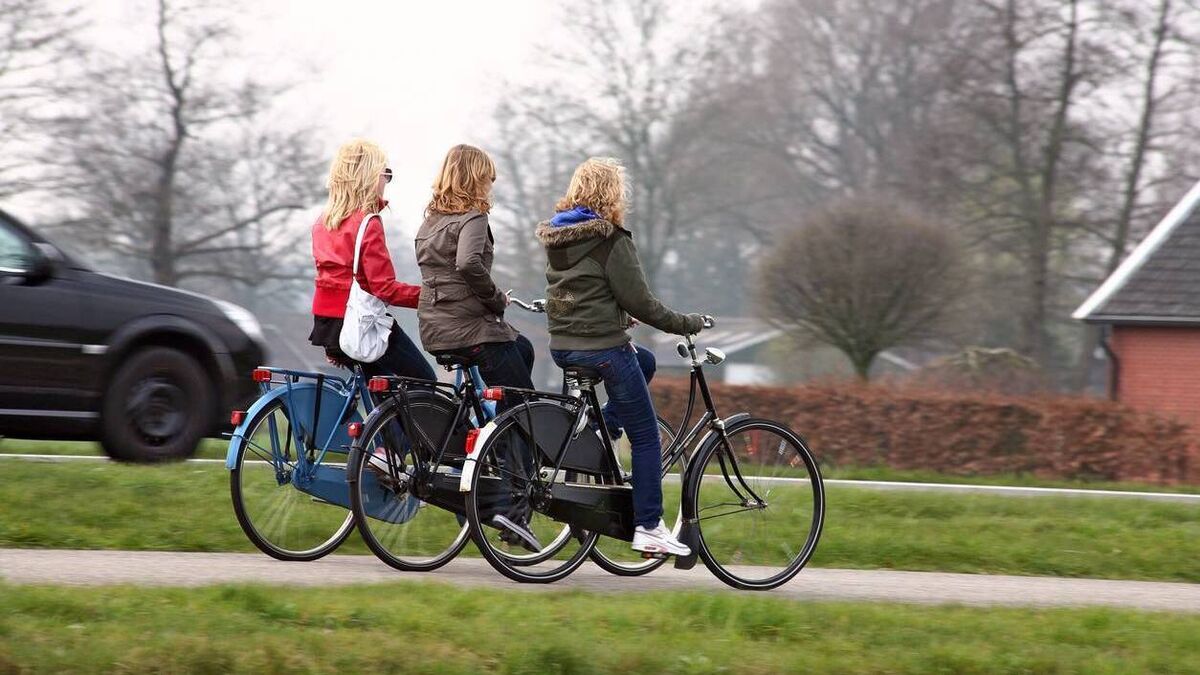
We need far more car-free zones and more cycle and pedestrian routes.
There is no doubt but we are programmed to want to stay alive. It’s our most basic instinct. We prepare for years to understand and respect the sea and we support our brave volunteers who continue to prioritise our safety and our enjoyment of the coast.
It was a joy to see some of the RNLI Tramore Lifeboat Station celebrated on the BBC programme Saving Lives at Sea. It’s easy to forget that day in and day out these citizens are ready and willing to endanger their own lives to save others.
It got me wondering about our learned respect for the sea and our total disrespect for our roads.
Like everything else until it happens to you, you can live in a cosy bubble inside your warm, music-filled, quiet vehicle as if you were completely alone on your drive to work or leisure. The more comfort that is added, the more insulated drivers are. Now with screens, Google maps, connecting your smart phone for incoming calls etc, it’s no wonder driving standards are falling.
We just don’t think of a car as a lethal weapon, do we? And yet our accident and death statistics are growing every year.
One statistic that really shook me was that for every one death on our roads there will be eight people who experience life-changing injuries and thousands of others with injuries that will require hospital treatment.
It seems to me that drivers are divided into two main types, the ones who ignore the speed limits, the blind bends and the rules, and the genuinely lovely drivers who tend to take care, give way and concentrate on keeping the roads safe.
More and more I see no option but to keep in my mind at all times to “give way no matter what!”
I have started to anticipate a crazy driver around every bend, and lo and behold, it turns out that this is exactly what I encounter!
Living as I do on a country road with the new speed limit of 60, I know for certain that this will be ignored by at least half of the drivers I meet.
I have had some very hairy experiences in the last few years. It amazes me that cyclists and pedestrians still attempt to navigate these country roads. Yesterday as I came around a bend in my usual “taking extra care mode” a young woman with a dog on a lead and a phone to her ear suddenly appeared. I couldn’t overtake as there was also a car coming in the opposite direction at the same time, so the only possible action was to brake. This almost caused a collision as the car behind me, already driving far too close, also had to brake hard.
This oblivious pedestrian never even noticed and I wanted to go back and say that I could have killed her.
What is the solution; more public transport, better roads, more rules, driver education, a ban on devices and screens? I don’t know, it almost seems too late for any of that.
Without any doubt we need far more car-free zones and more cycle and pedestrian routes. Now I’m not talking about the kind of attempts that we have seen to date where the driving lane is reduced and a cycle lane is simply cordoned off at the very edge of the road.
The Tramore Ring Road is an example of what not to do. The whole point of that road was to remove traffic from the town centre. Now after spending 5.5 million drivers are going back to finding any route at all except the Ring Road to travel on. This is one of the reasons that the back roads are plagued by drivers using them as a rat run to any side of Tramore away from it.
When I think of car-free zones I imagine the infrastructure of European cities built as far back as the 1950s. Long winding cycle and pedestrian routes were built connecting bus and train routes, as well as playgrounds, shops, creches and schools. I have walked for miles on some of these trails without ever seeing a car.
The solution to the Ring Road issue was to build a new route between the many housing estates and to totally avoid the chaos on the roads between cars and buses. It makes you wonder about the designers of our future and what they have in mind for us.
Managing and balancing the needs of drivers, deliveries and crucial transport with the needs of people is the issue. It’s difficult to add pedestrian infrastructure so late in the day, but we have to find more creative solutions.
As I walked from the inner city of Stockholm to the home of the little toddler in front of me on his bike, I thought of all the challenges here. But I also wondered about the lack of innovative design ambition.
Our countryside walks are spectacular. Imagine if we had a similar kind of imagination applied to our urban walks? Adding a cycle lane to the side of a busy road is not the best solution. Even today I was on the Tramore Ring Road driving very slowly behind a bus and two adult cyclists were also using the main road and not using the new cycle lane at all!
So, yes, we need to stay alive, but we also need better planning to make that much more possible.