Traversing Waterford’s Camino
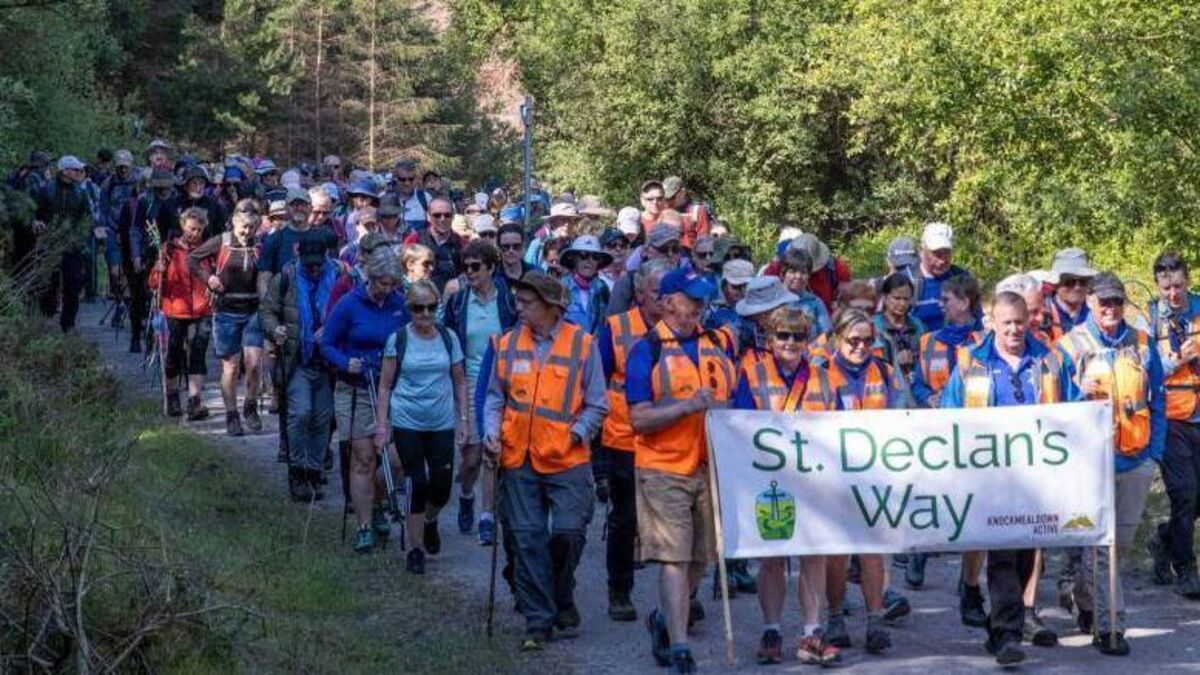
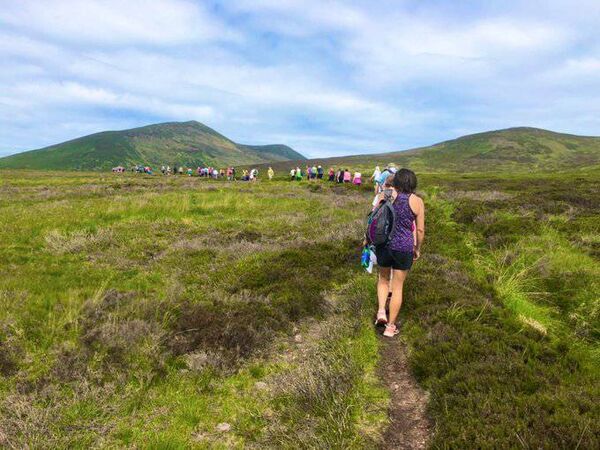
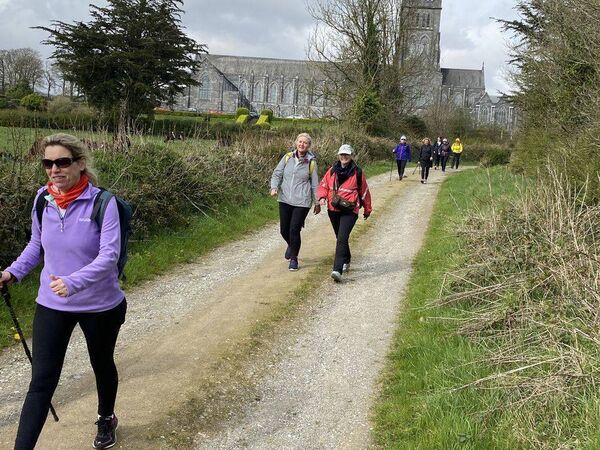
Walkers on St Declan's Way.
Who was Ireland's first Christian missionary? The people of Ireland's southern Déise region will almost universally reply – and many historians will agree – that it was not Patrick, but Declan of Ardmore. Robust local belief holds Declan was born at Dromrue, near Cappoquin into a royal family of the Déise region. After discovering the coming of Christ and the new message of eternal life, he journeyed in the early 5th century to study in the newly Christianised Roman Empire. Returning as a bishop, he began ministering in his native Déise.
Soon, however, he was disconcerted to hear accounts of a newly arrived, British-born evangelist, who was also preaching the gospel. Was he a true Christian and, if so, would he in some way disrupt Declan’s ministry? To sort this out, legend has it that the southern saint travelled from Ardmore to royal Cashel, the traditional seat of the Munster Kings, and met with St Patrick.
Here, it was agreed by the two saints that Declan would have unchallenged authority over the Déise, with Patrick declaring “Degláin, Pádraig na Déise” (Declan is the Patrick of the Déise), while Patrick would become Primate of all Ireland. Wisely, the man who would later become known worldwide as Ireland’s national apostle now refrained from crossing the mountain passes into the heart of the Déise on his missionary journey. This allowed Declan to remain supreme in his south Munster heartland, which he continues to do to this day, as the much-venerated saint of Co Waterford.
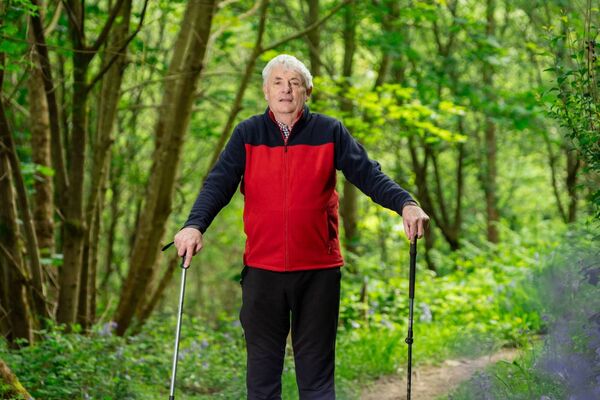
And Declan’s memory was not forgotten. The 115km trail was, for countless generations, walked by pilgrims following the presumed journey taken by Declan on his way to and from Cashel. In more recent years, the route fell into disuse but after a decade of urging from Ardfinnan man Kevin O’Donnell, the path was officially reopened in 2021. Leading pilgrims from the Rock of Cashel to the Celtic Sea, the route is now fully approved by Sport Ireland as a waymarked long-distance walking trail.
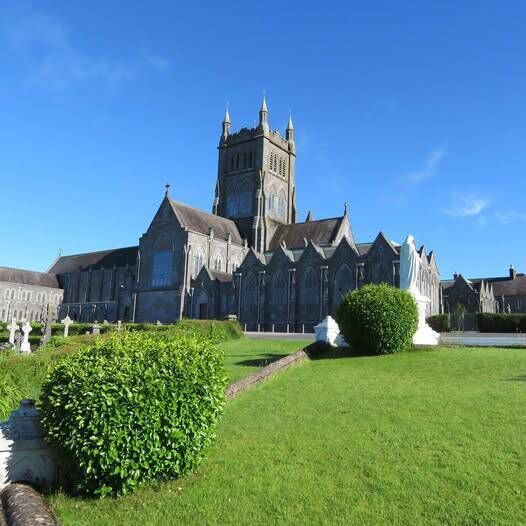
Developed in cooperation with over 50 private landowners, Declan’s Way incorporates several medieval pilgrimage routes, including the Rian Bó Phádraig, Bóthar na Naomh, Cosán na Naomh, and St. Declan’s Road. Below is an account of the Waterford section of the route leading from Mount Melleray to the Ardmore Monastic site.
A traverse of the monastery farmlands by a rustic lane leads to a minor road where the way is left. Next, swing right for about a kilometre along the relatively busy R669, before turning left onto quiet byroads. Follow the blue arrows through several junctions until an off-road excursion to the left follows part of the ancient Rian Bó Phádraig (Track of St Patrick’s Cow) along a lane. Legend holds that a huge bovine owned by Patrick was grazing placidly on the rich pastures of South Tipperary when a thief from Waterford abducted her calf and bore it over the Knockmealdown Mountains to his home near the River Bride. The cow angrily created this path with her horns as she thundered south to recover her stolen calf near present-day Lismore. Beyond the Rian, follow a quiet road offering an expansive view over the Blackwater Valley and Lismore for about a kilometre before diverting left by a farmyard.
A rural lane followed by an attractive woodland path leads to a road, along which you descend past Ballyrafter House to arrive at the R668. A further excursion by the banks of the Owennashade River then decants you to a magnificent bridge over the River Blackwater, offering superb views of Lismore Castle. Beyond the bridge, St Declan’s Way bypasses Lismore, but the town makes an ideal place to stop for lunch and perhaps a visit to the Heritage Centre since you only have about 6km further to walk.
Lismore was, in the early medieval period, a great centre of learning attracting students from all over Europe, including the future king of the Anglo-Saxons, Alfred the Great. Afterward, leave the town by Lady Louisa’s Walk: a lovely woodland path created by Lady Louisa Cavendish of Lismore Castle. For about 2km, the serene River Blackwater remains continually on your left until the route eventually joins a minor road. This conveys you to the elegant Avonmore Bridge, over the Blackwater and then into Cappoquin.
Today, the route lies east of the mighty River Blackwater, which is navigable up to Cappoquin. In this area known as Affane, a great battle was fought in 1565 between two powerful Anglo-Norman Irish families – the Butlers (Earls of Ormond) and the Geraldines (Earls of Desmond). The Butlers emerged victorious, while the power of the Geraldines was forever broken in their Munster heartland.
Next to capture your curiosity will undoubtedly be the spectacular Hindu Gothic Gateway and bridge over the River Finisk leading to Dromana House, which spans your route. Afterward, little frequented roads convey you eastwards past the ruins of Kilmolash Church. Dedicated to St Molaise – an obscure Irish saint from the early Christian era – the existent buildings all date from the later medieval period. Reaching Ballinameela, abandon the tarmac as the route swings abruptly south along the ancient tracks of the original pilgrim route, which provides a profound sense of walking into the past. Finally, you join a quiet back road leading to your destination for the day at the townland of Killatoor. Here a sign points 1.2km west across the R671 to Aglish village, where shopping facilities are available if required. The final stage of your pilgrimage leads south from Killatoor and follows rural boreens to Goish crossroads, which conveniently marks the end of your day's walk.
Beyond Goish, the way lies east through the pastoral countryside before swinging south at the entrance for St Patrick's Church at Mount Stuart. Notable for its woodland setting, this church was built before Catholic Emancipation by Lord Henry Mount Stuart in 1826 for his Catholic tenants. Afterward, when Catholics could not take a seat in Parliament, Daniel O’Connell asked Catholic voters to support Protestant candidates, who would give an undertaking to vote for Catholic Emancipation if elected. Henry Villiers Stuart became the first MP to be elected in this way.
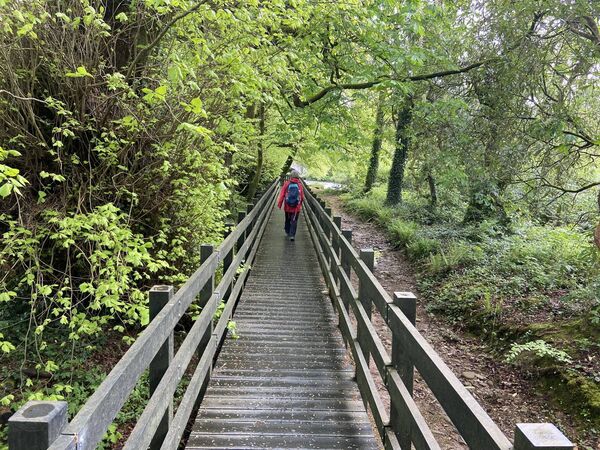
Continue to pick up the lovely and sylvan St Declan's Road. A highlight of the walk, this carries you over the Licky River at a pretty footbridge – which has replaced ancient stepping stones – before continuing through a hazel forest to reach the busy M25. Cross with care, and then ramble through fields and later along back roads, offering panoramic views over Ardmore. Finish spectacularly along the great sweeping beach where a large boulder known as St Declan’s Stone lies. This makes a great place to connect fully with the landscape by removing your footwear and walking barefoot on the silken sands by the water’s edge and perhaps dipping your feet in the salt waters.
Reshod, it's up the incline to St Declan’s monastic site. Occupying a striking location, the most prominent landmarks are the 30m high round tower and the now roofless 12th-century cathedral. With a lavishly ornate gable, depicting stories from the bible, this is regarded as one of Ireland's finest examples of Romanesque architecture.
Next, visit the oldest building on the site, which is the much smaller St Declan’s Oratory where, it is reputed, the remains of St Declan lie. And this means the time has come to bask in the heart-warming satisfaction of reaching your 115km journey's end.