Minister says controversial labour laws underpinning Search and Rescue squad is 'HR issue'
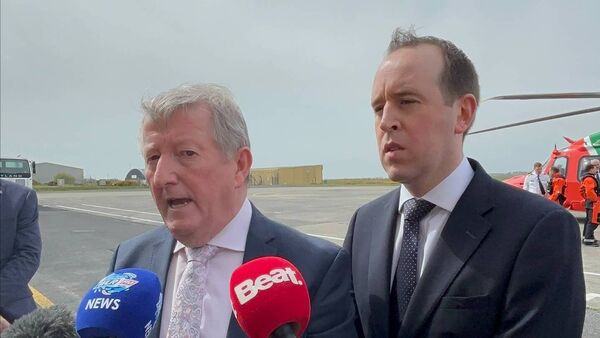
Minister of State at the Department of Transport Seán Canney speaks to members of the media at the official launch of Bristow Ireland's Search and Rescue operations at Waterford Airport.
Minister of State at the Department of Transport Seán Canney said the frequently criticised use of a ‘factoring system’ that accounts for Search and Rescue working hours is not in his remit to change.
Under the current labour laws underpinning Bristow Ireland’s contract of Irish Search and Rescue operations that include Waterford, workers can spend 24 hours on base and have their working hours reduced to 16.5.
From 10pm-8am, workers on a 24-hour shift are at an extended readiness to launch and spend time in on-site rest facilities.
If there is no call-out during this rest period, then 16.5 hours are logged for the shift. If a call-out is received, then the full 24 hours are logged.
The practice has caught bipartisan criticism from members of the Joint Oireachtas Committee on Transport.
In a December hearing with Bristow Ireland, Fianna Fáil TD Cathal Crowe suggested that the practice was in violation of Irish and EU legislation.
“The unions have a perspective on this, and I share it, that the current application of regulations, and how that manifests itself, in terms of hours off and how hours are counted, is not in compliance with the spirit of the regulations, and as such, it's creating potential risk,” Waterford Sinn Féin TD Conor McGuinness said to the
Speaking at December’s Oireachtas Committee, Derek Everitt, a member of the Irish Search and Rescue Technical Crew, said Bristow was running the operations on a solely commercial basis - with crews understaffed and undercompensated for their work.
Asked by the Waterford News & Star on whether he deemed the underpinning regulation fair, Minister Canney said: “I would say that’s a HR issue…there’s no point on me commenting on something like that, it’s being worked out between the companies.
“It’s important to keep (the workers) on side, and I know that any issues arising are being dealt by the company and the employees and that’s where it should lie.”
Deputy McGuinness said the onus now lies on the Irish Aviation Authority, the governing body that determines the regulation of Bristow Ireland’s Search and Rescue contract.
He told the that he has written to the head of the Oireachtas Transport Committee, asking for the IAA to be brought before the committee, but has yet to receive a reply.
In a lengthy response issued to the Waterford News & Star, the IAA said: “Aviation safety is our priority, and this is achieved through a thorough framework of identification, assessment and mitigation of safety risk, as well as ongoing audit and oversight assurance.”
A spokesperson for the authority pointed to the implementation of Fatigue Risk Management Systems that “combines schedule assessment, data collection, and continuous analysis to proactively and reactively mitigate fatigue.”
The IAA said they planned to issue streamlined regulations for Coast Guard helicopter operators that would provide “greater clarity” for involved parties.
A source with knowledge of the situation said crews are “very concerned they are being placed in legal jeopardy” and that current practices are in violation of EU and national working time regulations.