Harnessing the Déise: Will our grid infrastructure be ready to take the load?
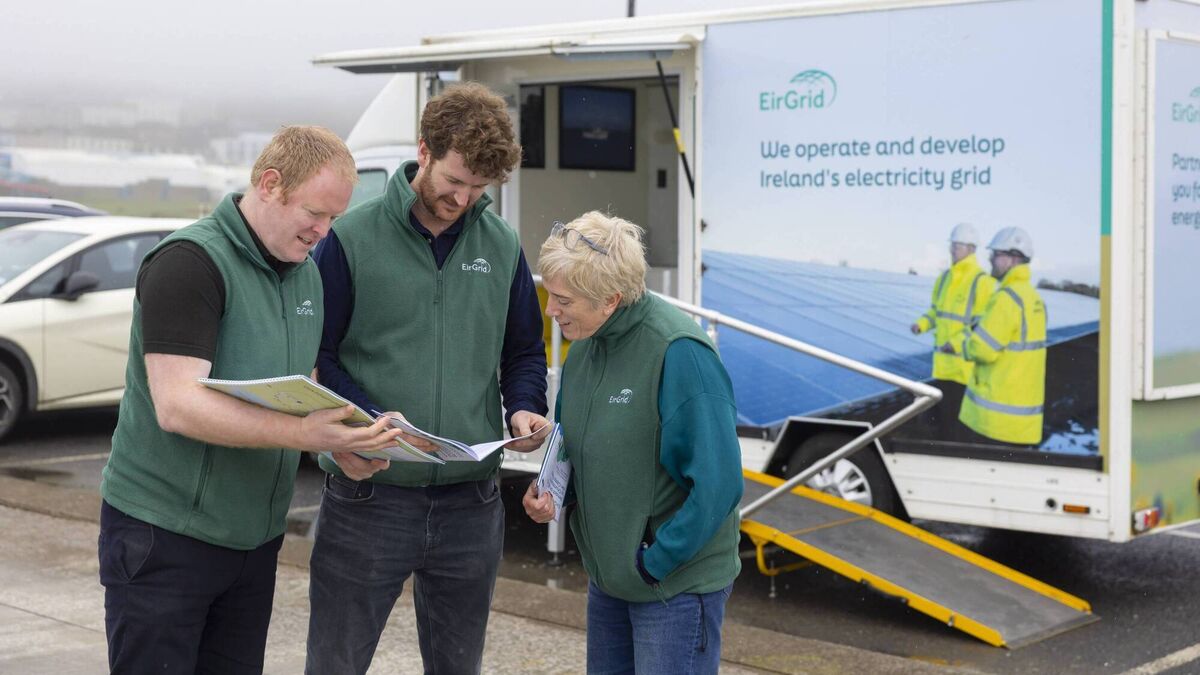
The EirGrid team in Tramore recently. Photo: Patrick Browne
If everything goes according to plan, Tonn Nua and the rest of the South Coast DMAP will be generating in the region of 5GW of energy by 2040, a large chunk of the total 20GW capacity planned for offshore renewables that same year.
But that energy has to go somewhere, and Ireland’s electricity grid is already under massive strain. It is well-documented that it requires a significant upgrade to ensure it can deliver the capacity required to meet future demand growth, as well as accommodate increasing levels of renewables on the system. At worst, any serious destabilisation of the grid system could cause widespread blackouts.
Bottlenecks are now a common occurrence in our decades-old electricity grid, which is being asked to cope with unprecedented demand - not only from a growing population and increasing electrification of our transport and heating, for example, but also large energy users, such as data centres. Indeed, many point to data centres as the pinch point for the strain on our national grid: they now account for around 23 per cent of Ireland's national electricity demand, one of the highest proportions in the developed world - and have ultimately accounted for 88 per cent of Ireland's electricity demand increase over the past decade.
But every day, clean affordable energy is “wasted”, as our grid fails to accommodate the variable surge of energy from renewables, on say a particularly sunny or windy day. If this happens, wind farms are told to “dispatch down”, or reduce the amount of energy they are producing.
The Climate Change Advisory Council’s most recent report highlighted that, due to grid constraints, the amount of clean electricity wasted last year was the highest since records began. The Council stated that approximately 10 per cent, or €523 million worth, in surplus wind energy was lost and it urged the Government to prioritise electricity grid reinforcement projects to ensure such energy generated is not wasted.
Meanwhile, more recent figures from Eirgrid say 16 per cent was effectively lost in the first nine months of 2026.
EirGrid says it has made “significant progress” in integrating renewable electricity, noting that the power system is now able to safely operate with up to 75 per cent of electricity coming from variable renewable sources, such as wind and solar at any one time, and work is underway to increase this to 95 per cent.
But according to David Carroll, energy transition director at EY Ireland, the two companies who plan and operate the power grid, EirGrid and ESB Networks, are being asked to deliver a grid capable of supporting both significant demand growth and a much higher share of renewable generation.
“A useful analogy is our road network,” Carroll explains. “For years, Ireland has squeezed more capacity from existing roads through better traffic management. The electricity system has done something similar through new technologies, operational changes and smarter use of existing infrastructure.”
However, he says, there comes a point where optimisation alone is not enough.
“If a road is carrying more traffic than it was designed for, eventually additional lanes or entirely new routes are required. That is where Ireland now finds itself.”
The good news is that this work is underway - substantial capital programmes have been given the go-ahead so that ESB Networks and EirGrid can modernise, strengthen, and make significant improvements to the electricity network. The Commission for the Regulation of Utilities (CRU) has approved an €18.9 billion investment package, which will see the replacement of around 80,000 electricity poles, upgrading and expanding substations, laying more underground cables, and reinforcing overhead transmission lines.
A number of key electricity interconnector projects involving Ireland and international grids are underway, which will significantly help to enhance energy security, lower electricity costs, and integrate renewable power. These include the North-South 400 kV Interconnector, a 138km overhead line connecting Meath, Cavan, Monaghan, and Armagh to Tyrone to eliminate blackout risks and support renewable flow between Ireland and Northern Ireland and the Celtic Interconnector, a 575km, 700MW HVDC subsea and land cable linking East Cork to Brittany in France.
Yet progress on these has been slow, as they have been beset by technical difficulties. The Celtic Interconnector was set to “go live” earlier this year - it was recently reported that it will now not supply any power before 2029.
Grid deficits can play a big part in delaying both onshore and offshore wind projects, as the necessary upgrades must be in place before a turbine ever begins to turn. According to research by the South East Energy Agency, the biggest barrier to developing any renewable energy project is grid capacity, while a report they recently published identified “moderate to high” overloads in the Waterford region.
According to Stephen Oba, EU project manager with the Agency, the grid is ultimately the link between the producers and the consumers. A full upgrade of the infrastructure in the region will be necessary to ensure that the grid will be able to cope with the energy generated by Tonn Nua and the other areas identified by the south coast DMAP, he says.
“When you export energy to the grid, much of it flows towards the Dublin area, where demand is concentrated, and is distributed from there,” Oba explains. “To bring other regions up to par with Dublin, and avoid concentrating all development there, the grid needs to be reinforced.”
That means building offshore substation platforms, laying submarine cables to onshore connection points, and constructing onshore substations in Cork, Waterford and Wexford.
If the necessary grid reinforcement doesn’t happen within the agreed timelines, Oba warns, investors in offshore wind farms - including Tonn Nua - may take their money elsewhere. That’s because they require certainty and confidence that the wind farms will be connected and able to export energy by its agreed date.
“The grid infrastructure has to happen because the grid is like the mother link between all of these energy carriers,” he explains.
“So, for the South Coast DMAP, there has to be grid infrastructure in place, not only offshore, but also for the carriers, especially the landing zones onshore. If that is not in place, that means the developers can't go into final investment decisions.”