Asbestos clean-up of Tycor in Waterford city projected to conclude within two weeks
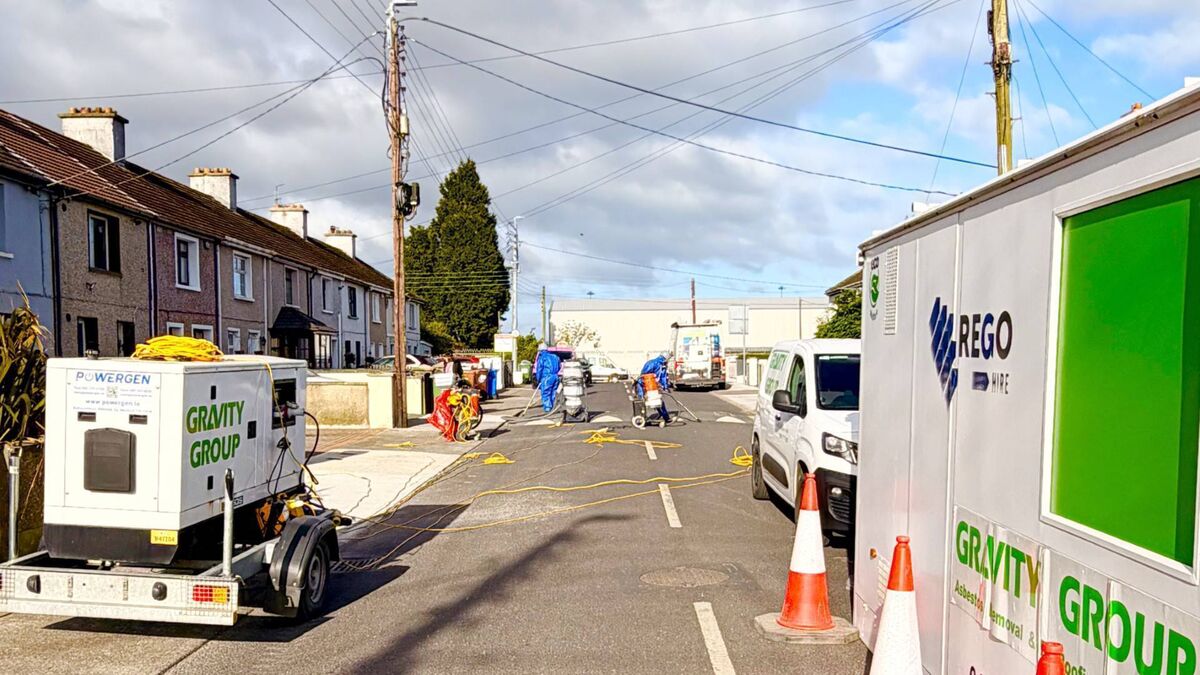
Asbestos clean-up operations continue to take place in the Tycor area. Photo: Waterford City and County Council
The cleanup of asbestos from Tycor is projected to conclude within two weeks, according to Waterford City and County Council Chief Executive Seán McKeown.
Concerns for public health have been vocalised following the fire at Tycor Business Centre on Saturday, May 9, where the centre’s roof- which was insulated with asbestos- caught flame.
Air monitoring began the following morning. No uptick in airborne asbestos was detected, but the debris containing asbestos was identified at the site.
The Gravity Group, asbestos removal specialists contracted by the Council, began a clean-up of the surrounding area on Monday, May 11.
Portions of Ard na Gréine, Griffith Place and Tycor Avenue were cordoned off to the general public, with nearby residents advised to close all windows and doors.
The enquired about the rationale behind the lack of monitoring of areas further afield of the business centre, and the potential presence of airborne asbestos before air monitoring was first installed at the site.
: Air monitoring systems were put in place on Sunday morning, and there has been no recorded uptick of airborne asbestos since monitoring began. How can the Council and its consultants account for the approximately 12-hour window between the start of the fire and the monitoring systems being put in place? Is there the potential threat that the asbestos could have spread in that window and was not recorded? Could bystanders on Saturday evening have been exposed to airborne asbestos?
: “The air monitoring was arranged as soon as practical after the fire occurred. The monitoring showed fibre levels below the threshold which would cause a health concern. This threshold is based on the risk experienced to people who are subject to a long term exposure. Any fibres which were released during the fire event would only represent a short term exposure, which is of least health concern. The clean up efforts were to remove these Asbestos Containing Materials to remove this risk as soon as possible.
“Bystanders on Saturday evening would typically have sought to avoid the areas where smoke was the worst, which would have kept them upwind of the fire, reducing any potential exposure to asbestos fibres. The EPA’s permanent air pollution monitor on the Paddy Browns Road recorded a slight uptick in particulate matter pollution during the fire, but to put it in context, the uptick was less than that on Tuesday evening, when the temperature dropped and homes were likely being heated with solid fuel.”
“Residents from outside of Tycor (Lisduggan, Larchville etc) have raised concern that their areas may have been adversely impacted. Is there the possibility that the wind carried asbestos to these areas, and if so, will the Council monitor the air in these areas. Is there any way in which the Council can be confident asbestos was solely confined to the perimeter of the Tycor Business Centre?”
- “The Asbestos Containing Materials were visually identified as being confined to the immediate area of the fire by a specialist asbestos consultant. On this advice, the air monitoring was carried out in this area as this was the area where the greatest potential for fibres to be found. By definition, if asbestos particles are below the safe level in the worst affected areas, it would be even less outside those areas.”
According to John Egan, Executive for Safety, Health and Skills at the Construction Industry Federation (CIF), the general rule of thumb is that any building built pre-2000 bears the potential for asbestos presence.
The naturally occurring fibre, which is now known to be carcinogenic when airborne, was commonly used for insulation, and its use was only banned in Ireland in 1999.
Generally, regulatory bodies would compile a record of materials used in the construction of buildings. For older establishments like the Old Jute Factory, which was originally constructed in 1936, those records are likely to have gaps.
Mr Egan said the actions taken by the Council were “prudent” in setting up air monitoring before asbestos was officially confirmed at the site.
“If I was putting myself in their shoes, I think the first principle, it’s to eliminate the potential loss of life or property,” Mr Egan said to the .
“The monitoring side of things, it is a very specialist area, that will take some time to even mobilise someone to actually do that… (The Council’s response) may seem like a bit of a lag, but I think that's probably as quickly as they could have mobilised without knowing further on the detail.”