Jute Factory fire throws future of one of Waterford's iconic industrial sites into uncertainty
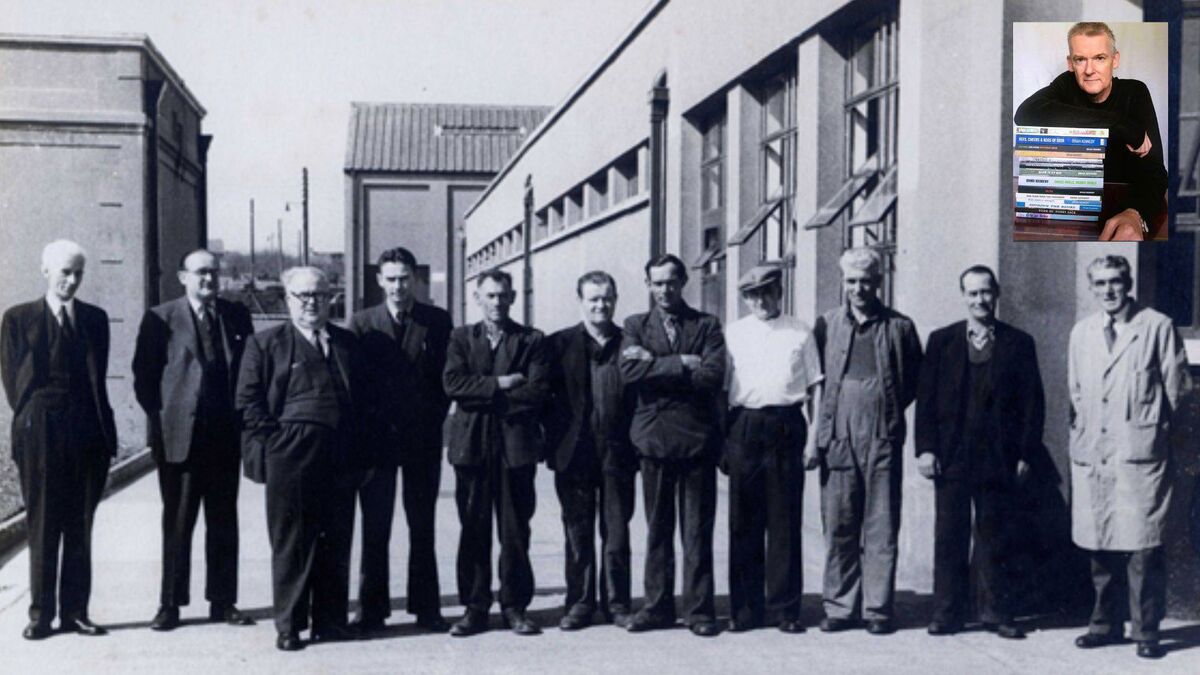
L-R: H.E. Guinness, D.M. Goodbody, Minister for Industry & Commerce Daniel Morrissey, R. O’Connor (secretary I.T. & G.W.U.), J. Forristal, T. Devereaux, J. Waters, J. Grant, P. Greene, M. Farrell, pictured at the Old Jute Factory. Photo: Paul O’Farrell. Top right: Waterford writer Brian Kennedy
Onlookers gaped as plumes of smoke billowed into the skies.
The sight of the Tycor Business Centre’s ashen clouds climbing upwards preceded the eventual destruction of some 35 businesses.
Those flames were also chewing into a relic of Waterford’s industrial past.
The business centre, colloquially known as the Old Jute Factory, was once a site akin to Waterford Crytsal, an industrial block woven into the social fabric of the city.
Waterford writer Brian Kennedy spent time chronicling the factory’s history and its inhabitants when he wrote “Characters and Closures” in 2016. The book covered 14 of Waterford’s most famous factories that came to define the city, the highs and their eventual demises.
Under sweeping protectionist legislation designed to safeguard Irish industry, the sod was turned on a five-acre green field in Tycor in 1936.
The proprietors of the site were J & L.F Goodbody - a Quaker family hailing from Offaly. The factory's doors opened in 1938 and kickstarted the mass production of jute - the long, coarse, twine-like fibre made to create durable sacks and sandbags.
Production began to boom, and at its peak, it employed 600 people in the early 1950s.
In many ways, the factory became emblematic of the times. Alongside Ireland’s industrialisation, women began entering the workforce. The working population in the factory was about 75% women, though their total wage bill was still dwarfed by that of their male counterparts.
“That time in the ‘60s, women started going to pubs,” Kennedy says.
“Before that, there was Maher's (the O’Connell Street pub which famously refused to serve women)... women were sacrosanct, there's no way you could go in it, but that bit of money they had, they could go out.”
The factory had begun to enjoy a reputation as one of the most commercially successful in the South East. Kennedy wrote that at the factory’s height, it was producing 50 tonnes of jute cloth a week.
But like so many businesses, the workers were soon to be touched by the economic depravity of the 1970s.
Jute as a material was becoming obsolete, with cheaper synthetic fibres coming to the fore. A slow drumbeat of redundancies and picket lines eventually came to a crescendo, when in 1974 the factory’s remaining 393 workers were laid off.
Kennedy says that for the affected workers, their lives soon came to resemble something like an ex-convict released back into the public realm. Their lives had been shaped in the confines of the factory, and they were now left adrift without their familiar surroundings.
“Fellas had more than 10, 20, maybe even 40 years in the place, so they couldn't adjust to it,” he said.
“They found themselves getting up at 7 o'clock in the morning, as they would have when they were going to the Jute factory… a lot of them were of an age, 50 odd, I mean, no one was going to employ you.”
An interview given to RTÉ’s ‘Seven Days’ programme from former Jute Factory worker Dick Larkin gave a flavour of the shock experienced by workers, particularly those in their older years.
“We knew the place wasn’t going too well but we felt as if it might have been phased out, and that there could be about another five, 10 years in it - this is what we believed,” he said.
“No luck whatsoever… we can never hope to get permanent employment, we can only hope for casual employment.”
Parallels spring back to modern times as 200 employees now face an uncertain future following the fire.
Demolition works on the site have begun, with its ultimate future still in the dark.
Kennedy intends to release a new book later this year, ‘Factories and Floors’, which will see an updated chapter on the Jute Factory following the fire, as well as the tale of 54 other Waterford factories.