Waterford's Blue Plaques: Tallow Library and the Carnegie Connection
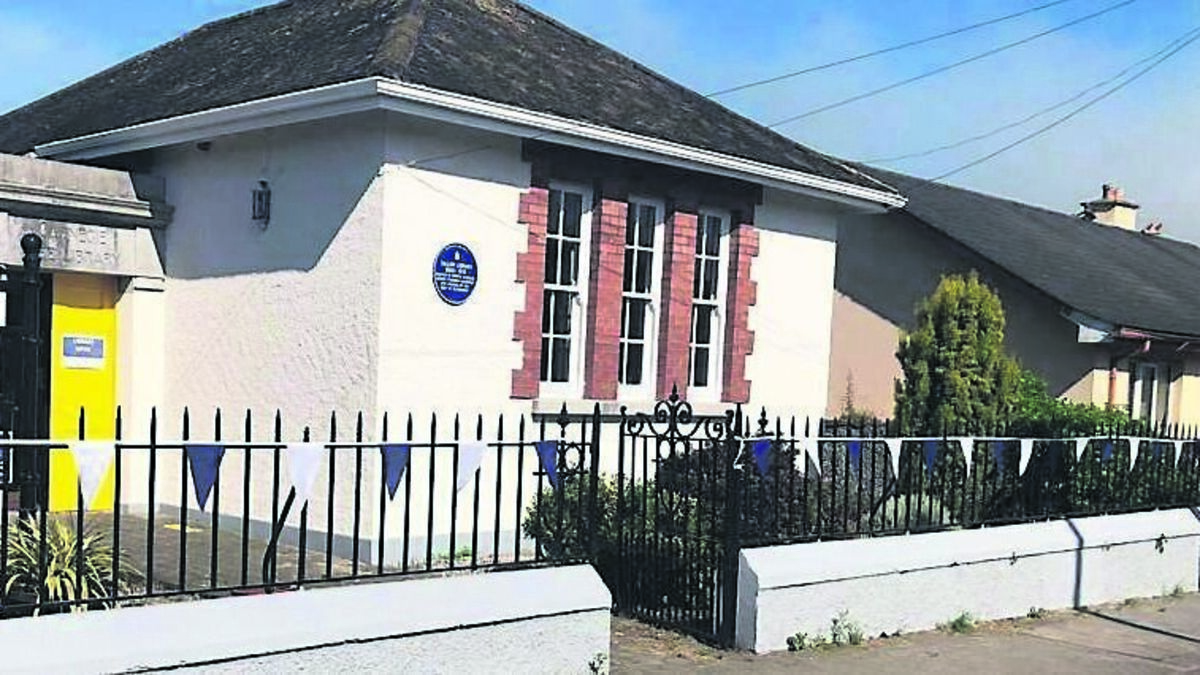
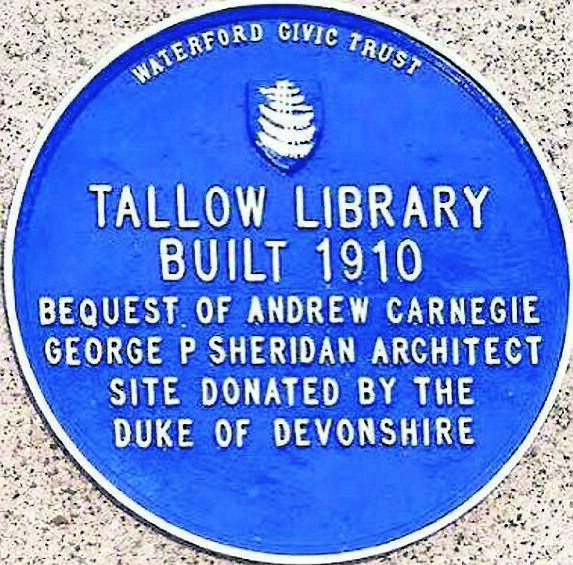
Tallow Library
Built in 1910 on Convent Street, Tallow, this Carnegie Library is one of a group of five in County Waterford and one of over 2500 worldwide, donated by Scottish philanthropist and businessman Andrew Carnegie (1835-1919) at the turn of the twentieth century.
Born in Scotland, Carnegie emigrated with his family to the US in search of a better life. At 12, he began working in the cotton industry and through his natural ability and application he became one of the world’s richest men.
Between 1897 and 1913, Carnegie promised over €179,000 to pay for the building of some 80 libraries in Ireland, 60 of which survive today.
Scotland-born industrialist and philanthropist Andrew Carnegie amassed an early 20th century steel industry fortune estimated at $309 billion in today’s money, more than double the $136 billion of Bill Gates’ software wealth. More importantly, Carnegie was the “father of modern philanthropy”, including the funding of 2509 ,public libraries in the United States, United Kingdom, Australia and New Zealand.
In Ireland, 80 Carnegie library branches were opened between 1897 and 1913, a decade before the island’s political partition and civil war. Carnegie died on August 11, 1919, at age 83.
On the centenary of Andrew Carnegie’s death, An Post issued some new stamps to commemorate four of the libraries in the Republic of Ireland. At the unveiling of these stamps on August 14, 2019, Felix M Larkin, Chairman of An Post’s Philatelic Advisory Committee, and founding member of the Newspaper and periodical ‘History Forum of Ireland’ said in his speech: “A characteristic of the Carnegie libraries is that, apart from their contribution to scholarship and learning, they were invariably housed in beautiful buildings - architectural ornaments in the towns and cities in which they were located…
“Libraries are the foundation of all scholarship, where books, newspapers, photographs, prints and drawings - and now digital material too - are lovingly preserved for posterity. And they are preserved not only for use by the elite scholar laboring away in a university, in an ivory tower (so to speak), but for everyone with the curiosity to want to learn more about history, literature and a host of other things - or indeed just to enjoy the pleasure of reading and be enriched by it. Libraries are fundamentally democratic centers of learning, open to everyone - and free…Carnegie funded libraries, museums, and other cultural institutions in the region that directly contributed to my ability to learn about history, literature and a host of other things.”
Thanks to Des Griffin, Waterford Civic Trust, Bray People article by Mary Fogarty, August 24, 2019, and Mark Holan’s Irish American Blog www.markholan.org
Heritage Blue Plaques
Marcus Copley, Waterford Civic Trust, researches past recipients of the Heritage Blue Plaques that you see dotted around Waterford. He also presents talks on these to public and private organisations.
A Heritage Blue Plaque is a permanent sign installed on a building in a public place to commemorate a link between notable figures of the past and the buildings in which they lived or had some connection to. It is a unique way to highlight these special achievements and celebrate those who have helped to shape Waterford’s heritage and history. Waterford Civic Trust is a registered charity and has erected over 70 Heritage Blue Plaques in various locations across Waterford city and county.