Waterford's Blue Plaques: Seán Dunne’s literary legacy to Waterford
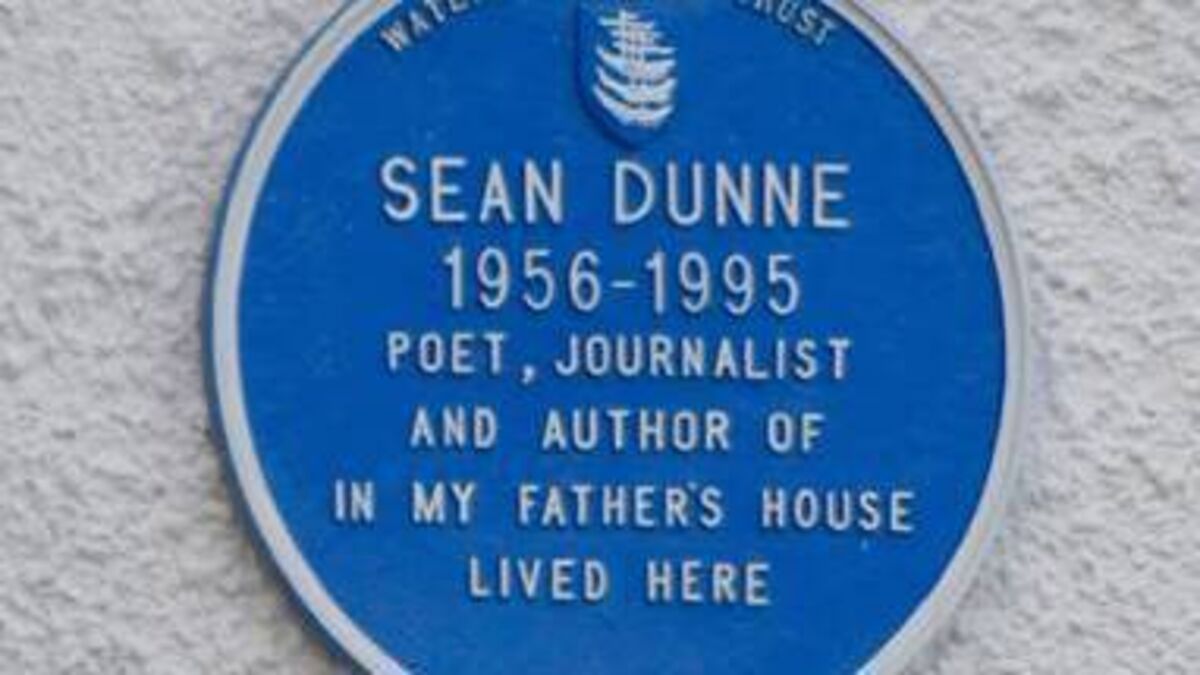
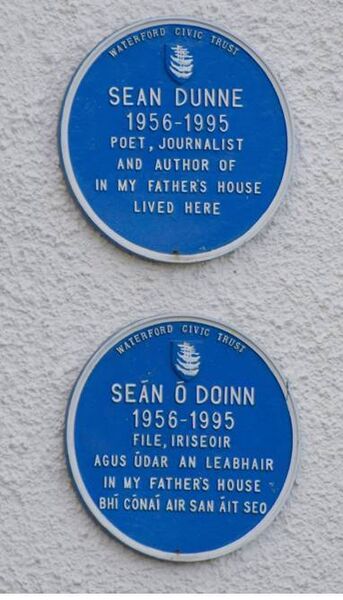
A Blue Plaque on the house in Waterford city where the writer Sean Dunne lived.
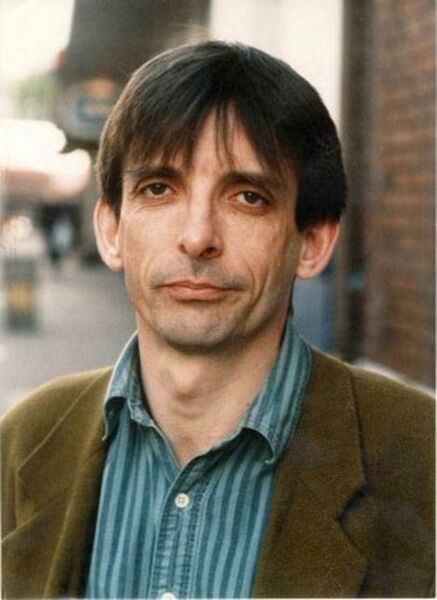
Seán Dunne was born in Waterford in 1956. He was a poet, biographer, anthologist, journalist and an editor. He died at the exceptionally young age of 39 in 1995. Established in 1996, the annual Sean Dunne Literary Weekend honours Seán’s literary legacy, and a Heritage Blue Plaque is affixed to the wall of his childhood home, in St. John’s Park, Waterford city.

As though Seán’s talent was innately singular, his brother Aidan told me: “We were five or six and he was showing signs – definitely reading books at nine and 10; more so than an average child, a brainy fellow, a clever fellow – somebody different.”
In his book ‘In My Father’s House’ Seán writes: “The class I liked best in school was that given over to the writing of English essays…my essays were long and adventurous.”
Regarding education, Seán writes about his father, “He was anxious that each of us try hard at school.”
Just before Seán entered secondary school, his teacher spoke of subjects such as Latin, with words like mensa, Dominus vobiscum and oremus, and Seán wrote, “Something happened to me as I saw and heard those words. It was as if the world had broadened.”
Seán describes the effect reading and writing poetry had on him.
“It was as if I had become airborne and earthed at once. By trying to write, I had found a way to be myself.”

Aidan went on to say: “He loved Irish” and a trip to the Gaelteacht at Cúil Aodha (Coolea) in Cork “pushed him forward bigtime…I’d say it had a major effect on him. He met Séan Ó Riada, and that visit indirectly positioned him for Cork [UCC]. I remember that day he went to university, walking up the footpath, leaving the house, I knew there was something profound going on.”
Nicholas Allen’s contribution to the Dictionary of Irish Biography tells us: “He entered university in 1973, already determined to be a poet and possessed of Byronic airs. His natural enthusiasm overcame his pretensions, and he was soon well known in literary circles. He graduated BA (1976). He edited Poets of Munster (1985)…and was a frequent contributor to RTÉ radio’s ‘Sunday Miscellany’ and ‘Poetry Choice’.”
Dunne’s first unpublished pamphlet of poetry was called Lady in Stone. It contained eight poems, and Aidan pointed out to me that Sean photocopied and stapled it together himself, adding “There’s no publisher, it’s handmade!”
In his memoir In My Father’s House, Seán recalls walking down Lady Lane in Waterford City, “Halfway along the street, a weathered stone head was fixed to a wall near the Franciscan Friary. Carved and expressionless, it stared into the street like a death-mask. I knew nothing about it, but imagined it as the head of a woman who had been turned to stone after falling from the top of a tower.”
He was, at some later point in his life, inspired to write the poem ‘Lady in Stone’. The last verse reads: ‘Assisi chants disturb the stained-glass silence of the friary. Centuries ago, a tower stood here and Cromwell, tired of wenching Catholics, tossed from the turret a local girl named Power. She turned to stone on hitting the ground. Her granite face stared from the wall, blank and impossible to kiss now; the single lady of Lady Lane’
I discussed a poet’s need to write with Aidan, and he pointed out that it gets things out of your system, it purges you, and that there is a reason we have this need to create; that we were not given this extraordinary gift without some fundamental reason behind it. This creative process untangles us from where we are at in the present moment. I knew Aidan (an artist in his own right) understood his brother’s need to write.
“We write for ourselves,” he said, but it is important to publish, it brings the community in, and while a creative piece may have no effect on one person, it might strike a chord with another.
Seán was four when his mother passed away.
“The post mortem on my mother’s body showed that she had died of heart failure.”
Seán wrote about his mother, a tender heartfelt poem entitled, ‘Lament from another Room’. I chose this excerpt: ‘My dead love, without permission they came and washed you, soaped away your usual smells, dressed you in foolish brown despite your love of blue…despite your need for everyday song, darkly they coffined you, hammered nails into you who feared forced things, while rooms away I loved you’.
If the basic definition of the word ‘poet’ is ‘a maker of verses’, then this simple description belies the depth that one can go.
The poet Thomas McCarthy and I chatted recently; he said Seán was amazing, and so proud of Waterford, describing it as “A James Joycean pride”. He was charismatic, good-looking, charming and a great singer too. With regards to poetry Thomas said Seán felt very strongly that poems should be recited, to be shared and listened to by others. He said he had a fine speaking voice and that amongst his friends were poets and playwrights such as John Ennis, Liam Murphy, Jim Nolan and Dan Mulhall.
Sean’s daughter Niamh recently communicated to me, “It’s only since I began writing that I realised how prolific a writer my dad was…he had so much published by the time he died, on top of his career as a journalist with The Cork Examiner. Truly inspirational.”
She remembers: “He was always writing and always ready to write; he carried a notebook and had a pen in his shirt or jacket pocket.”
Niamh and one of her brothers would join their dad for breakfast in a local cafe.
“I can remember him figuring out poems by writing on the napkins in the café.”
I chatted with Sally Phipps, another friend of Seán’s, and she commented that Seán was, “A very spiritual person”.
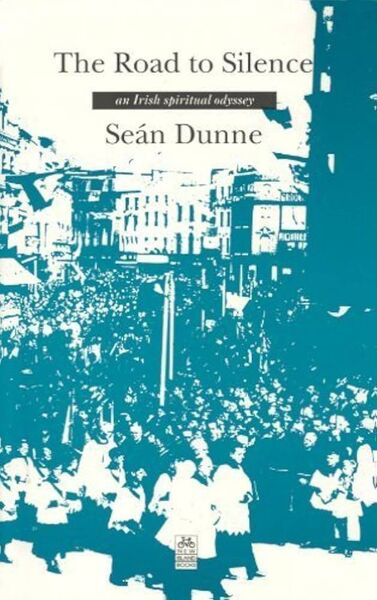
In his book The Road to Silence (New Island Books 1994), Seán writes: “I had an image of Catholicism as narrow, intolerant and regressive”, and he likened these words as skittles to be knocked down - “I would break out from all of this…have nothing to do with it. My mind would be open and free…yet, I found it impossible to let Catholicism go.”
Sally remembered Seán loved the way of life of the Trappist monks of Mount Melleray Abbey, with special and fond memories of Fr Kevin Fogarty.
His personal anthology Something Understood: A Spiritual Anthology (1995), shows us the kind of writing he gravitated towards, and in the introduction, he writes: “In compiling an anthology of spiritual writings, I was not simply guided by the need to combine a selection of pieces that, where possible, had literary worth. I was also guided, as in the cases of these writers, by the need to communicate aspects of spirituality in a way that is real and true, and that is free of the kind of piety that prefers to think of saints as rose-bordered visions, rather than as people who, among their more spectacular and troubled achievements, shaved or sewed or walked through plain streets where rain or sunlight fell.”
Sean’s poem from Collected entitled ‘Quakers’ also writes of silence:
‘Silence takes over the room. As if gathered for a sign, they dispatch business and let the moments pass…Outside their acre of graves shows names and dates like the flat cover of shut files’
Collected includes the following works by Seán: Against the Storm (1985), The Sheltered Nest (1992), and Time and the Island (1996).
In terms of prose, The Road to Silence captivates the reader with Seán’s questioning, and we become part of this quiet and contemplative search. Where then silence? In the Parisian church of Saint Gervais, he attends a mass that, “Was among the most moving and joyful experiences that I had ever known…I felt again that prayer is not simply a matter of words, but is often wordless, gathering an accretion of quiet as it deepens and grows. I learned that I could keep this core of silence in my life.”

Excerpts by Seán Dunne from Collected (2005), and In My Father’s House (1991), are reproduced by kind permission of the author’s Estate and The Gallery Press. See the link to Seán Dunne’s page https://gallerypress.com/authors-published-b-the-gallery-press/a-to-f-gallery-authors/sean-dunne-1956-1995/
Thanks to the following: Niamh Garvey and Mariel Deegan, New Island Books; Mary Feehan, Mercier Press; Cork City Library, and, the Dictionary of Irish Biography, Royal Irish Academy.
Heritage Blue Plaques
Marcus Copley, Waterford Civic Trust, researches past recipients of the Heritage Blue Plaques that you see dotted around Waterford. He also presents talks on these to public and private organisations.
A Heritage Blue Plaque is a permanent sign installed on a building in a public place to commemorate a link between notable figures of the past and the buildings in which they lived or had some connection to. It is a unique way to highlight these special achievements and celebrate those who have helped to shape Waterford’s heritage and history. Waterford Civic Trust is a registered charity and has erected over 70 Heritage Blue Plaques in various locations across Waterford city and county.