View from the Green Room: Summer beckons!
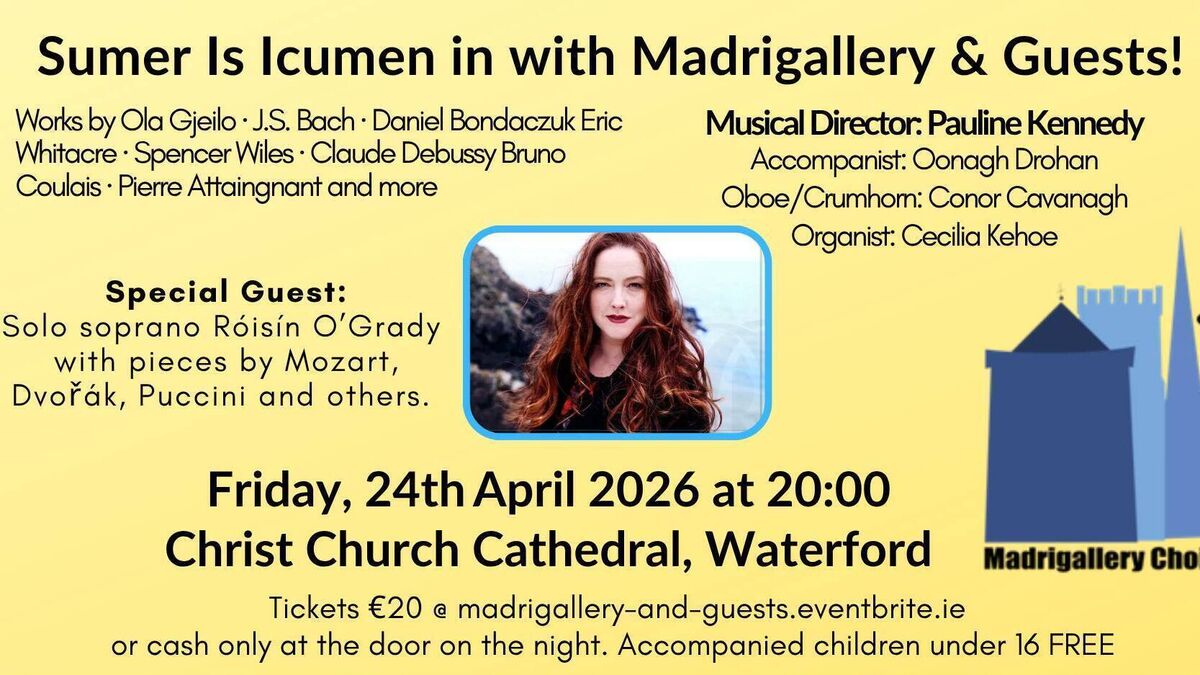
The billing for Madrigallery's recent event.
The sun seems to always shine on a Madrigallery concert. Tonight’s balmy April evening is just perfect for the large attendance to turn out the summer wardrobe.
The choir is highly regarded for their performance of complex and largely unknown pieces. Quality, experienced singers, who are also known for their stage performances, make up the group. They clearly delight in performing Baroque and Medieval pieces from well-known composers who were the giants of composition that influenced the compositions of subsequent writers.
Madrigallery usually see us into the summer with a special concert and tonight’s performance is entertaining, varied and polished.
The concert has the perfect opening, ‘Sumer is Icumen in’ (summer has come out). It’s the opening phrase of a medieval 13th-century English round that is also known as the Cuckoo Song, and is written in the Wessex dialect of Middle English. It is the oldest manuscript in secular music.
There’s an air of summer about the piece when thoughts turn to warm evenings and bounteous orchards and, of course, love.
American composer Eric Whitacre’s (b. 1970) ‘Seal Lullaby’ is based on Kipling’s ‘White Seal’ and remains one of his popular choral works. The soft style and accessible lyrics make it a favourite amongst amateur choirs around the world. The voice of the mother seal, sung by the sopranos, is gentle and calming with long breathy vowels and a reassuring bass line to her calf that is fearful in stormy seas. Swelling harmonies and a delightful accompaniment add to the gentleness of a mother’s love.
Debussey reaches all the way back to Charles Duke d'Orleans (1394-1465), who was captured by Henry V’s armies and held hostage for over 25 years. An aristocrat with a claim to the French throne, he was eventually released after, literally, ‘a king’s ransom’. While in captivity he became well-known as a medieval poet in both English and French. Tonight’s ‘Dieu, qu’il la fait’ (‘Lord! how good to look on her!’) is really a lovesong to France, personified here as a woman. Rich and delightful harmonies characterise Madrigallery’s singing here in a sensual, layered performance.
Guest artist Róisín O’Grady is a huge favourite with Irish audiences and her performance of the Allegro from Mozart’s glorious ‘Exultate Jubilate’ (Rejoice and be glad) with those magnificent cadenzas and sensitive piano accompaniment from Oonagh Drohan is a delight.
O Mio Babbino Cara (Oh! My beloved father) carries O’Grady’s trademark ‘wow’ factor in the Puccini aria of the young daughter who beseeches her father to allow her marry the young boy she loves. Róisín moves the rhythm around in ‘She moves through the fair’ – the famous traditional Irish folk song with lyrics by poet Padraic Colum. Its haunting melody tells the story of a young man watching his love move through a market before her sudden death and ghostly return. The Dvorzak classic ‘Song to the moon’ brings me to a different space and is worth the admission price alone.
And a big shout out to Róisín for securing her Doctorate recently from Trinity. Talent and brains - you can’t beat it!
Madrigallery leaves us with five short pieces that all show the quality of their work with a wonderful ‘Jesu, Joy of man’s desiring’, the perfect stage left exit.