At The Movies: Sorkin returns to confront the cloud

Mikey Madison and Jeremy Allen White star in The Social Reckoning.
Envisaged as a companion piece to 2010’s ‘The Social Network’, writer Aaron Sorkin’s initial thought for this sequel of sorts was apparently to try and get the original creative team back together.
That would have meant the return of David Fincher as director and Jesse Eisenberg reprising his role as Facebook founder Mark Zuckerberg. It may never have gotten to formal offers but both men declined to return, leaving Sorkin to start afresh.
In a brave move, he took the directing reins to bring his own script to the big screen. And he quickly serves up the best scene in the movie as a woman waits for roadside assistance after her car breaks down on an American highway.
When two cops pull in to ostensibly help, the brittle but oddly antagonistic car driver entangles the officers in a charged exchange. The escalating, almost non-linear, non-logical argument contains several queasy deliberate shifts in tone. Sorkin brilliantly calibrates the volatile power dynamic between the verbally sparring characters as the encounter slides into chaos.
The film never gets back close to this moment again, though it remains very watchable. The main reason I can discern is that from that scene onwards, the battlelines are drawn, sides are picked and certainty replaces the pleasing jittery uncertainty of this stellar opening. When everything is so entrenched, nothing moves. So, nothing moves us as an audience.
The bulk of the film is given over to the coaxing of a Facebook insider Frances Haugen (Mikey Madison) to turn full informant by Wall Street Journal investigator Jeff Horwitz (Jeremy Allen White). Frances claims to be a fan and believer in the social network’s original remit but a recent turn towards radicalization on the site prompts a desire to leak the truth about the inner workings of the company.
The film shuttles back and forth in time in a style familiar from Sorkin’s era-hopping biopic of Steve Jobs. The second main setting revolves around Zuckerberg’s prep for an important public hearing and it’s in this budget-friendly crucible that the audience finally hears his stance on the direction his own company is heading.
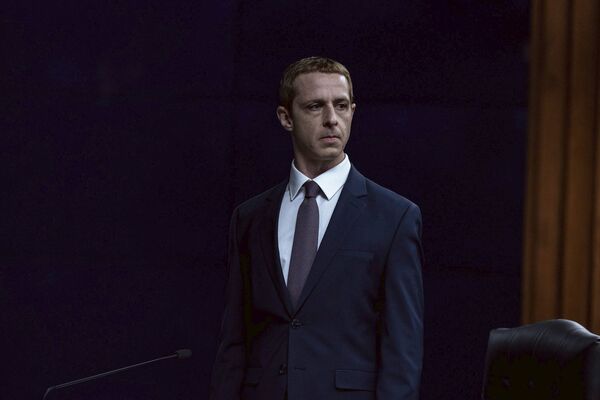
As played by ‘Succession’ star Jeremy Strong, Mark understandably never interacts with the other leads of the film. Jeff can’t get access to him and only once is Frances in his orbit. She is ushered in and out of a brusque meeting where her head is bowed, her eyes are averted and her lips are sealed.
Ultimately Sorkin resorts to rather crude tactics to crowbar both information and opposition into a sometimes far from subtle script. In the hearing prep, Bill Burr plays a contrarian allowed in the room to push Mark on uncomfortable topics. Utilising aspects of his angry stand-up persona, Burr is accomplished enough delivering reams of truth-to-power rants. But the role is writ so large that Burr may as well be starring in a separate film named ‘The Social Conscience’.
Elsewhere, Sorkin usefully paints Jeff as a total luddite so vital industry info can be spelt out and repeated for the audience. His ignorance is a stretch for someone assigned the tech beat at a major newspaper but, okay, we’ll accept it. A bigger problem is that beyond patiently waiting for Frances to turn full whistle-blower, Jeff does precious little onscreen sleuthing of his own.
Often the film feels like a low-budget effort (albeit with movie stars and a recent Oscar winner) masquerading as a much bigger movie. It lacks sufficient scale at certain vital times. Handily for the film, downsizing in print journalism means even the Wall Street Journal is apparently run by a skeleton crew of staffers in mostly empty offices. Still the smallness rankles in places.
For example, for its climax, the film folds in the Capitol Riots but shoots them in such a style that it’s more like a student film take on that seismic day. It looks like any set of steps with about 20 extras milling around. Is this a limitation of resources or a lack of vision? It’s hard to know but Sorkin has positioned himself fully as the key creative who will either shoulder the blame or claim any acclaim on offer.
For these preview screenings, we are lucky enough to invite along a guest occasionally. My plus one for this is an experienced editor who summed up the didactic and often inert central essence of the piece as ‘old man yells at cloud’. If I may further tweak that witty insight – maybe it’s a case of ‘old man yells at cloud storage’.