Oliver Callan receives second payment for Callans' Kicks, RTÉ reveal
Ellen O'Donoghue
RTÉ director general Kevin Bakhurst has accepted there could be “one or two cases” where people in the organisation are earning more than him.
He was responding to a question by Media Committee chairman and Labour TD Alan Kelly.
Kelly said: “There could very well be a scenario, Mr Bakhurst, where somebody working in RTÉ is actually earning more than you.”
The director-general agreed, adding: “There could be in one or two cases.”
Bakhurst has previously said no-one at RTÉ should earn more than he does.
He has a basic salary of €250,000 and is entitled to a car allowance of €25,000 and a pension contribution of €62,500.
RTÉ said last week that Late Late Show host Patrick Kielty earned €266,323 in 2025 and €257,657 in 2024.
Fine Gael senator and former RTÉ sports broadcaster Evanne Ní Chuilinn criticised a “two-tier system” in her previous employer.
Questioning Bakhurst at the Media Committee, Ní Chuilinn said there are people presenting high-profile programmes without presenter contracts.
She said they had been asked to be reclassified, in a way similar to how Derek Mooney had his role reclassified, but were told they couldn’t.
Ní Chuilinn said she asked repeatedly for a presenter contract but never received one. “I was never paid or contracted as a presenter, and I should have been, because, as you say, presenters earn more than reporters.”
As an example, she said there was someone on €70,000 presenting World Cup programmes and researchers presenting the Today Show.
Bakhurst said he did not believe they were on researcher contracts and said there had always been a range of salaries for presenters depending on experience, how they connect with the audience, and how valued they are.
Ní Chuilinn said: “I was good money, I was worth the money that you paid, you got good value out of me.
She also told the committee she was “treated very poorly” by the head of sports and another senior figure.
Some of the commentary around RTÉ recharacterising Derek Mooney as a presenter was “unfair”, Bakhurst also said.
He told the Media Committee: “We were trying to do the right thing to be more transparent by putting this out and there was comments around it, which I thought were unfair.”
He added: “And there was a price for it.”
RTÉ's director general Kevin Bakhurst has told the Media Committee that there are some presenters who work for independent companies providing content to RTÉ separately to the direct work they do for the broadcaster.
He said it was not industry practice anywhere in Europe to include those earnings in overall salary figures, but said they could “look at it”.
Radio presenter Oliver Callan was cited as an example, who also produces the satire show Callan’s Kicks.
Senator Ronan Mullen told the director general: “I am astounded to learn today what I think you’ve said, which is that it remains the case that through a combination of a personal salary and a payment to a company, a person might avoid being mentioned in the top 10.
“And I actually thought we had moved beyond all that, and listening then to talk of it still being possible, if I understand you correctly, that a person could be put on a personal contract that they bring you to exceed the cap – it sounds to me like we’re still down an Animal Farm and that some animals are still more equal than others, and the public is still in the dark.”
RTÉ staff members have been put on “personal contracts” that exceed the salary cap for their role, the organisation's chief also said.
Bakhurst told the committee that this would have happened in the past in circumstances where someone had been offered a job somewhere else and wanted to “keep them”.
However, he said RTÉ does not “do it anymore really”.
RTÉ is not releasing information in a “drip-drip” fashion, the broadcaster’s director general also said.
Responding to Fine Gael TD Brian Brennan, who questioned Bakhurst on whether he was the right person to lead the organisation and stop a “drip-drip” of information, the director-general said: “It’s not a drip-drip – when we discover things, we will put them in the public domain."
Sinn Féin TD Joanna Byrne told Bakhurst that there was a perception that RTÉ was playing “fast and loose” with the public purse.
It was later revealed that RTÉ's then-director-general and then-chief financial officer took a decision in 2020 that Derek Mooney was doing more producing than presenting.
Byrne asked Bakhurst who made the decision that saw Mooney excluded from the annual list of the top-10 highest-earning presenters between 2020 and 2024.
The director-general said “from what we’ve seen, the decision was taken by the CFO and the director general” that the balance of is work was he did more producing than presenting.
He added: “Though we took a different view, which is he’s well known as presenter.”
Deputy director-general Adrian Lynch added a “clarification”: “It was an instruction that was given to a person in payments that – per DG – he was to be classified as a producer.”
RTÉ are appearing before the Media Committee from 12.30pm.
It comes after recent pay revelations uncovering that Derek Mooney was not included in the top-10 highest-paid presenters list, even though he was paid enough to feature every year between 2020 and 2025.
Mooney, however, was reclassified as a producer in his contract, and the broadcaster said he had not been considered for inclusion in the list since then.
The 2025 figures also revealed that RTÉ continued to pay Ray D'Arcy and Claire Byrne after they left the broadcaster in October 2025.
For the remainder of the year, D'Arcy received €50,000, and Byrne received €47,000.
Late Late Show presenter Patrick Kielty, who recently came to the end of his contract, was also paid an additional €23,980 across 2024 and 2025 as he presented additional programmes beyond his standard contract.
RTÉ bosses met with Communications Minister Patrick O'Donovan on Tuesday evening amid the fresh scrutiny of its financial management.
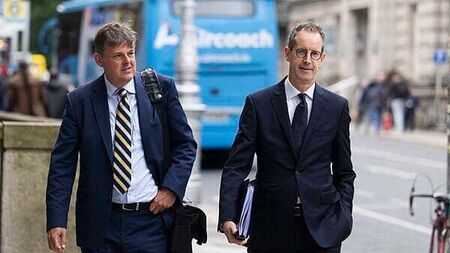
Station director-general Kevin Bakhurst, deputy director-general Adrian Lynch, and board chairman Terence O’Rourke attended the meeting with O’Donovan and his officials in Dublin.
Bakhurst and Lynch are the RTÉ reps to attend the meeting on Wednesday.
Consultant Sam Whipple, who worked as a “change co-ordinator” at the BBC, has been tasked with examining how RTÉ is structured and resourced and to identify areas to “improve workflows” and “delivery” across TV, radio, online and social media.
His review started at the end of April and is expected to last 40 days. It was not required to be publicly tendered and is therefore understood to cost less than €50,000.
On Tuesday, however, Bakhurst refused to provide a specific figure on what Whipple was being paid and declined to put a figure on how much in savings he was expected to identify.
The Committee session, which begins at 12.30pm, is expected to last two hours, with station bosses likely to be grilled on much of the above and whether they learned their lessons from previous governance failures and transparency issues.