Remembering Labour’s first Mayor of Waterford
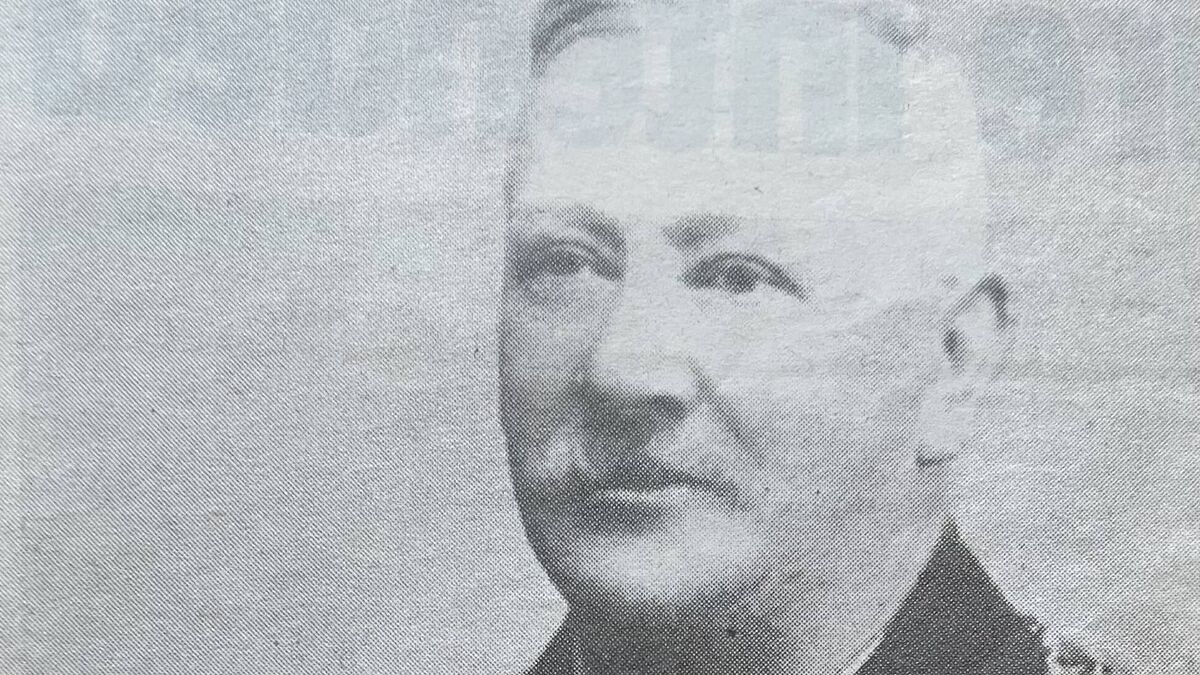
Mayor Richard Keane.
The year 2025 marked the 100-year anniversary of the election of the first Labour Mayor of Waterford.
Richard Keane was elected as mayor in 1925 and his descendants have kept his memory alive by researching his life and celebrating his mayoral role since.
Two of his grandchildren, Marie and Tony, sat down with Waterford News & Star to tell us about this amazing Waterford man and his enduring legacy.
When Richard Keane was four months old, his family moved to 126 Morrisson’s Road, where he spent his life. He lost his mother when he was five and at the age of nine, his father. He went to work at the Post Office before taking employment as a labourer on the Waterford-Limerick railway. And it was this work that led him to what might be his most well-known role as a trade union organiser in the infant labour movement.
Workers like dockers and railwaymen in Ireland began organising from 1889 onwards with the establishment of the Irish Trade Union Congress (ITCU) in 1894. The Irish Transport and General Workers Union was founded in 1909. ITCU formed a political wing in 1912 and became the Irish Labour Party and Trade Union Congress, with the two separating in 1930.
But it was in 1911 when Richard Keane found himself leading the charge.
Richard Keane was a hard worker and that quality led him to rise through the ranks at the railway to become a Yard Foreman in the traffic department, middle management, Tony explains.
“And somehow or other, he got involved in the early trade union movement. (Marie said he brought it in) which was in its infancy. He actually hosted a man called Kier who founded the union – the British Prime Minister is named after him,” said Tony.
In 1894 he helped found The Amalgamated Society of Railway Servants (later The National Union of Railwaymen).
In 1911, the workers from his yard joined an ongoing dispute, and Keane was one of the leaders in Waterford.
It started on the Dublin side and spread across the country, and was in response to workers being brought in to do the work of the strikers.
The railway was run by a man called William Goulding and he intended to wait the works out and got covered. Those men crossed the picket line and took up the work left by the striking labourers. The labourers along the line, including those in Waterford, called them blacklegs and scabs and refused to handle goods transported by those who crossed the picket.
The strike was resolved, but Goulding would only take back 75% of the labourers.
Keane had been at the forefront of the Waterford strike and Goulding intended to move him to Wexford but stories were to follow that he was in fact a blackleg.
“Because my grandfather was on both sides of the fence, because the workers trusted him and management wanted him as well, they said you can come back, but we are going to transfer you to Wexford and they would send stories down there to the effect he was a scab that he passed the pickets,” said Tony.
But Keane went down an entirely different route.
Tony said that his grandfather saw a gap in the market for a local coal yard and he took it. And when he retired, his eldest daughter took over the family business.
“I remember going down to get the coal. Never brought money – I presume someone paid for it. But I’d go down in a little broken down tan… a pram and I would collect two stone of coal, the equivalent of a big sack of potatoes,” said Tony.
Marie recalls her mother telling her that her grandfather had four horses and carts.
“I remember them. And on Easter Monday, he packed up all the children around the whole place and brought them out to the picnic field, which was the Six Cross Roads,” said Marie.
But Marie does have some memory of her grandfather and his fondness for reading the newspaper.
Read More
He married a Dublin woman, Margaret Dowling from Capel Street and they had seven daughters, of which her mother was the seventh, and two boys.
Marie and Tony recall that their mother travelled with her father on his many trips as part of his trade union work. His eldest daughter inherited the coal business.
One of his son’s, Joe, moved to London and worked for the council as an overseer for road crews. He passed away only died two years ago at the age of 105.
“A lovely gentleman – the most gentlemanly man I ever met,” said Tony.
Billy became an artist and cabinet maker in Wexford.
“Billy was an artist, a superb artist. He did woodcarvings, he was a cabinet maker and moved to Wexford. So they were the youngest – two beautiful people to be honest,” said Tony.
Even though Keane now worked for himself, he remained a strong representative for workers in Waterford. Marie said he would attend meetings in John Norris’s pub.
“They would come up looking for him and he would leave down the coal shovel and he would head down the road to the pub,” said Marie.
According to the in 1954, Keane was “prominent” in the foundation of the Trades and Labour Council, which became the Waterford and District Council.
In a small feature the in a small feature on his election to mayor, Keane was known for his belief that one does a “fair day’s work for a fair day's wages” and that one takes pride in their work.
In 1912 he was elected to Waterford City Council on the Labour ticket and spent many years as a senior alderman, known as being dedicated and diligent.
In 1925 Keane was elected as mayor.
Tony explained that mayors were not elected in the same way they are today and he needed the backing of the elite.
So, for a working-class man and one known for his work in the trade union movement, this was some achievement. It was a testament to his reputation in Waterford that he received that backing.
“When he became mayor at that time, (it was) not like the situation now, where everyone has a vote. Back then, only the elite and rate payers could elect him, so not everyone was entitled to vote. Not everyone was entitled to vote in municipal elections. And I find it astonishing that he was the first, say, non-establishment figure to be a mayor of Waterford,” said Tony.
According to the reports on his election in the and , Keane said: “I thank God for having spared me to this day, which sees me elected Mayor of my native city.”
Keane spent just six months as mayor, sharing the Mayoralty that year with Alderman Vincent White.
In 1927, he was selected to run in the Dáil elections but was ultimately unsuccessful.
Keane used his influence in politics to not only benefit ordinary workers but also his family too. Marie said that when her mother was married in the 1940s, she was given the pick of houses on Leamy Street.
She said her grandfather was later accused at a public council meeting of nepotism, to which he replied: “Only a gire wouldn’t look after his own.”
Keane died in May 1954 and the obituaries for him in the local newspapers, including were very complimentary.
Former mayor Thomas Dunne told the at the time: “Dick Keane was in every way a fine gentleman. He was an excellent mayor and discharged his duties in a very efficient manner. He was exceptionally keen on the procedure of the council and was most active in looking after the welfare of workers.”
The wrote: “During his Mayoral term, he proved himself an efficient chairman. His strict adherence to the rules of debate, coupled with, of course, impartiality, winning him golden opinions of his colleagues. He was unswerving in his loyalty to Labour as he was forthright and outspoken when it came to matters of expressing his opinions in public or private.
“In company he was most congenial to meet and this trait, as well as the others to which he could claim, won him the regard of the citizens.”
But that is not where his legacy ended.
In 1984, his family decided to contribute a medallion to the Waterford City municipal chain. The chain isn’t used anymore, but it does sit in City Hall as a display piece.
And in 2025, his family celebrated the 100th anniversary of his election in the Mayor’s Parlour in Waterford City, hosted by the last Mayor, Cllr Jason Murphy.
There his many descendants included not only grandchildren but great grandchildren and great-great grandchildren.
One of those great-grandchildren is Marie’s daughter, Suzanne Parker of Parker Law on The Quay.
At this year’s celebration at the Mayor’s Parlour, the then mayor, Jason Murphy, and the current mayor, who is himself from the Labour Party, Seamus Ryan, spoke eloquently about the family and the honourable role of mayor.
Mayor Murphy (2024-2025) said he was honoured to host the family and see how Keane’s legacy had inspired them through the generations.
Current Mayor Ryan told the family gathered that it is a “great honour” to be elected mayor and that they should be proud.
The then mayor of the Metropolitan area, Joe Kelly, called Richard Keane “a colleague through time”.
And perhaps one of the young guests in attendance might one day grow up to follow in his footsteps.
“There is something special about this occasion. To see so many members of the one family is fantastic,” said Cllr Kelly.