Housing the Déise: Homelessness can feel like a lifetime to a child
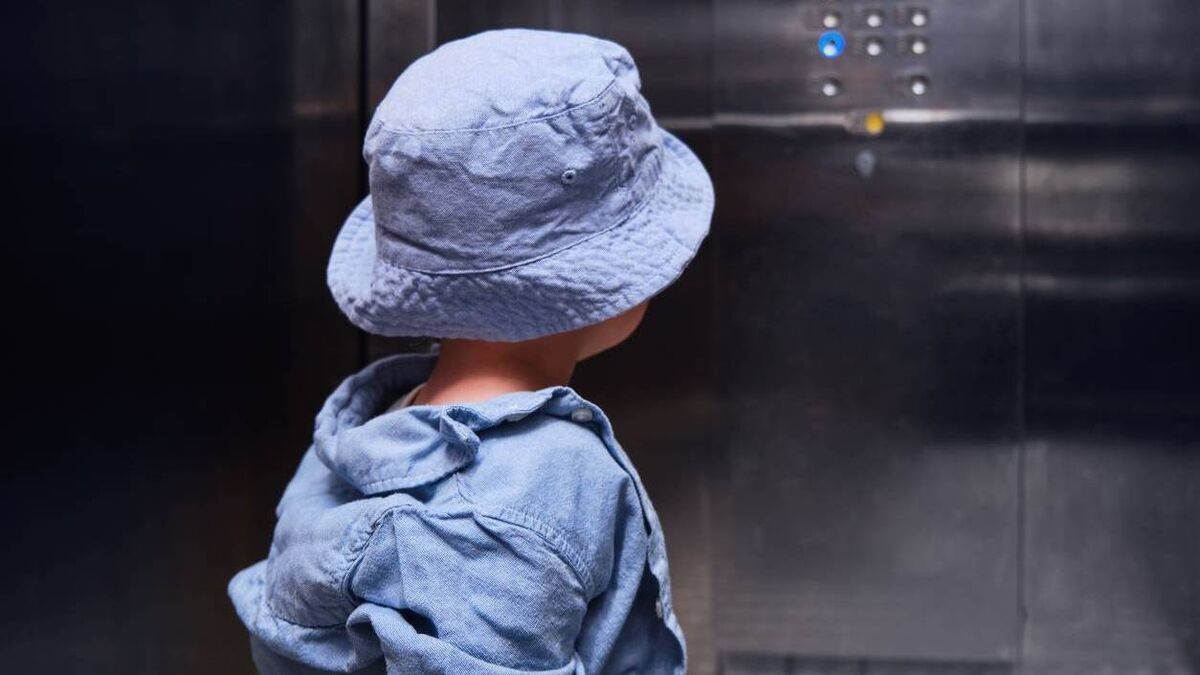
But protecting the home is adult stuff. Not for the kids. They shouldn’t have to worry about ‘security, safety and stability’.
Every child deserves the ‘security, safety and stability’ of having their own front door, a place to call home.
‘Security, safety and stability’ and a place called home have taken on an extra poignancy in the wake of the horrific tragedy at Birchwood estate.
If ever it was in doubt, the Birchwood tragedy hammered home how security within your four walls can never be taken for granted. As adults, we learn to expect that, which is why, year after year, we avail of enhanced security measures.
How many homes today have peephole cameras and motion-activated security cams that weren’t there five years ago?
But protecting the home is adult stuff. Not for the kids. They shouldn’t have to worry about ‘security, safety and stability’. A permanent sense of protection under the umbrella of the family unit should be their norm.
However, the absence of ‘security, safety and stability’ for many homeless children in Ireland – latest figures indicate 5,000 – has been a staple of their lives for many years.
With their number on the increase, there is no light at the end of the tunnel. Budget 2027 earlier this month was supposed to set that right. It didn’t.
That noble pledge, “every child deserves the security, safety and stability of having their own front door and a place to call home,” came from the lips of a government minister weeks before the budget: the assumption is that it reflects government policy.
But experts in the field of child care, like Mike Allen, dispute this, arguing that government policy hasn’t been fit for purpose for some time.
Budget 2027, which aimed to tackle homelessness through targeted measures, instantly became a lightning rod by drawing anger and frustration from homelessness charities like Focus Ireland.
Mr. Allen is its Director of Advocacy. He doesn’t hold back.
“In such a massive give-away budget there are some things to welcome but the overall conclusion is that the government has decided that homelessness is something it has no answers for.”
Ouch!
“Groups that make the biggest noise receive the greatest attention, but families experiencing homelessness are focused on finding stability and caring for their children. Unfortunately, this has resulted in government apparently forgetting people who are homeless and, in the midst of a massive budget give-away, offering so little to help them escape homelessness.”
Since the last budget in which the word ‘homelessness’ was referenced – 2023 – children who are homeless in Ireland has doubled from 3,991 to 5,830 today, a percentage increase of 46%.
Allen’s ire was directed at the Department for Housing, Local Government and Heritage and Minister James Browne, the man behind “every child deserves the security, safety and stability of having their own front door and a place to call home.” (Browne’s words echo the sentiments of Focus Ireland CEO, Pat Dennigan: “Every person deserves the safety, dignity and stability of a home.”)
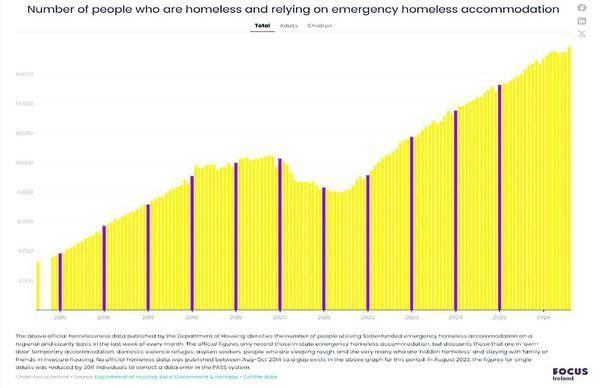
Statistics are not on the Minister’s side. They are damning. On the eve of the budget, homelessness rose to a record high. 17,885, or 2,800 families and 5, 830 children.
As our graph illustrates, while there was a dip from 2020 to 2023, there has been a sharp rise in children left without a permanent roof over their head in the past three years. Between July and August, the number in emergency housing increased by 358: 171 additional children, 76 additional families.
Government policy has been unable to put a dent in these figures since 2022. There are different reasons why. A shortage of financial clout isn’t one of them. Earlier this month Ireland was accorded Europe’s second richest country by GDP per capita at purchasing power parity, by the International Monetary Fund (IMF). It is on track to displace Luxembourg by 2030.
But despite closing in on a GDP per capita PPP of around €168,000 compared to Luxembourg’s €154,000, the overall level of homelessness in Ireland today is 9% higher than a year ago.
Which begs the following questions: why is the so-called second richest state in Europe among the top four in the European Union with the highest rates of homelessness per 10,000 people. And why is Ireland failing in the provision of ‘security, safety and stability’ for its most vulnerable citizens, children?
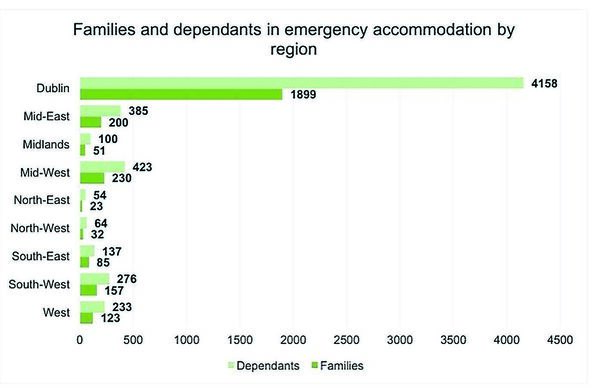
The numbers indicate that a decade of tackling homelessness has fallen way short of addressing the crisis.
But is homelessness perceived as a crisis by the government? Apparently not. Explore the language. Homelessness is described by government figures as ‘an emergency’ or ‘a pressing social issue’, but never a crisis.
In a speech during End Child Poverty Week to the Children’s Rights Alliance last month, crisis was not mentioned once by Minister Browne: instead, homelessness has become an “an issue.” Language matters, as do figures. There is no getting around research by the Children’s Rights Alliance that 206,202 children were at risk of poverty in 2025, an increase from 15.3% to 16.9% in 12 months – the highest of any age cohort.
“Each day there are over 5,000 children waiting to hear their parents say today is the day they can go to a home of their own. Almost 20,000 families sit on a stagnant social housing list for some good news to keep them going,” said Tanya Ward, Chief Executive of the Children’s Rights Alliance, after the publication of the latest government housing plan, Delivering Homes, Building Communities 2025-2030.
“Living in cramped, unsuitable and over-crowded accommodation is the reality for too many of these families. Children and families have been paying the price for well over a decade of lacklustre government action to address the housing crisis.”
This is a theme taken up by Pat Dennigan.
“Thousands of children continue to grow up without security, spending critical years of their lives in emergency accommodation,” he said.
A report by Barnardos (Because Childhood Lasts a Lifetime) investigated the potential impact that moving into emergency accommodation can have on a child.
“For many children we work with, it is a case of suddenly leaving their homes, most of their belongings, potentially their pets, and moving into much smaller accommodation that is less suitable and a considerable distance from their previous homes.
“This event can be extremely traumatic for children and unfortunately, without supports, long lasting. The trauma can affect children’s relationships with others, their behaviour and ability to engage in school, their confidence levels and feeling of wellbeing, in essence all aspects of their lives.”
Monthly data for the number of adults – not children – in emergency accommodation in Waterford stands at 98, less than Tipperary (115) but considerably more than Kilkenny (42) or Wexford (39).
People are housed in either Private Emergency Accommodation (hotels and B&Bs), Supported Temporary Accommodation (family hubs, hostels) and Temporary Emergency Accommodation (emergency accommodation with no support). Of the 85 families in emergency accommodation in the south east, there are 137 children.
Other government initiatives to safeguard children have also come under fire. When expenditure is deemed budget dependent, like the Housing Assistance Payment (HAP) or the Child and Family Homeless Action Plan, it runs the risk of falling by the wayside in terms of priorities.
For example, in advance of the budget, there were calls to increase HAP payments to keep pace with the cost of living and calls to green-light funding for the Child and Family Homeless Action Plan.
They fell on deaf ears.
HAP, a social housing assistance provided by a local authority, is where rent is paid directly to the landlord: while average rents have risen by 75% in 10 years, HAP hasn’t. Not once.
Across Ireland, 55,000 households on HAP are struggling to find an average of €900 rent per month. (A local authority has a discretion to apply a top-up of up to 35% above prescribed maximum limits.)
The risk is more households being pushed into homelessness as rent hikes outpace any supports.
As a Band 2 local authority, Waterford City/County places its HAP rate limits in the mid-range nationally. The HAP rent limit for a single person in Waterford City/County is €430 a month but with the discretionary uplift, it can increase to €580. (In Kilkenny, the HAP limit is €480 a month and the discretionary uplift, €648.) To qualify for HAP or social housing in Waterford, a single applicant needs net household income under €35,000 a year (€36,750 for a couple.) This rises to €38,500 for a couple with two children (add 5% per extra adult, up to 10%, and 2.5% per child). There are on average 1,230 households in Waterford benefitting from HAP assistance.
Meanwhile, the Child and Family Homeless Action Plan is in limbo. There were hopes before the budget that the government might announce significant funding, rumoured to be close to €20 million.
“It is disappointing that the actual funding level was not announced,” explained Mike Allen.
“Without sustained investment in prevention and family supports, we will continue to see families entering homelessness when that outcome could and should have been prevented.”
The government’s long term ambition for the Child and Family Homeless Action Plan is to tackle child homelessness through specific targeted measures which, it is hoped, but nobody is certain because the funding hasn’t been announced, will accelerate exits from emergency accommodation by delivering long-term housing.
(The Ombudsman for Children in its Homeless Action Plan believes sustainable exits from homelessness in the future must move away from a reliance on the private rented sector to provide social and affordable housing with children’s needs and rights in mind.)
Delivering long-term housing seems idyllic but is it also pie in the sky? The Minister waves his wand and housing appears out of thin air. The reality is that the government still expects local authorities – indeed, Minister Browne has contacted every local authority chief executive – to rescue those families who have been longest in emergency accommodation.
The reality on the ground makes for sober and sombre reading. Families leaving emergency housing are being replaced almost immediately and figures therefore continue to grow. Why? A steady decrease in the number of landlords prepared to accept HAP payments.
This was evident after the Covid 19 epidemic. Where HAP had accounted for 70% of people leaving emergency accommodation in 2021, this fell dramatically overnight to 20%. Research by the charity Simon into the growth and decrease of HAP tenancies in the past decade tells its own story: from 5,284 in 2015 to 60,590 five years later and falling year by year after 2021 to 48,355 this week.
Minister Browne in September promised that the Child and Family Homelessness Action Plan will “strengthen prevention measures, improve supports and help more families secure permanent homes as quickly as possible.” However, this is against a backdrop where the numbers of homelessness rise by the day and HAP tenancies decrease by the month, which is why his government stands accused, by Focus Ireland, of having no answer for homelessness.
Though late in the day, prevention is not only better than cure, it is cheaper. In 2024, just €20 million was spent on prevention compared to over €360 million for emergency accommodation.