Waterford's Blue Plaques: Dr John Coghlan - Guardian of the Poor
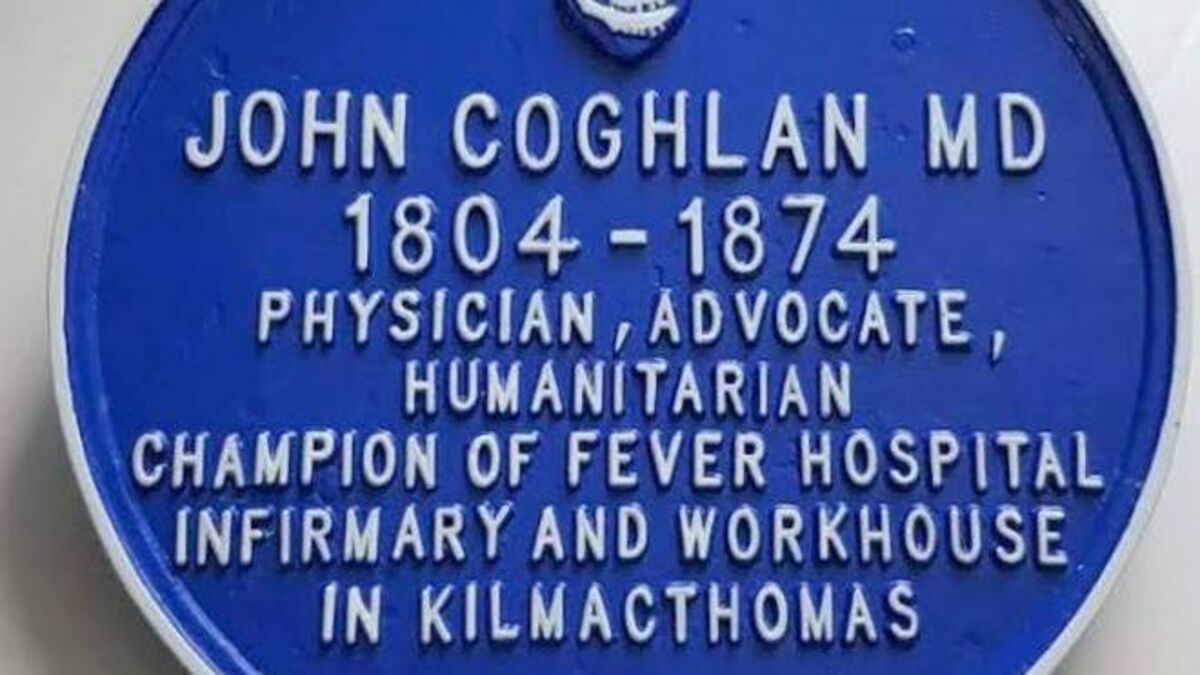
The Heritage Blue Plaque, erected at the former workhouse in Kilmacthomas, remembering Dr John Coghlan, MD.
A Heritage Blue Plaque was unveiled at Coach House Coffee, The Workhouse, Kilmacthomas, on Thursday, August 8, 2019, commemorating the humanitarian work of John Patrick Coghlan MD.
The event was attended by members of Coghlan’s extended family, including his great great granddaughter Ms Claire Coghlan, who travelled from San Francisco for the event. She presented a very thoughtful speech about her great great grandfather.
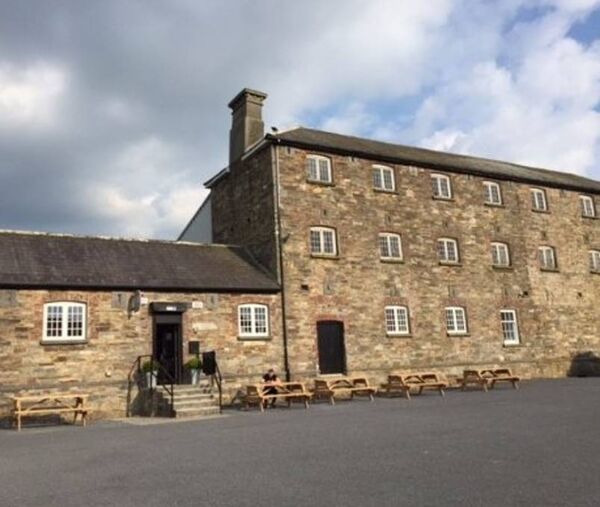
The event was also attended by relatives from the local community, together with Councillor John Pratt, and Mr Sean Murphy, a local historian.
Coghlan was born at South Lodge, County Tipperary, in 1804. He trained as a physician at Edinburgh College and Trinity College in Dublin. His work at Kilmacthomas began at the start of February 1833 – he would serve the community for 40 years, becoming the most highly regarded and respected medical practitioner by that community. The workhouse and infirmary were opened in 1851, and Coghlan also advocated for a fever hospital.
It is important at this point for the reader to be made aware of some useful background information, which enables all of us to have a greater understanding of famine times. A substantial amount of the information I gathered regarding the Kilmacthomas Union comes from Decies No. 64, the Journal of Waterford Archaeological and Historical Society. This paper was written by Ger (Gerard) Crotty, historian and respected expert on the topic. He refers to the work of many other experts, including Dr. Christine Kinealy, Director of Ireland’s Great Hunger Institute.
Another valuable source were newspapers from the mid to late 1800’s reporting very frequently on the meetings of the Kilmacthomas Union by the Board of Guardians, who included Thomas Meagher MP, Dr Thomas Lewis Mackesy, Terence O’Reilly and of course Dr. John Patrick Coghlan. Some of the Guardians regularly attended the meetings, others did not attend even one meeting.
The workhouse was administered by this Board of Guardians. Only ratepayers and those who owned property could sit on the board.
Much of the day-to-day business involved dealing with requests from the Poor Law Commissioners for returns on rates, and it was only rarely that there was any mention of the conditions of the paupers (as the poor were known at the time). These people were also referred to as ‘inmates’.
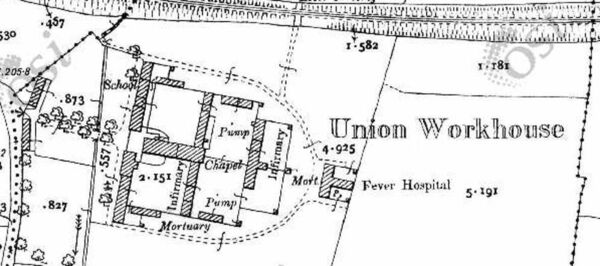
Although the workhouse was completed in 1851, Ger Crotty’s research shows us that "most sources quote Kilmacthomas as having opened in 1851, (located 1 mile from Kilmacthomas), and the first minute books are for October 1851, although it did not actually admit paupers until 1853". Dr Coghlan’s salary was £100 per annum at that time.
Prior to the opening of the workhouse that still exists today, the inmates must have been accommodated in other buildings. An article in the dated November 15, 1850, gives us some valuable detail as to the ‘State Of Our Workhouse’: 1,690 inmates (1,009 in the original workhouse, and the rest came from other city and county workhouses in Michael Street, Hennessy’s Road and White’s Store), two born that week, 83 discharged, and 10 deaths. The cost of keeping a healthy inmate was 10¾d (equivalent to 4p in Sterling today), the cost to keep a patient in the hospital per week was 2s (two shillings, or about 10p in Sterling today).
There was a finance report too, with £2611 4s and 5½d with the treasurer. It reported that there were 110 patients in the ‘Fever Hospital Sheds’. These data and figures were published in the on a regular basis, displaying complete transparency and accountability by the Board of Guardians.
Shortly after the opening of the workhouse the plans for the fever hospital were approved, with the board accepting the tender from Mr Terence O’Reilly for the erection of a fever hospital.
The Poor Law Commissioners authorised the borrowing of £1,400 to defray the cost of erecting the fever hospital – equivalent to £201,000 today.
The fever hospital was reported completed on December 9, 1854. The workhouse infirmary or hospital was an integral part of the workhouse, Crotty reports. He goes on – "prior to his resignation in February 1854, Dr John Coughlan’s report for 14 January of that same year, described the hospital as overcrowded and healthy children being accommodated with children suffering from hooping cough."
His report goes on to state that the infirmary "is in fact used as a district hospital".
The conditions prevalent in the hospital were evident in the reports of Dr Coughlan’s successor, who highlighted the outbreak of fever in March within the hospital. The medical officer asked the matron that the bedclothes coming from the fever ward should be washed separately from those of healthy inmates, intimating that the doctors must have been somewhat aware of cross-contamination.
Claire Coghlan’s research informs us that, “The workhouses, and workhouse doctors, were often unpopular – because it was desired by the Board of Guardians who funded them that they be run as economically as possible. As a result, the conditions were often deplorable. However, Dr Coghlan was not prepared to allow this one follow suit. While he was a mild-mannered doctor, he was also a fierce voice for those who had none. And he wasn’t afraid to incur the wrath of the powerful – or risk the loss of his popularity, his patronage or his profession – to speak the inconvenient truth. To demand that things be done differently. Better. More humanely. Whether it was arguing for more rations so the occupants could grow strong enough to work the garden and grow their own food and become self-sufficient, or more medicines for the infirmary so more people could be better treated, and more lives saved, Dr Coghlan spoke up. That takes courage, and conviction.”
I found the following in the Kilmacthomas Board of Guardians Minute Book between the dates March 25 and July 8, 1854: "When differences of opinion did occur and the board refused to comply with the commission’s wishes; the latter resorted to sealed orders with invariable success. The appointment of the workhouse doctor caused a level of disagreement between the Board and the Commissioners. Following his resignation, Dr Coghlan re-applied for the position and was approved by the Guardians but the Commissioners refused to sanction his appointment. The issue was finally resolved when Dr. Coghlan resigned at the end of June, and a new doctor was appointed in early July 1854.”
Clearly, Dr Coghlan had challenged, and had been regularly challenged by the Commissioners.
One can only surmise that there was, at times, a friction of sorts between the Board of Guardians and the Poor Law Commissioners. It must have been incredibly frustrating for those, such as Dr Coghlan and other caring board members, when their requests, albeit rational to them, were denied or even diminished in substance. Having said that, I can also understand that the Poor Law Commissioners themselves would, I expect, have seniors who would have dictated to them about what monies were going to be available to them, and I am certain detailed accounts for those monies were expected to be meticulously kept.
During his time at Kilmacthomas, Dr Coghlan had to endure accusations too. There is an example of such an accusation in 1869 toward Dr Coghlan by a Mr Hamilton, the then Poor Law Inspector. He questioned the neglect of duty by Dr Coghlan in relation to a form connected with vaccines and vaccination contained within The Medical Charities Act.
Crotty reports that: "All defaulters in his area had been summoned to appear in court. Coghlan was still on the defensive and wrote a detailed letter pointing out that he had not one defaulter and also taking the opportunity to point out the deficiencies in the Act. In particular, he highlighted issues with carrying out vaccinations during the difficult seasons."
There is much information on the diet of the inmates. Crotty’s research shows us that "the food was meagre" and was continually criticised by the medical officers. The workhouse inmates were given a diet, which was not superior to that of independent labourers. The Commissioners issued a circular in April 1854 (which Dr Coghlan would have been aware of at that time), outlining the risk of cholera and drawing the Board’s attention to the quality of the diet during their visits. The Commissioners enforced the "Nuisances Removal and Diseases Prevention Acts...threatening to prosecute any suppliers who violate their contracts in terms of quality in the event of the Guardians declining to do so", and "there are numerous accounts in the minute books of the medical officer requesting changes to the diet either as a result of shortages of particular foodstuffs or due to extremes of weather".
An account from July 12, 1859, shows the diet to consist of Indian meal, buttermilk, oatmeal, vegetables, white bread, cocoa and sweet milk.
Crotty reports that: "By the time the Kilmacthomas Union was formed the county had seen the worst of the famine and the situation was improving although there were still high levels of disease, mortality and emigration.
"The Medical Charities Act (of 1851), resulted in a decline in the ravages of cholera, smallpox and other contagious diseases."
Dr John Coghlan witnessed this at close hand, and he must have been pleased about further improvements 20 years down the line when "by 1872 (two years before Coghlan’s death in 1874), state medicine, as it was understood by the commission, was firmly established in Ireland along with the government’s acknowledgement of a basic responsibility for the health and welfare of those at the bottom of the scale. While this healthcare would fall short of twenty-first century expectations it must be viewed in the context of its time."
Claire Coghlan, Dr Coghlan’s great great granddaughter, gave us an interesting insight into the man. She said, “it wasn’t through his words, his letters, that I came to know who Dr Coghlan was, it was through the words, and letters, of others – his sons, his daughters, Lord and Lady Waterford of Curraghmore, the Uniackes and later the Beresfords of Woodhouse, the Pallisers of Comeragh House, the Osbornes of Newtown Anner House, there was even a letter from Charles Bianconi, the founder of public transportation in Ireland.
"Through their eyes, I caught a 360-degree glimpse of Dr Coghlan – the father, the doctor, the friend, the confidante, the humanitarian, the advocate, the agitator. Dr. Coghlan refused to discriminate between catholic and protestant, Irish and English, pauper and peer...it was owing to the relationships Dr Coghlan developed with his private patients, that he was able to rally their support for projects that tackled the poverty, squalor, disease and hunger prevalent in the district.”
Ms Coghlan mentioned Lady Waterford, Louisa Stewart, “who worked tirelessly with Dr Coghlan to put in motion practical, inventive, workable solutions to a seemingly insurmountable problem”.
They established a textile industry, organised vegetable gardens, soup kitchens, cottage renovations and much more.
“Dr Coghlan never gave up...in addition to the projects he undertook with Lady Waterford, he had his duties as dispensary doctor, medical officer at the fever hospital and workhouse infirmary, regular calls to the cholera hospital in Stradbally, his private practice and, of course, his wife and family. That’s overwhelming...it’s important that Dr Coghlan’s and other stories are told, to ensure that Waterford’s history is appreciated and preserved.”
Thanks to: Crotty, G., 'Kilmacthomas Union: The Administration of Poor Law in a County Waterford Workhouse 1851-1872'. Decies 64. Waterford Archaeological and Historical Society; Coghlan, Claire, descendant of Dr. John Coghlan; Mac Cártaigh, Stiofán: 'The Remarkable Career of Dr. John Coghlan in Kilmacthomas' - Steps Back Thru Time; for articles of the 1800’s; Waterford Libraries staff.
Marcus Copley, Waterford Civic Trust, researches past recipients of the Heritage Blue Plaques that you see dotted around Waterford. He also presents talks on these to public and private organisations.
A Heritage Blue Plaque is a permanent sign installed on a building in a public place to commemorate a link between notable figures of the past and the buildings in which they lived or had some connection to. It is a unique way to highlight these special achievements and celebrate those who have helped to shape Waterford’s heritage and history. Waterford Civic Trust is a registered charity and has erected over 70 Heritage Blue Plaques in various locations across Waterford city and county.