View from the Green Room: Mná na hÉireann sa bhaile!

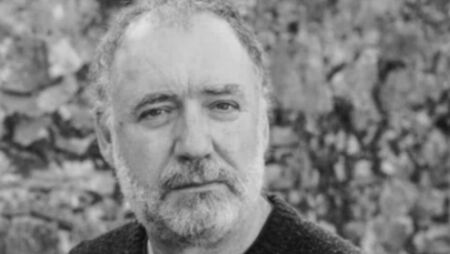
Dr Eugene Broderick.
Dr Eugene Broderick concluded his current lunchtime lectures in the Medieval Museum on Wednesday last to yet another packed house.
The genial historian’s been dealing with the place and fortunes of women in the first two decades of the state when the place of the woman in the home was firmly established by referendum on the Irish Constitution in 1937. One article on the status of women drew feminist ire and not without good reason: ‘Without which the common good cannot be achieved’.
Feminist objectors objected with good reason. The offending article defined women by their domestic role – they belonged only to the home and had nothing to offer outside it.
Louie Bennett, president of the Irish Women Workers’ Union, wrote to de Valera to suggest a change of wording: ‘the state recognises that by her work FOR THE HOME...'
In her letter she argued that, "the part played by woman for the common good outside the home, in education, in social service, in culture, in workshops and on the farm, has now become indispensable to a civilised state. It is surely, therefore, invidious to introduce into the constitution a clause which makes it appear that only the women within the home can contribute to the common good."
Hanna Sheehy Skeffington described it as "a fascist proposal". Kathleen Clarke condemned it "as an attempt to take from women the equal rights and opportunities accorded to us in the Proclamation" which her husband Tom had signed and died for.
Dev’s biographer Dorothy McArdle wrote to him stating "as the Constitution stands, I do not see how anyone holding advanced views on the rights of women can support it." In one phrase, Dev had made nonsense of the roles of women who were doctors, nurses, teachers, shop owners and wives who worked farms alongside their husbands. Dr Broderick is quick to point out that all of the collaborators on the new constitution were men, including Waterford barrister John Hearne who drafted the legal text.
Broderick gives special mention to advisor Fr John Charles McQuaide, who was then President of Blackrock College, where Dev was apparently ‘Professor of Mathematics’ (Dev had a degree in Maths and a post-grad’s inflated sense of self-worth).
Dr Broderick gives a modern twist on Dev’s vision of the perfect home. Catherine Coll, his mother, was born in Bruree, County Limerick, emigrated to the United States when she was 23 years of age, arriving in New York in October 1879 to work as a domestic servant. In September 1881 she claims to have married Spaniard Juan Vivion de Valera, who died when Dev was only two years old. No record of Juan Vivion de Valera – birth, marriage or death – exists in the USA and a year later in 1885 her brother, who was in America, was returning home to Ireland. She sent her son with him to be reared by her family in a labourer’s cottage in Bruree.
Modern historians believe that this rejection by his working mother brought about Dev’s vision of idyllic woman in a family home that appears in the Irish Constitution. Historian Dr Joe Lee remarks: "It was as if he were subconsciously striving to obliterate the memory of his own childhood."
The Irish Constitution was put to referendum on July 1, 1937. Turnout was 1,775,055 (75.84%) with votes in favour (Yes): 685,105 (56.5%); votes against (No): 526,945 (43.5%) and Invalid / Spoilt Ballot Papers: 134,157 (approx. 10%).
July 1, 1937, remains a defining moment in the history book of Irish women.