Fr Liam Power: Celebrating the feast of St. Brigid
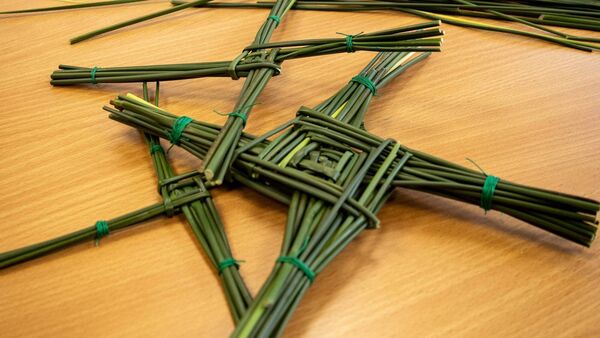
A St Brigid's Cross, created at a workshop held at Waterford Volunteer Centre. Photo: Joe Evans
The feast of St Brigid of Kildare, patroness of Ireland, was celebrated on Sunday, February 1. The national holiday was celebrated on February 2. I was amazed and fascinated by the level of celebration throughout the country to mark this feast day.
The Irish Times reported on festivals held in her honour in many parts of the country. In County Louth, for example (Faughart is identified as the birthplace of Brigid), Feile na Tana was celebrated, which included events celebrating traditional music and dance. The main festival concert was sold out.
Kildare is, of course, the place where St. Brigid built her famous monasteries. She ruled there with the authority of a bishop. There was a county-wide festival there, a highlight of which was the Carrying of the Flame procession through Kildare town.
The Mid-Kerry Biddy’s Day festival included Brat Brid-making workshops and concerts, with the festival highlight of the Biddy’s Day parade, which included fire performers. The venue was Killorglin’s town plaza.
In Dublin, we had the Festival of Brigit: Dublin City Celebrating Women. Dublin City Council promised to awaken the streets with “Art, Myth and Women’s Power”.
Read More
It seems that Brigid is now adopted as a feminist icon and celebrating her legacy is a positive tribute to female empowerment.
However, it is also a fact that Brigid is portrayed as a neo-pagan Celtic goddess in many events commemorating her feast day.
I am fascinated by the dual approach to the celebration of St Brigid on February 1. She is celebrated as a pagan goddess and as the patron saint of Christian Ireland. I have often wondered if Neopagan Ireland can have anything in common with Christian Ireland. Are they totally incompatible or is there room for dialogue?
In the Christian tradition, Brigid is revered as a saint, a real flesh and blood person whose life continues to inspire Christians throughout the world. It is accepted as historical fact that Brigid founded two monasteries in Kildare, one for women and one for men, which became renowned centres of learning, spirituality, and of outreach to the poor and needy.
Legend has it that Brigid was effectively bishop in Kildare at the time.
The Brigidine Sisters, founded in 1807, working in America, Australia, and New Zealand, continue the legacy of St Brigid. Like St Brigid, they devote their lives to be healers of brokenness in the world and to empower women who are oppressed. They act as advocates for those fleeing persecution and seeking asylum.
Brigid was a friend of the poor. Her followers seek to reach out to challenge unjust structures and to befriend those in need.
Many devotees highlight Brigid’s reputation as a peacemaker. They have joined in protests against nuclear armaments and work for reconciliation between warring factions in many parts of the world.
Brigid cared for creation. Many Celtic traditions link her with the land, the Spring, and the birch tree — images of renewal.
She taught that all creation is a gift to be tended. In our time, stewardship has urgent dimensions: caring for the Earth, using resources wisely, defending those whose livelihoods depend on a healthy world. Brigid’s stewardship was practical and spiritual: tending fields and hearts at once. She continues to inspire many in their fight for ecological justice today.
On the other hand, paganism is a nature religion that understands the divine as immanent in all aspects of life. Pagans attempt to live their lives attuned to the cycles of nature: the seasons, life, and death. Pagans celebrate the sanctity of nature, “revering the Divine in all things; the vast, unknowable spirit that runs through the universe, both seen and unseen.”
They cultivate a spiritual life through their relationship with the natural world. The symbol of Brigid, as goddess, encapsulates this vision of life.
Carol Christ, a feminist scholar, finds in the image of the goddess a compelling image of female power, a vision of the deep connection of all beings in the web of life and a call to create peace on earth. She hopes that the return of the goddess can bring healing to the deep rifts between men and women and between ‘man’ and nature.
The feast of Brigid is celebrated on the pagan feast of Imbolc, which heralds the coming of spring, as nature emerges from the darkness of winter into the dawn of a new day. So the goddess Brigid is portrayed as a ‘cosmological mother’, the unseen force driving the cycle of life.
There is a radical difference between the pagan and the Christian vision of life. The goddess is a symbol, an impersonal force. The Christian believes in a personal God as imagined fully in Jesus Christ. The pagan does not accept the need for salvation, refusing to accept that there is a force for evil in the world.
However, I see possibilities of dialogue, which could lead to mutual enrichment.
Brigid as goddess and St Brigid are powerful icons for the empowerment of women. The saint and the goddess encourage us to embark on a deep spiritual journey to develop our most creative and enlightened self. Christianity and paganism respect the ecosystem and promote care of creation, even though paganism does not accept the concept of creation.
There is much room for deeper dialogue.