End of an era for Sisters of Mercy in Waterford City with closure of convent on Military Road
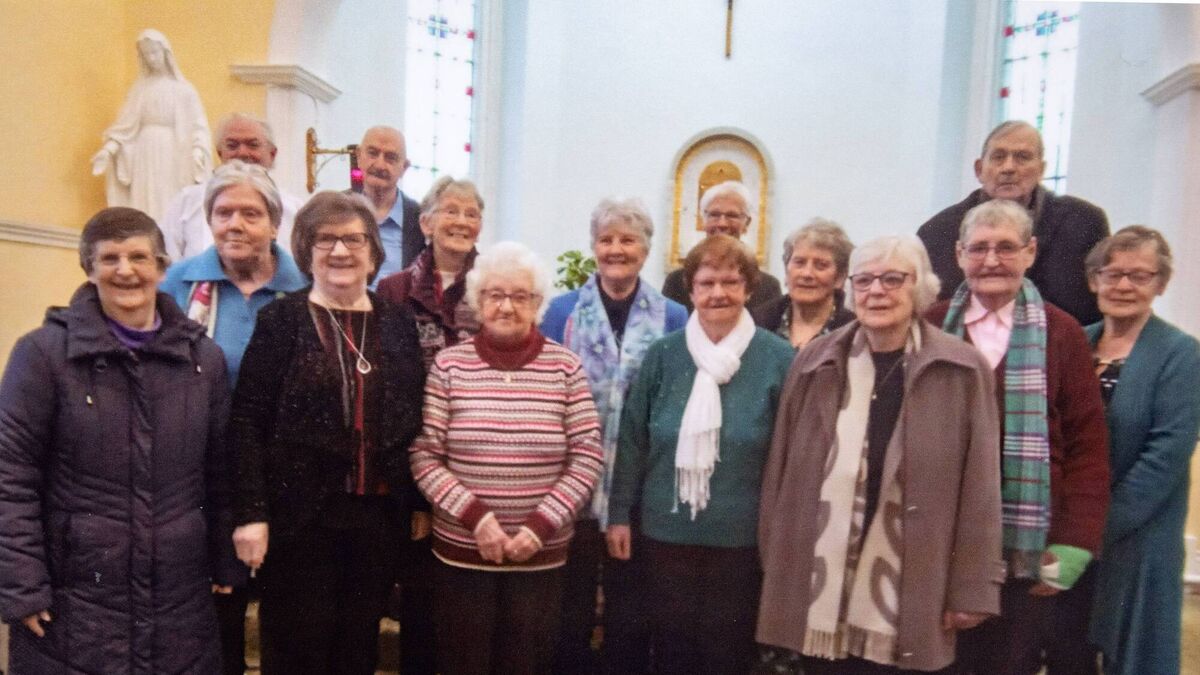
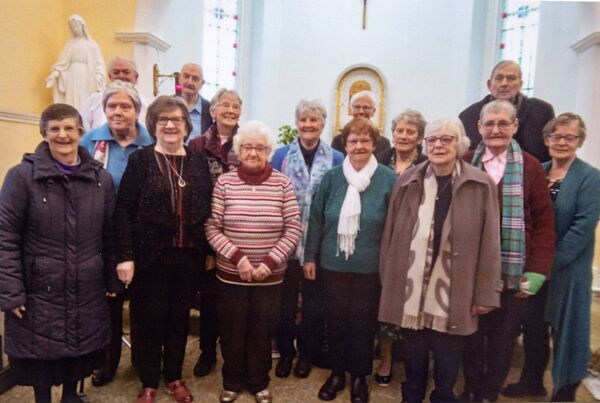
A group of sisters who began their lives as Sisters of Mercy at the Convent of Mercy on Military Road. This picture was taken in January following a Mass of Thanksgiving in the Convent Chapel. Front L-R, Sisters Francis O'Brien, Teresa Fraser, Pauline Drohan, Catherine Brown and Assumpta Hackett. Middle row, Sisters Ita Phelan, Ann Lynch, Bernadette Power, Frances Kennedy, Pat O'Donovan and Bernie Ryan. Back row, Fr. Gerard Langford, Fr. Michael O'Brien, Sr. Sheila O'Gorman and Fr. Michael Mullins.
This year, 2026, marks the 150th anniversary of the arrival of the Sisters of Mercy to Waterford City. It also heralds the end of an era for the Sisters of Mercy in the city with the closure of the convent on Military Road, at the end of January.
Prior to the closure, a group of sisters, some of whom began their religious lives in that convent, gathered for a Mass of Thanksgiving in the convent chapel.
The Sisters of Mercy had been at the Military Road/Yellow Road site for 120 years. It was a poignant occasion for those who have a deeply rooted affective investment in that sacred place, and have contributed to the shaping of its history. The convent building was home to faith-filled women of mercy who played a pivotal and historical role in developing ministries of healthcare, education, and social care in Waterford City and in Dunmore East.
The first Sisters of Mercy arrived in Waterford, from Clonakilty, in 1875, and were welcomed to the Diocese of Waterford and Lismore by Bishop John Power. They came in response to a request from the Board of Guardians of Waterford City Workhouse, which was located on John’s Hill. They were given responsibility for the medical care within the workhouse.
In post-famine Waterford, poverty, destitution, and illness was widespread. The Sisters lived at the Workhouse, and remained a branch of the Clonakilty community until 1883.
After the foundation of the Irish Free State in 1921, the Workhouse was re-purposed and was renamed St. Patrick’s Hospital. It became an acute care regional hospital. The sisters had responsibility for the administration, as well as for the nursing care within this new regional hospital. Shortly after the opening of the hospital they negotiated the establishment of a School of Nursing at St. Patrick’s Hospital, with the Department of Health. In 1959, the acute healthcare services and the School of Nursing transferred to Ardkeen.
Four of the sisters transferred from St. Patrick’s to the new Waterford Regional Hospital, taking responsibility for nursing services in the surgery theatres, the maternity section, and the ophthalmology department, as well as for managing the catering services. After the transfer of the acute healthcare services to Ardkeen, St. Patrick’s Hospital was repurposed as a geriatric hospital. Sisters of Mercy continued to work there until the beginning of this century.
Bishop John Power and the Parish Priest of Dunmore East, Fr. John Crotty, requested the Clonakilty community to establish a foundation of Sisters of Mercy in Dunmore East. The sisters arrived in Dunmore East in 1883. Mother Columba Marmion, Sister of Blessed Columba Marmion, was installed as the first Superioress by Bishop Power. The vacant Bay Hotel, which had fallen into disrepair, was bought to accommodate the convent and a school. The foundation attracted vocations quickly, and the school opened almost immediately.
In 1898, Dean Flynn, the Parish Priest of Ballybricken in Waterford City, was having a school built on Philip Street for children in his parish and in the surrounding area. Poverty, underprivilege, and unemployment were enormous problems in Waterford City. The majority of the children’s parents lacked a proper education, and illiteracy was a common problem. Dean Flynn requested that some Sisters of Mercy would be appointed to run the new school.
Mother de Sales, the then superioress, envisaged education becoming a gateway to freedom from poverty and oppression for the children. She gladly acceded to Dean Flynn’s request and St. Otteran’s School opened in 1900. Initially, the sisters lived in the convent at the workhouse on John’s Hill, and travelled to and from the school each day in a horse-drawn vehicle.
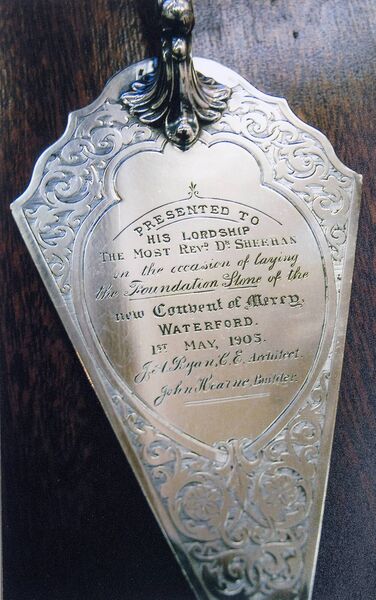
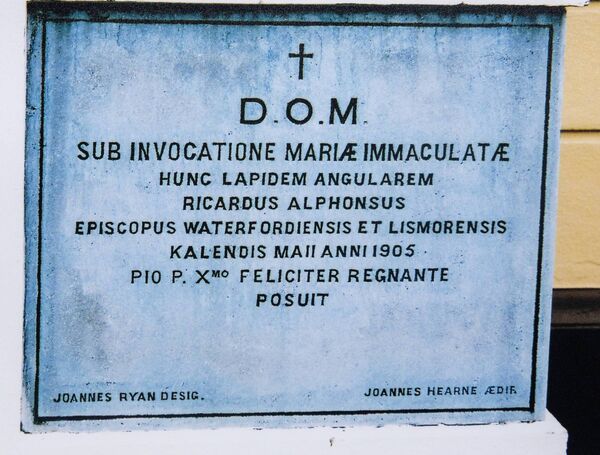
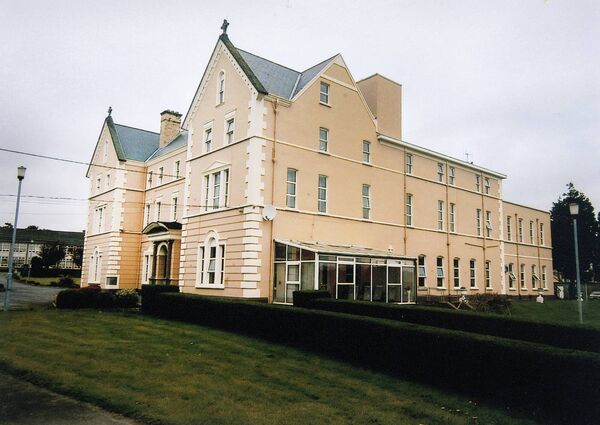
Bishop Alphonsus Sheehan, who was then Bishop of Waterford and Lismore, was anxious that a convent would be built close to the school. A piece of ground adjacent to the school on Philip Street, but with an opening on to Yellow Road, was acquired. The foundation stone was laid by Bishop Sheehan in 1905, and the new convent opened in 1906. This convent then became the "centre of gravity" for the development and maintenance of Mercy ministry in Waterford City and in Dunmore East.
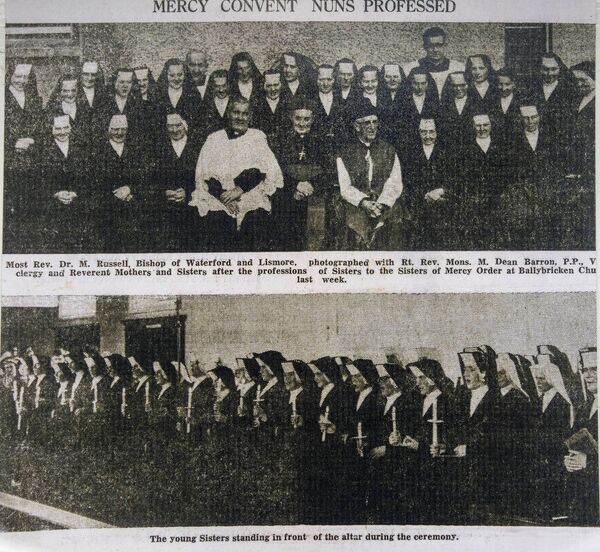
Shortly after the opening of the convent, night classes were organized for illiterate and poorly educated adults in the area. A year after the opening of the convent, a Diocesan Central Novitiate was established in a section of the building.
By the 1930’s accommodation within the convent was inadequate for an increasing number of vocations, and Summerland House and farmland was acquired. Summerland House became St. Joseph’s Central Novitiate, and the farmland subsequently provided sites for new primary and secondary schools that were built during the 1960’s and 1970.
Enrollment continued to rise in St. Otteran’s School and several extensions were erected throughout the first two decades of the twentieth century. By 1913 the school was offering its students a broad range of subjects. Drama, art and music had an important place in the school curriculum. In 1917, the Mason Educational Methodology was introduced throughout St. Otteran’s School. This liberal and intensive educational methodology was highly commended by an official from the National Board of Education who visited the school.
After the establishment of the Irish Free State the Mason method was not recognized by the Department of Education, and it had to be discontinued. In 1920, the first Montessori school to open in Ireland was established in the junior section of St. Otteran’s School.
W.B. Yeats, who was then a senator in the Free State Government, and a member of a government committee investigating the state of Irish education, paid an official visit to the school in 1926. The school was of interest to him as it had a reputation for modern and enlightening teaching methods.
Dr Maria Montessori visited St Otteran’s School in 1927, and again in 1937. She was delighted with how truly her spirit had been interpreted by the sisters, and her ideals embodied so perfectly by the children.
Other visitors who were attracted by the pioneering educational methodology included educationalists from China and Holland, and the Jesuit educationalist Rev. Allan P. Farrell.
In the early 1930’s, the provision of second-level education began in St. Brigid’s Building, which was located on the Yellow Road. This section was under the direction of Sr. Redemptoris Cummins. St. Carthage’s Commercial Academy was also established in the 1930’s.
St. Carthage’s was run by Sr. Eucharia Toomey. She developed a good business rapport with employers throughout the city, and was very skilled in her ability for placing students in suitable employment when they had completed their courses.
By the 1950’s, St. Otteran’s School building was no longer adequate. It was replaced by Holy Family Primary School, accommodating pupils from Junior Infants to Second Standard, and by Our Lady of Mercy Primary School, accommodating pupils from Third to Sixth Standard. These schools are located on Military Road and were officially opened in 1965 by the Minister for Education, Patrick Hillery, and blessed by Very Rev. Dean Michael Barron.
In 1977, Our Lady of Mercy Secondary School opened on Ozanam Street, on a site that had previously been a walled garden for the Novitiate. The following year a sports hall was built on the same site, and further rooms were added during the following two decades.
In 1980, St. Joseph’s Novitiate closed. The building was developed as a centre for adult learning by the Waterford Vocational Educational Committee. This centre was officially opened by Minister for Education, John Boland, in December 1980. It continues to be a thriving centre for further education and training.
A new entrance to the convent opened on Military Road after the schools were built.
From the outset, compassionate engagement with people who were ill and confined to their homes, and to the bereaved, was a vital element of the Mercy sisters’ ministry. Outreach to those who were socially underprivileged or culturally deprived, and appropriate responses to family difficulties with practical help, was an important priority.
Visiting homes in the area, and hospitality towards those who came to the convent seeking help and support, was part of daily life for the convent community.
The 1980’s presented families and communities with many challenges. The country was in the grip of a recession. The cost of living, unemployment, and emigration were all high. People needed practical help and hope.
When St. Carthage’s Commercial Academy closed, it was decided to repurpose St. Brigid’s building as a centre where up-to-date social care services would be offered, that would respond effectively to people’s needs. St. Brigid’s Family and Community Centre opened in 1984.
Early in the 21st century a group of lay colleagues took responsibility for the ongoing work of the centre, and St. Brigid’s was registered as a separate charity. St. Brigid’s has effectively navigated its 40-year journey of professional quality service to the community because of the commitment of extraordinarily dedicated, skilled and generous professionals. The property has recently been gifted to St. Brigid’s charity by the Mercy congregation.
Sharing their lives with the people of Waterford City and Dunmore East has been a distinct privilege for the Sisters of Mercy. Engaging with colleagues, and those with and for whom they served in healthcare, education and social care, has been formative and humanizing. They left the convent at Military Road knowing that they have been profoundly blessed by the decency, loyalty, kindness, and generosity of those among whom they lived and ministered.
Since coming to the Diocese of Waterford and Lismore, the sisters have engaged collaboratively in ministry with the bishops and clergy within Waterford City and Dunmore East during the episcopates of 10 bishops, Bishop Alphonsus Cullinan being the most recent.
Pope Francis referred to religious life as a "gift to the Church". The sisters have experienced appreciation for being that "gift" from the bishops and clergy throughout the 150 years they have been in the diocese. That has been a special and empowering blessing for which they are truly grateful.
Buíochas le Dia, agus Buíochs ó Chroí do Phobal Dé, agus do Mhuintir Phort Láirge.