Editorial: Recognising the immense contribution of the Sisters of Mercy in Waterford
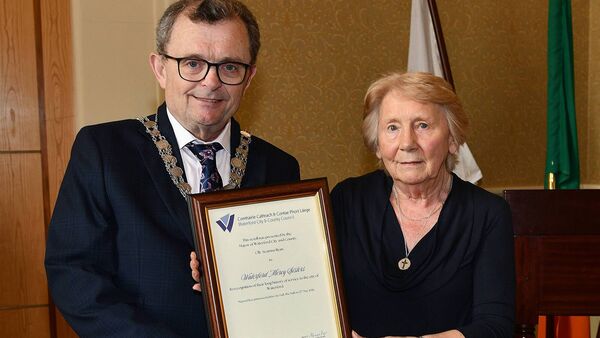
Mayor of Waterford City and County, Cllr Seamus Ryan, presenting the scroll to Sr. Coirle McCarthy, Mercy Sister, on the occasion of a Mayoral Reception held for the Sisters of Mercy at City Hall.
A huge milestone and also a poignant one, as the Sisters of Mercy mark 150 years in Waterford but also the closure of the convent on Military Road in the city. Their immense contribution, which continues through the classrooms of the Mercy schools, has been profound in terms of education, health and social care across the last century and a half. This was recognised last week through the occasion of a Mayoral Reception, held by Mayor of Waterford City and County, Cllr Seamus Ryan, in honour of the Sisters.
The first Sisters of Mercy arrived in Waterford in 1875, in response to a request from the Board of Guardians of Waterford City Workhouse, which was located on John’s Hill. They were given responsibility for the medical care within the workhouse. Post-famine Waterford was an incredibly difficult time for the population, with poverty, destitution and illness widespread.
The workhouse later became St Patrick's Hospital.
The Sisters also established a presence in Dunmore East, with the establishment of a convent there, as well as in the city.
They played pivotal roles in health - in both St Patrick's Hospital and later the new hospital at Ardkeen.
Shortly after the opening of St Patrick's Hospital, they negotiated the establishment, with the Department of Health, of a School of Nursing there. In 1959, the acute healthcare services and the School of Nursing transferred to Ardkeen.
Their influence in terms of education was also widely respected. In fact, in 1920, the first Montessori school to open in Ireland was established in the junior section of St. Otteran’s School run by the Sisters.
W.B. Yeats, who was then a senator in the Free State Government, and a member of a government committee investigating the state of Irish education, paid an official visit to the school in 1926, while Dr Maria Montessori herself visited St Otteran’s School in 1927, and again in 1937.
Other visitors who were attracted by the pioneering educational methodology included educationalists from China and Holland, and the Jesuit educationalist Rev. Allan P. Farrell, according to an article by Sr Pat O'Donovan for the earlier this year.
Today, the Sisters' legacy continues through the progressive Junior and Senior Mercy Schools - Holy Family and Our Lady of Mercy Primary Schools and Our Lady of Mercy Secondary School.
In terms of social care, St Brigid's Family and Community Resource Centre - which marked its 40th birthday last year - was also borne out of the work of the Sisters of Mercy.
"Outreach to those who were socially underprivileged or culturally deprived, and appropriate responses to family difficulties with practical help, was an important priority," said Sr O'Donovan.
The current-day highly progressive organisation is run by a group of lay people, with the Mercy congregation gifting the building to St Brigid's in recent years.
It is only fitting that the Sisters of Mercy were recognised in the esteemed presence of the Mayor of Waterford in City Hall. They arrived all those years ago to embrace the communities already here, and make possible a better future for Waterfordians. They became one of our own.