Willie Walsh – a hurler, footballer, and All-Ireland final referee
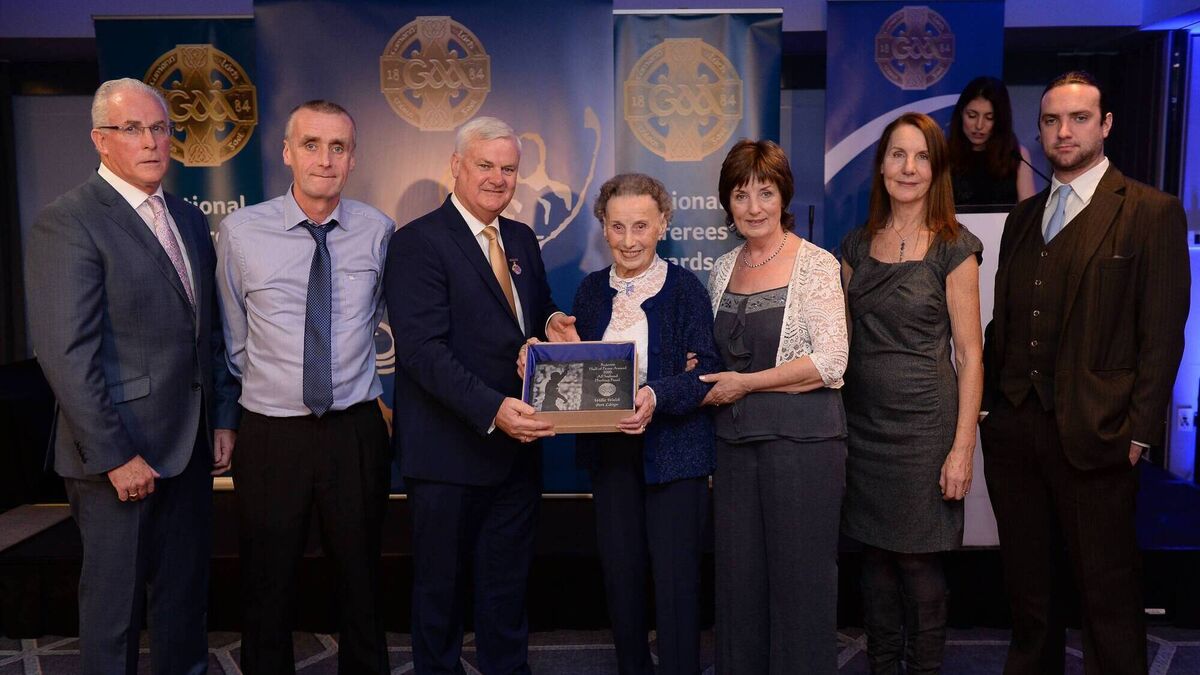
Family members of the late referee Willie Walsh, Waterford, who refereed a total of nine All-Ireland Finals, including seven hurling and two football, grandson Seán Walsh, second from left, daughter Ita Power, fourth from left, granddaughter Máiréad Bourke, fifth from left, granddaughter Ursula Kenny, sixth from left, and great-grandson Neil Bourke, far right, accept the Hall of Fame Referee Presentation from Uachtarán Aogán Ó Fearghail, third from left, and Seán Walsh, far left, Chairman of National Referee Development Committee, at the GAA National Referees' Awards Banquet 2016 at Croke Park in Dublin. Photo: Sportsfile/Cody Glenn
One of the best-known Gaels of his era in Ireland was Willie Walsh of Waterford, whom Walsh Park GAA pitch in Waterford is named after. Willie's association with the GAA, both as a dual Inter County player of hurling and football, and official, extended for many years, during which time he was an outstanding figure in the Gaelic life of his native city and played a big part in the promotion and perpetuation of the National Pastimes in the Urbs Intacta.
Joining the Old IRA. at its inception, he served with the S. Company, East Waterford Brigade. On his return from a Gaelic League Convention in Dublin in 1916, he was arrested at the local Railway station and interned in Mountjoy for a considerable period. He was arrested again at Ballyduff Lower in November 1920 and interned until December 1921 in Ballykinler Camp in County Down. The late Mr Walsh joined the staff of Messrs. Ed. Phelan Ltd, Sack Merchants, Newrath, when he was 15 years old and became a director of the firm 15 years later. He was a founding member of the Gaelic League in Waterford. He was also a founder member of the Waterford Athletic Club N.A.C.A. in 1923, and his Vice President was the famous Olympic Champion and World Class long Jumper Peter O'Connor.
At the early age of 17 year, he participated in his first Intercounty match when he played, for Waterford in the Munster Senior football Championship against Kerry at Turner's Cross, Cork, in 1899, when, after a great game, the Kingdom emerged victorious by the minimum, on the score of 1-3 to 0—5, the game actually played in 1900 and secured selection for each successive year until 1914.
He also played Inter-County hurling with Waterford from 1903 to 1912, and had the distinction of being on the team for each successive year during that period also which was a high tribute to his prowess as a player.
Willie Walsh was one of a small number of pioneer Gaels, together with his colleagues, being Ned Phelan, a man well-known in city business circles at the time, a native of Mooncoin; Mick Lynch from Durrow, and Matty Nolan of Ballyduff Lower.
He gave up inter-county hurling in 1913, but played club matches with the Mitchels Hurling Club. In 1904, at the age of 21, he was called on to referee the Munster Senior Hurling and Football Championship games between Clare and Limerick at Ennis, and so efficiently did he carry out his first big task with the whistle that he got many appointments in a similar capacity from that year onwards.
He refereed his first All-Ireland final in 1915, when Laois beat Cork, a big surprise at the time, and was also called upon for the 1916 final, in which Kilkenny and Tipperary crossed camáns and not played in Croke Park until January 21st 1917 due to the troubles at that period, which Tipperary represented by Boherlahan won beating Kilkenny represented by Tullaroan.
He also refereed the 1917 final between Dublin and Tipperary. In 1918, he had the honour of refereeing the Munster final between Limerick and Tipperary, the Leinster decider between Wexford and Dublin, and the All-Ireland final later between Limerick and Wexford.
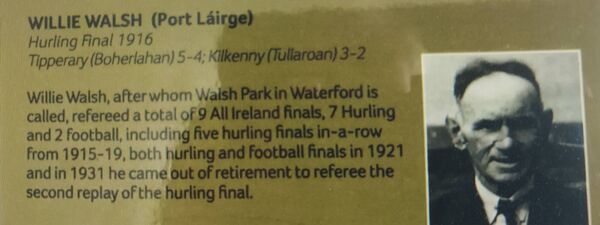
He was again chosen for the 1919 final between Cork and Dublin, which completed a record of five All-Ireland finals in succession, to which can also be added the record of officiating in Six Harty Cup senior hurling colleges finals in sequence. Other big games included the 1920 All-Ireland football final between Tipperary and Dublin, played in 1922, and which was started by Mr. Dan Breen, T.D, the senior football final between Dublin and Mayo, in 1921, and the senior hurling final between Limerick and Dublin for the same year.
In 1922, the latter three games were decided owing to the Black and Tan trouble intervening, so that he established what must surely be something like a unique record by refereeing three All-Ireland senior finals in the same year.
In his time interned at Ballykinler Camp, County Down, his capabilities as a referee were again brought to light, when he officiated in all the interline football competitions played between the prisoners' representatives of many prominent Gaels from all over Ireland. He refereed the Waterford /Cork game in the 1929 Munster minor hurling final, something that would be unheard of nowadays add to that the Interprovincial Railway Cup finals in 1930 and 1931, and his last big match was the famous All-Ireland hurling final of 1931 between Cork and Kilkenny, which he refereed on the third occasion. Sean Bobbins officiated in the two drawn games.
Here in Waterford in 1931, in the midst of a dispute between the GAA and Soccer as the Chairman of the Waterford GAA County Board, Willie Walsh, posed the question "where were the Rugby Union, the Soccer Association or the Hockey Association on Bloody Sunday “?
He noted that the Black and Tans had not gone to Dalymount Park or Lansdowne Road to look for rebels. Instead, it was at Croke Park that they performed deeds which shocked the civilized world". From 1908 onwards, he firmly believed in the "Sports Field" in Waterford, now Walsh Park , being used exclusively for Gaelic Games only. But up until 1930, it was used for lots of other games, including soccer, rugby, cricket, to name a few. His referee travels brought him all over Ireland He had the distinction of refereeing All-Ireland finals in all three grades, senior, junior, and minor, and was also called upon to referee county finals occasionally in the adjoining areas of Kilkenny, Tipperary, and Wexford, which was a high tribute to his popularity amongst the Gaels and his efficiency and impartiality as an official.
Of all the contests, he considered the famous Munster final of 1908, between Tipperary and Limerick, at Fermoy, as the best match he ever refereed. This epic clash was won by Tipp by a point, on the score of 19 to 18, and as a hurling classic had few equals. Willie had another record all his own in the fact that he has never missed an All-Ireland hurling final since 1899, with the possible exception of one, that of 1926, which he was prevented from attending through illness.
His proudest possessions of his day were two highly valued souvenirs: the whistle he had used in every match, the gift of Tom Semple, former railway guard, and great Tipperary All-Ireland hurler, and a blackthorn stick found after a clash between police and a bunch of Gaels after a hurling match in Tipperary during the troubled times.
An incident worth recording here occurred during Willie's long career as a referee. He was appointed to officiate in an important Munster Championship tie between Tipperary and Limerick at Cork Athletic Grounds. It was during the trouble period, when many big matches were banned by the R.I.C. as a precautionary measure. Willie arrived in Cork on the previous Saturday night, only to learn that the match had been cancelled. A hurried meeting of all available members of the Central Council was held, and it was decided to change the venue to Riverstown, about seven miles outside the city, and to pass the word quietly around amongst supporters.
As a decoy, it was arranged to send three or four ticket sellers equipped with bags and tickets to stand in the vicinity of the Athletic Grounds. The subterfuge was a complete success, and whilst the big force of police held the Athletic Grounds and patrolled the vicinity, thousands of Gaels were cheering themselves hoarse out at Riverstown, seven miles away, the large amount of over £300 being taken in.
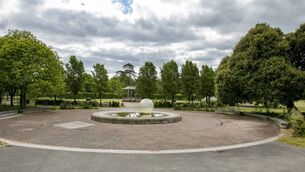
After a number of different people, including business people in Waterford in 1908 and also the early to mid-1920's purchased the Sports Field, then a number of people, besides Willie Walsh and others, pooling their own financial resources, acquired it for their purposes alone from the then-owner at that time , Michael Norris of Norris’s Pub.
In the late twenties, it then became officially known as "The Gaelic Field" as previous to that many other sports were played there such as soccer, rugby, cricket etc and was bought around 1930 by the Munster GAA Council on behalf of Waterford County Board with Willie a Trustee for the Munster Council and a year later it became a GAA field only, something that Willie fought and had many an argument with different people over the years.
When Willie Walsh died in August 1960, the County Waterford GAA Board later that year unanimously decided to name the field in his memory. And so we bring to a close one of Ireland's foremost Gaels and nationally minded too, who, it was stated at one stage that if you wanted to know anything about the GAA, contact either Croke Park or Willie Walsh in Waterford, he played a big part in the organisation and advancement of the National pastime.
He was honoured by the Gaels of the Urbs Intacta by being Chairman of the Waterford County Board for six years, 1930 to 1935, with an able hand but with great impartiality, and guided the destinies of the Eastern Board with marked ability and tact for years also, and was a Munster Council member.
He continued to take an active interest in the games which had always been dear to his heart, and was a popular figure at all the big games in the locality and adjoining areas up to shortly before his death.
His favourite pastime, besides the games of the Gael, was long walks, which kept him fit. He died on August 1st, 1960, after a long illness, aged 84. His funeral was of huge proportions, including GAA people from National and Munster Council, Old IRA, Gaelic League, Waterford Politicians and Public people, Businesses, Industrial and Commercial interests, and is buried in St Mary's Cemetery. Ballygunner.
His family's proudest possessions are memories of their invitations to Croke Park in 2016 for the Referees Banquet, remembering the Referees of 1916 with the photos in this piece.