'Paris has the Eiffel Tower and we’ll have Tonn Nua' - impact of Waterford offshore wind farms
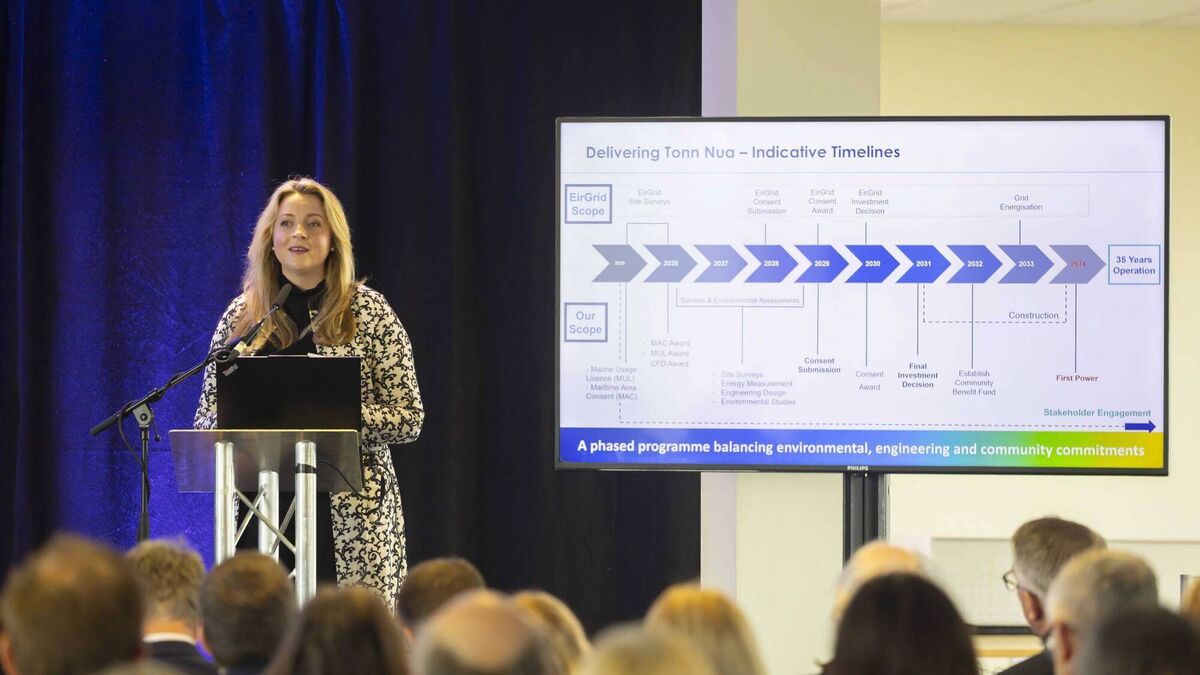
Tonn Nua project manager Moira Walsh speaking at the launch, at the Port of Waterford, of an economic report studying the potential impact of windfarms off the Waterford coast. Photo: Patrick Browne
Offshore wind could awaken the dormant economic force of the Southeast, according to figures involved in the delivery of a series of wind farms off the Irish south coast.
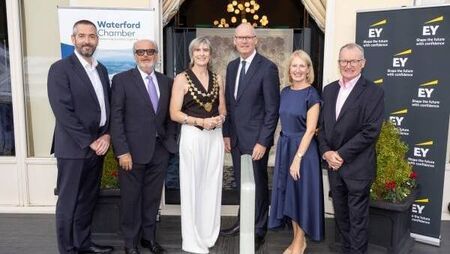
Businesspeople and politicians mingled at the Port of Waterford on Monday, March 9, as a new economic report was launched studying the potential economic impact of south coast windfarms.
According to the report, up to €500 million in community funds could go towards the Southeast for the construction of the new wind farms.
The South Coast Designated Maritime Area projects plans for four offshore wind farms. Tonn Nua, which will be delivered by a joint venture between ESB and Danish energy multinational Ørsted, will be the first of the wind farms delivered.
Construction is expected to begin off the coast of Waterford in 2030.
4,000 jobs could be generated at the peak of the wind farm’s construction.
The Gross Additional Value the wind farms could generate was estimated between €1.7- €2.2 billion.
Tonn Nua is projected to develop 900 megawatts of energy, enough to power around 800,000 homes.
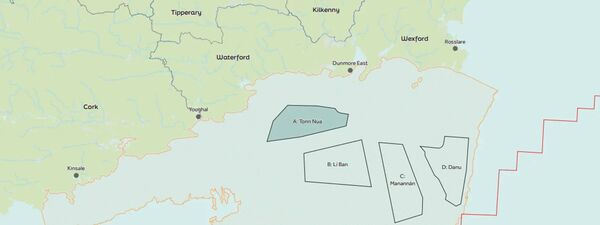
Overall, the total south coast energy development could produce 4.9 gigawatts of energy across all of its stations.
CEO of the Port of Waterford, David Sinnott, said that local politicians must be pushed to allow the progression of the wind farms.
The comments come as Waterford councillors questioned the Waterford-specific benefits of the project.
“We can sustain momentum by ensuring continuity, by avoiding stop-start cycles, by empowering decision makers to make what I call ‘sufficiently good decisions,’” Mr Sinnott said.
“We have the capacity. The challenge now is to create the capability, the systems, the coordination, the confidence that will bring certainty to the market and ensure competitive tension.”
Speakers framed the development as one that’s both a necessity and inevitable.
The development was promoted as crucial in the context of conflicts in the Middle East that have caused fossil fuel prices to balloon across the world.
Energy independence and the ability to produce energy for data centres were highlighted as a key pull factor in courting foreign direct investment.
“The challenge will be, somebody doesn't want to look at a turbine the height of the Eiffel Tower off the coast,” said Chair of the Ireland South East Offshore Wind Partnership Dr David Dempsey.
“I'd say it's better for your children to look at that than look at the Burj Khalifa or the Sydney Opera House when they wake up in the morning.
“This is going to happen. It's going to happen around the world.”
Dr Dempsey said a failure to act and develop swiftly could see wind farms as close as Wales or as far as the Philippines become market leaders in an industry Ireland is optimised for.
Project director for Tonn Nua, Moira Walsh, outlined the plan for the project.
2026-2029 will be dedicated towards the planning and consultant process, while construction is intended to begin in 2030 and finish in 2033.
Ms Walsh said the underwater cables that connect the individual turbines together could run as long as 170 kilometres.
“The supply chain is moving at pace, and we will just have to work with that supply chain to figure out which technology will be most suitable for here.
“Paris has the Eiffel Tower and Rome the Colosseum, and the Southeast will have Tonn Nua.”
The economic report cited Waterford Airport as a possible ancillary facility that could be used for the development of the wind farm via drone technology.
Infrastructural upgrades to the Port of Waterford were also highlighted as a key strategic enabler.
“What the report is saying…is that over the next 25 years, there's going to be €15-20 billion of capital expenditure in building out these projects, so that's significant,” said South East Energy Agency CEO Paddy Phelan.
“I suppose we're looking at this as not being jobs just for the next 20 years. We're looking at this stimulating those large, heavy industries, if they choose to come here.
“Jobs for my kids and my future grandkids, and the assessment is it's going to be five to seven generations of impact in terms of jobs in the Southeast region.”