Meet the shareholders: Hear from the people who invested in Waterford Airport
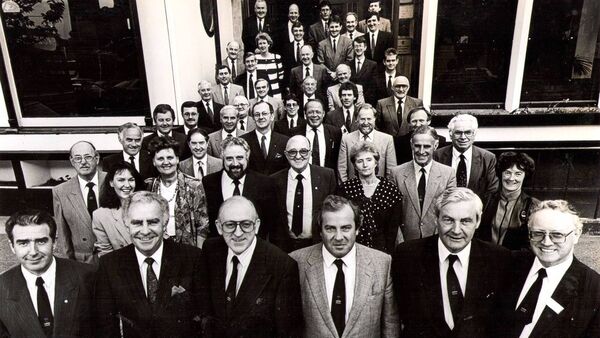
Key figures in driving Waterford Airport back in 1981 are pictured. Front row (L-R): Sean Power, J.P. McGoldrick, Tom Sheridan, Nicholas Fewer, Christy Ryan, Dominic Ellickson. Other figures in the picture include Liam Cusack, Antoinette Boland and Alfie Hale.
On December 8, shareholders agreed to dissolve Waterford Regional Airport Plc, the entity that has controlled Waterford Airport for the past 44 years.
Years of ups and sustained downs have led to the airport requiring financing from Waterford City and County Council to stay operational. The last commercial flights flew from Waterford Airport in 2016, with future commercial avenues failing to materialise.
Government complacency on the airport’s future cleared a path for an anonymous investor to swoop in with promises to inject €30 million into the airport.
The investor’s terms were clear- the asset must be completely unimpeded; the airport would have to be a blank slate they could mould in their image with absolute autonomy. Waterford Regional Airport Plc, and its 1,036,480 shares, must be reduced to ashes.
The assets of the old airport company will be disposed to Waterford Airport Ltd, a company that lists William Bolster as its sole director but that will soon onboard the anonymous investor.
Former Waterford council chief executive and board member of Waterford Airport Michael Walsh made the pitch to shareholders at the EGM: Any funding solution for the airport involving centralised government was untenable following years of drawn-out negotiations and costly business plans.
Private investment was the only way forward, even though the mystery investor and the cloudy information around their NDA made many bristle. A failure to move now could condemn the airport to an everlasting death following an extended bout of frail health.
For shareholders, seeing an airport built by Waterford’s own now pass over to an anonymous investor conjured up a myriad of feelings.
Here are some of those shareholders’ stories.
Sean Power, owner of Harvey Travel Ltd on Gladstone Street, was one of the driving forces in getting Waterford to the sky in 1981.
“There was a gentleman called Mr Michael Doody, a former city manager, that was keen to get an airport up and running, and there was a few of us got together… We’ll call it a committee,” Power recalled.
“It was somewhat like raising money for a football club or a hurling club at the time, whereby there was desire for Waterford to do well, and at that stage, we were told by the government that if we raised a million pounds that day, they would back it pound for pound.”
Each share equated to an old English pound. Power owned 16,875 shares. Using the Bank of England’s inflation tracker and the European Central Bank’s exchange rates, Power’s shares would be valued at roughly €75,000 today.
How does he feel about those shares becoming worthless?
“I wish this new company every good wish, because there was no other game in town, and when there wasn't another person or people prepared to sort of say ‘I'm going to back this airport’, then, as I see it, it's very good for Waterford and very good for the South East to feel that we have an airport.
“I wouldn't have any resentment or anything towards being a founder member- That's phase one. This is another phase down the line, and in life you have to move on and look to the future. Forget about the past.”
That sense of community activism acts as a common thread amongst the shareholders, regardless of their shareholding size.
Following the optimism of the ‘70s with Ireland’s accession to the European Community in 1973, economic hardship calcified in the 1980s.
An ERSI report showed the rate of unemployment in 1980 had doubled from 1973 levels to 7-8%. It was a time when income inequality had begun to fester.
The opportunity to uplift Waterford and simultaneously build a bridge to the outside world was well-received.
Piltown Labour councillor Tomás Breathnach owned 100 shares in the airport. He said the fundraising drive offered an opportunity to show palpable support for the area, rather than merely vocalising it.
“A lot of us in the South East felt that not only was the country going badly, but the South East was going particularly badly, and needed people to pull together.
“It seems a small amount, but at the time, to come up with 100 quid as it was, I won't say substantial, but it was significant.
“I call it the new regimen…If that's going to deliver an airport to the South East in line with the vision that we had in the 80s, then if the last of my 100 quid is the price I have to pay for it, it’s something that I have no difficulty with.”
The funding drive was in part powered by Breathnach’s late brother, former mayor of Waterford City and County Council Jack Walsh. Other key players included businessman Dominic Ellickson and Ryanair co-founder Tony Ryan.
Former Fine Gael senator Katharine Bulbulia was one Waterford power broker who was approached by Ellickson as he tried to leverage support for the airport. She bought 300 shares under the name of her three children.
“[Ellickson] came, and he was sort of rattling the box to drum up some money from people to get the thing going… he was the sort of man if he asked us for something, we wouldn't dream of refusing,” Bulbulia said.
“I think [the airport fundraisers] probably approached every professional in the town, people they felt had a reasonable income, that were working with the public. It wasn't a bad thing to be seen to be investing in the future of Waterford.”
Waterford footballing icon Alfie Hale (500 shares) was tapped by Sean Power to get onside of the airport.
“It was as much for Sean as it was for Waterford that I was subscribing. I would have looked at it from the point of view that we were one of the small retail outfits at the time, and if we could help, it’d be fine,” he said.
“So many people have changed their minds on whether they wanted the airport back again, and other people just would love, absolutely love to open an airport again and have independence of some degree, to fly into different countries, which we had for a short time.”
While the motion to dissolve the airport company’s shares passed comfortably- 99% of the present shareholding at the EGM voted to dispose of the company’s assets to Waterford Airport Ltd- many took the stand to express discomfort with the deal.
Clodagh Berserford Dunne, a Waterford-based poet, had shares passed down through two different generations.
“My grandfather- although he would have loved the idea of being part of something so huge- voted as a commercial man who would have done so and taken a punt in the hope that his shares might now be worth something because of the potential that this anonymous US investor clearly sees in the airport.
“If we are such an encumbrance to this potential shareholder, why isn't there a price put on us as an encumbrance to be removed?”
CEO of FLI Global, Michael Flynn (250 shares), also raised issue: “The risk taken by all shareholders here initially to set up Waterford Airport is no less than the risk being taken by the current investor. There should be a mutual agreement to go forward together.”
Michael Tebay (250 shares) said: “My reading of this document is that somebody wants to put their hands in my pocket and take the shares that I have at the airport away from me, and as far as I'm concerned, my shares are not going to go away.”
Tebay’s call to dissent was met with vocal approval across the room but was ultimately soundly defeated.
Perhaps the happiest person to see their shares deteriorate was William Bolster. With 270,623 shares, he was comfortably the largest shareholder in the business.
He said most would’ve been bought from the shares that previously belonged to the Ryan family more than a decade ago.
“My ambition was always to end up where we are now, as to extend the runway and have commercial traffic going through it,” he said.
“I suppose unfortunately, with the lack of support from the government that took many, many, many years, and here we are now having to do this transaction to get the job done and be self-sufficient.”
There have been false dawns before, as the same system that brought the airport to life- a hybrid government/private investment- continually faltered as the Comer group grew frustrated with government inaction.
Now, after almost a decade without commercial flights, Waterford Airport seems to be at its closest point yet to becoming a genuine commercial asset.
Many of the people who invested in Waterford Regional Plc in 1981 have since passed away, but their future generations may bear witness to the airport’s revival.
Whether it will still taste as sweet knowing that the airport’s autonomy has transferred from Waterford shareholders, and into the hands of an anonymous investor via a cloudy transaction, is anyone’s guess.