Is rural Waterford moving too fast for its own good?
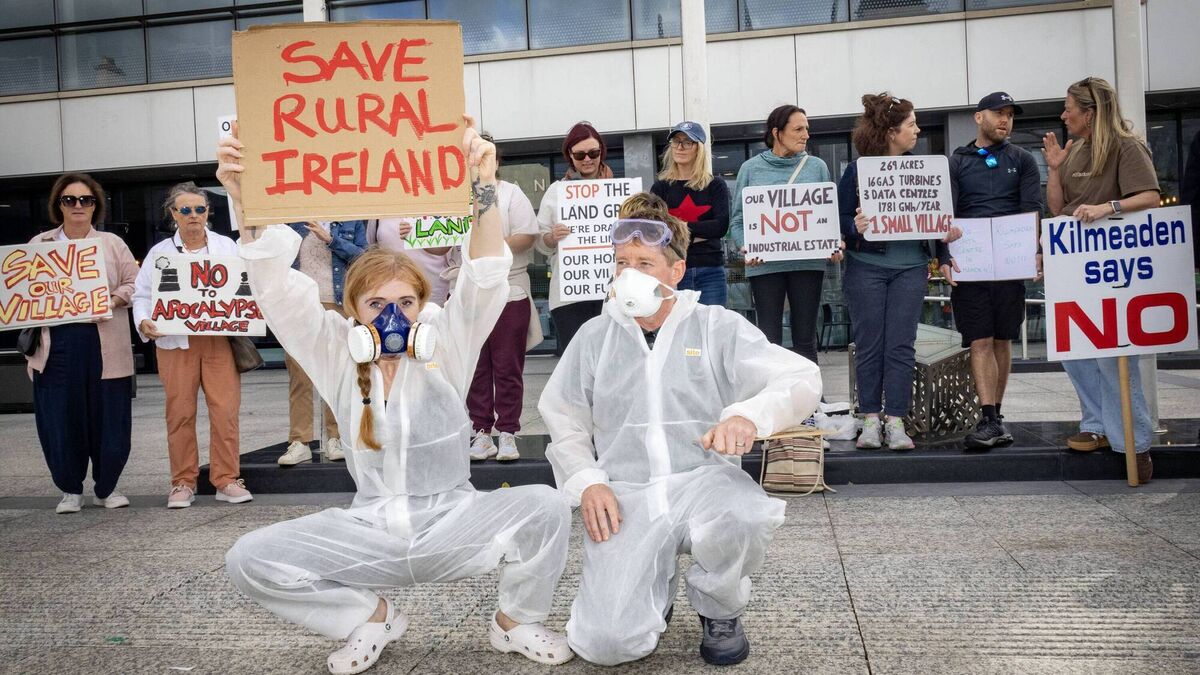
Mary-Sue and Niall along with residents of Kilmeaden, during a protest outside the planning offices of Waterford City and County Council in recent weeks. Photo: Joe Evans
Agricultural lands which surround the Comeragh Mountains in mid county Waterford have become a popular destination for developers of large-scale energy projects.
In recent years, there has been an unprecedented scale of solar farm, wind turbine and data centre planning applications in this region.
Amidst this trend, one developer flew too close to the sun in their attempts to raise the stakes, when they submitted a planning application which is believed to be the second largest ever submitted to Waterford Council.
It included provision for data centres, wind turbines and solar farms, as well as apartments, supermarket, gym, café, health centre and more, in the small, rural village of Kilmeaden in the middle of county Waterford.
Over 500 locals made submissions of appeal during the planning process, and hundreds attended protests in Kilmeaden itself and at the planning authority offices in Waterford city.
Last week, the local authority's decision to quash the planning application was met with a collective sigh of relief from locals.
Following on from this debacle in Kilmeaden, concerns are now heightened regarding the disproportionate level of solar and wind farm developments across the Comeragh area of county Waterford.
Largescale solar farm planning applications have been submitted en-masse here.
Separate applications have already been approved in Clonea-Power and Stradbally, whilst there are currently live applications being considered by the planning authority across multiple townslands addressed to both Portlaw and Kilmeaden.
The sheer scale of these developments has been sharply criticised by residents, farmers and elected members, who say that small rural villages and good agricultural land should not be used for largescale industrial type projects.
Cllr Seanie Power, Cathaoirleach of the Comeragh Municipal District, said that Waterford farmers have become increasingly annoyed.
“It’s crazy”, Cllr Power said, “Clonea-Power, Stradbally, Kilmeaden; there’s a huge amount of good agricultural, food producing land being given up to these solar farms."
Mayor of Waterford City and County Council, Cllr Liam Brazil, shared a similar sentiment, saying: “Years ago, farmers used to try make good land out of bad land, now, we have the best land and its being given up for solar farms. Land is scarce, and our food chain eventually will get tighter and tighter because of this.”
Under Ireland’s planning framework, there are currently no national regulations for solar farms, with all 31 local authorities determining their own planning regulation.
Ms. Aisling O’Sullivan, Senior Planner with Waterford City and County Council, said that in the absence of national guidelines, the local planning authority must deal with every solar farm planning application on its own merit.
“Mid-Waterford is experiencing a large share of solar farm applications” she said, “and the planning authority here has been calling for national guidelines in relation to these solar farms for a long time. We have climate targets and obligations, and the government policy is very strict in relation to that."
Portlaw councillor Declan Clune, said that the local authority cannot continue to deal with such large scale solar farm applications.
“There are a large number of solar farms proposed in a relatively small geographic area in the Comeragh District, and I believe we have to ask some questions" he said.
“My concern is not with solar energy itself, we all recognise the importance of renewable energy, my concern is the scale, concentration and impact of these developments on one local community.
“We can’t continue to assess each application in isolation, without properly considering the combined impact on agricultural land the rural landscape, neighbouring homes, local roads, and the people who live in these communities.”
The recent Kilmeaden plans have exacerbated another concern; data centres.
Amidst this, a motion is due to be submitted to all 32 elected members of Waterford City and County Council, which calls on a pause to the granting of data centres across Waterford.
Cllr Declan Clune said he will be submitting the motion in the coming month.
Specifically, he will be calling for a halt to the granting of any further data centres until the completion of a comprehensive national evaluation of their environment, energy, infrastructure and community impacts.
He said: “The people of Kilmeaden have demonstrated what a united community can achieve, it is now our responsibility as elected representatives to ensure their concerns, and those of similar communities, are heard on a national level."
"The wider issue of largescale developments in rural communities remains."
The mega planning application in Kilmeaden has been refused locally, and whether or not the developer decides to appeal this decision to the national planning body remains to be seen.
In the meantime, Kilmeaden is a small village which continues to experience significant growth.
A native to the area, Cllr John O’Leary, explained last week that housing in the village is rapidly expanding, and there is now a need for developers to prioritise building community facilities to support the population growth.
Meanwhile, Cllr Brazil said that the local authority must now put in place a plan for Kilmeaden to support this growth.
“Kilmeaden is going to be as big as Dungarvan or Tramore, and there is currently no plan there to show where we’re going" he said.
Senior Planner, Aisling O’Sullivan, said:
“Given its location on the periphery on the metropolitan area, we do need to look at it. Kilmeaden will be getting a special focus, given its location, and given the development pressures it has come under over the last number of years.”