Housing the Déise: One off or not one off, that is the question
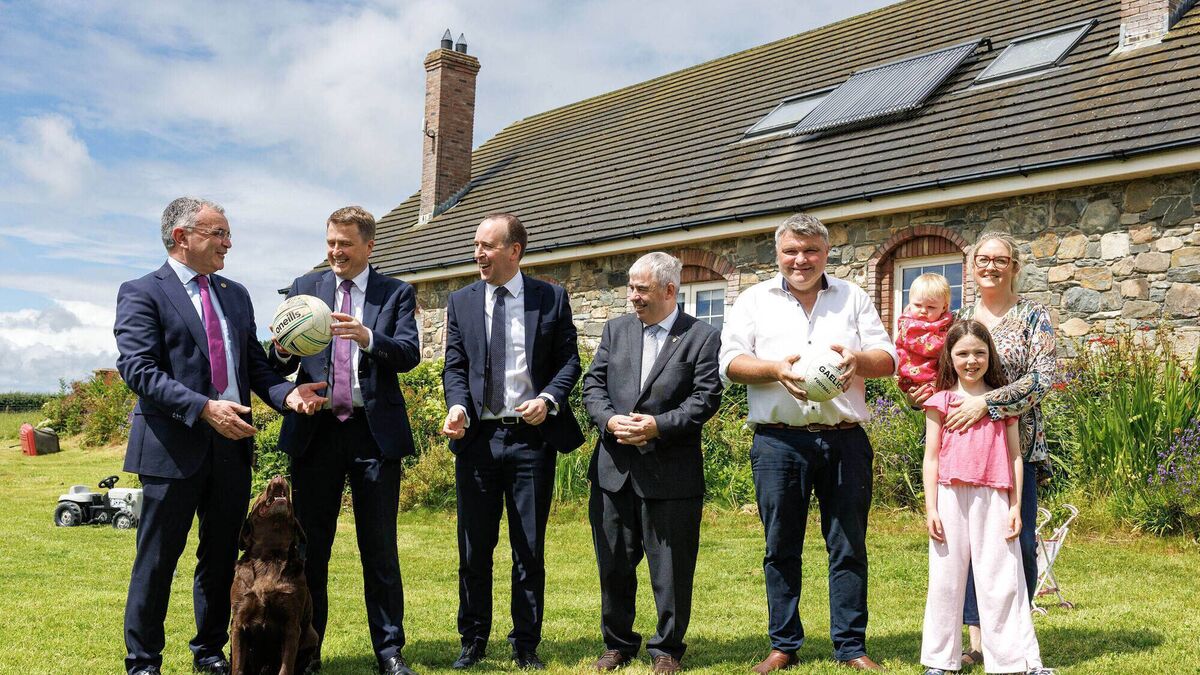
Just another political football? Minister John Cummins and colleagues at the launch in Waterford of plans to revitalise rural housing planning policy. Photo: Marc O'Sullivan
In rural areas, it is a story as old as the hills.
The son who returns from across the water and wants to build a home on the family farm, but is denied planning permission.
Or the daughter who is confident of a dormer on her parents’ land but is also turned down because of a lack of identifiable housing need in the area.
It wasn’t always like this, planning as a contentious battleground between the well-meaning applicant and the allegedly draconian local authority, a battleground with its own specific language: ‘back land development’, ‘eircode lottery’.
Generation Z will be unfamiliar with the terms ‘ribbon development’ or the bête noire of environmentalists in the Celtic Tiger era, ‘bungalow blitz’.
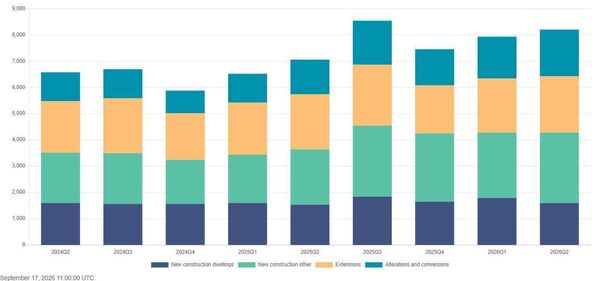
It is arguable that the farmer’s son who is today refused planning permission is as much a victim of the excesses of the Celtic Tiger decades ago than a planner’s mere whim.
But long before the Tiger roared, legislation – extending back to 1935 – had successfully sought to regulate the building of one-off houses in the countryside.
If the Celtic Tiger era Fianna Fáil glorified financial gung-ho, property inflation and excessive consumer spending, the 1930s era Fianna Fáil was the polar opposite: private wealth seen as a baseline for living day to day, and not needless accumulation.
That rugal vision, once transmuted from Dublin into rural Ireland, gradually became more austere because of a dearth of economic investment. Real national income rose by just 8% in the 1930s, compared to 40% in Britain, so the Irish by the thousand crossed the sea to the promised land.
It was a trickle which became a torrent: half a million. Three out of every five children reared in 1950s Ireland would emigrate, the country sharing a distinction with East Germany as the only two in Europe whose populations were in steep, annual decline.
With rural Ireland denuded of its young, property growth in the country came to a standstill. In the 1970s, the tide was reversed. The catalyst was Ireland’s delayed entry into the European Union. Suddenly, the rising tide in the country’s fortunes – albeit with a short shelf life – increased the number of new one-off houses in rural areas.
It wasn’t exactly a free for all for builders and new home owners, but Ireland was on the right path to getting there.
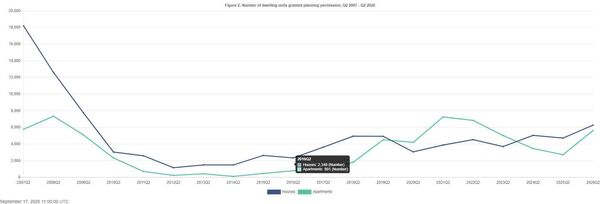
Ireland is not a country to do anything by halves: planners opened the taps and one-off houses spread like wildfire across every hill and dale – commonly on top of the hill – so that by 1997 – when the Celtic Tiger was flexing its muscles – the number of new bungalows stood at 50,000.
Hence the expression, ‘bungalow blitz’. Those two words would shape a generation of planners who materialised with a different set of priorities - sustainable rural housing - in the aftermath of the Celtic Tiger implosion.
To planners, the excesses of the Celtic Tiger meant one thing: from property boom to property bust. From 90,000 new units in one year (2006) to 3,000 ghost estates in 2010. And the cost to the taxpayer: €64.1 billion invested to save Irish banks which had over loaned.
Which brings us to 2026 and the daughter who wants to build a family home on family land, and is turned down.
This is Senator Joe Flaherty’s experience. “I have seen planning applications in recent months where a lady had a six-bedroom house. She is separated. Her son was coming back from the UK with his young family. She wanted to build a small house on the farm and she wanted the son and his family to move into the large house. That made eminent sense to me but it did not make any sense to a planner, who said that because she had got planning for this house 25 years ago, she was not entitled to look for planning for another house. Fortunately, she reapplied and she got the planning. I had another instance where the planner came back to somebody and, because they were looking for a new house on their father's land, they were told there was no identifiable housing need in that area.”
The written-in-stone perception of an inconsistent planning policy at local government level is widespread.
“I could walk into Wexford tomorrow morning and sit down with a planner and discuss my planning application. In Wicklow, I will submit an email and get sent a link to a document. I think we need consistency so rural people can sit down with a planner and go through everything they need to go through, namely, qualification, landscape, transport and environment, so that they know what they are getting into,” said Senator Pat Casey.
The topic has also been lighting up online forums.
“Waterford is known as one of the most stricter counties when it comes to interpretation of the National Planning Framework's strategy regarding rural building. It's come home to roost with a family member recently whose partner, from a rural area, got refused planning on a two-bed house solely due to the site being just outside the 10km limit from her home place to satisfy 'local housing need'. It's basically broken her heart as it was the only site closest to her family, as mountains are pretty much in the way; in addition to the fact that there's little to any land for sale in that area in general,” wrote one Reddit user this year.
“I get that there's a need for local authorities to set out a plan for how the county is to manage housing over time but if you look at towns like Dungarvan where only one housing development has gotten planning permission in the last five years while there appears to be little to no land zoned for housing in towns and villages - yet at the same time they won't let people from the countryside build in the countryside.”
However, if the government has its way, changes are afoot. The gloves are coming off.
Spearheading a revolution in planning strategy is Waterford’s John Cummins, Minister of State for Planning & Local Government.
So what’s on the cards?
In the summer, Minister Cummins announced a 180-degree reversal to rural housing planning policy with serious – but apparently advantageous - repercussions for rural and Gaeltacht areas.
Specifically, for the returning emigrant or the farmer’s son or daughter, he is seeking to replace planning barriers with practical measures to promote the planning applicant ahead of red tape.
“We are restoring fairness and common sense to the planning system, giving local families, young people and returning emigrants a real opportunity to put down roots in the places they know and love,” explained the Minister.
In his crosshairs are rural areas, including townlands with a population of below 1,500, which have suffered from what he refers to as “overly rigid and restrictive planning practices.” And his proposal: the draft National Planning Statement will encourage one-off homes in the rural area applicants are from, even if they own a house in a town. Subject to meeting normal planning considerations, all an applicant requires is proof of an economic or social need.
Which is what, precisely?
The primary means of earning a salary is dependent on living in a rural area to be close to employment – farming, teaching, equine – although remote working as a sole bread-winner doesn’t count, which on the surface is at odds with the spirit of the Work Life Balance and Miscellaneous Provisions Act 2023, for whom flexible working arrangements are recommended for carers. Many rural areas, after all, are entirely bereft of child care facilities.
More flexible for anyone who has lived in the area for a minimum of seven years, not just now but at any stage, or building 10 kilometres from the current home. If an applicant has connections to the Gaeltacht, all the better: speak Irish and show a genuine housing need, the requirement is living five years within three kilometres of the proposed building.
“I’m removing barriers that have caused frustration for too long and introducing common-sense measures that put people ahead of red tape,” said Minister Cummins.
“We want people from rural areas, which will now include villages and towns with a population of below 1,500, the opportunity and flexibility to be able to live in the communities that they have always called home.”
At first sight, these changes are the biggest overhaul of rural housing rules since the Celtic Tiger, a radical departure from what the Minister has condemned as planning policy which held rural communities back.
Which begs the question that if planning has been so restrictive, why hasn’t Fine Gael, in government since 2011, acted before now?
The answer, of course, is expediency, in that – as the coalition was reminded this year with the public protests against fuel rises in April – all politics is local. The year of the grassroots rebellion targeted a government with an unprecedented number of dyed in the wool, local level focused, independent Ministers of State: up to half a dozen.
Not as close to the levers of power as Minister Cummins but not without influence is the Cathaoirleach of the committee on budgetary oversight, Independent deputy, father of four Richard O’Donoghue, who lives in the small village of Granagh.
He believes the planning reforms, by “helping local people remain in the areas they call home,” will make the planning system both consistent and fairer. Therein is the crux: what constitutes home?
Its meaning is being redefined.
And it is important, what constitutes a home, because Deputy O’Donoghue is calling for an end to the so called ‘Eircode Lottery,’ a suspicion among rural politicians that a property’s postcode can have a negative impact on the outcome of a planning application.
Minister of State at the Department of Housing, Christopher O’Sullivan is in agreement: “It does not mean you have to have been born in the field where the site is, or maybe the field next to it, or in that postcode but rather the community you are part of, that you grew up in, played sports in, went to school in and worked in. We need clarity and flexibility when it comes to interpreting that.
“It means if you have a bit of a landholding and there are a number of sites, you are not expecting to get permission to build on the top of the tallest hill there but we cannot be sending people down to the lowest, darkest, deepest hole either.”
With minimum political objection to the proposed changes – the draft National Planning Statement will undergo the relevant environmental screening and new changes will come into effect later before December - is everything rosy in the garden?
Not by a long shot. For a start, the exclusion of remote workers might come back to bite the Minister: according to the Central Statistics Office, there are 990,600 people remote working in Ireland, 34.9% of the workforce.
Also, there is the question of funding essential services. By building solo houses in out of reach places, there will be increased demands on the supply of water, the maintenance of roads, the capacity of service providers – like waste disposal - to cope.
The Green Party has voiced concern that the proposed changes will place further demands on service providers, increase the burden on local authorities by placing further pressure on vulnerable groundwater and add risk to public health.
Public health? Specifically, how.
Senator Malcolm Noonan pointed to Environmental Protection Agency analysis of septic tank inspections which found a high failure rate (53%) despite a low level of inspection of the 500,000 estimated on site treatment systems.
“This is leading to increased vulnerability of the 180,000 private wells and 370 Group Water Schemes which is a public health risk. If government is hell bent on increasing rural housing output on this scale, it must in tandem make the septic tank remediation grant more easily accessible and introduce a regime of free well water testing for private wells. Such measures would reduce contamination of both drinking water and watercourses over time.”
Limited resources and solutions in a time of emergency have this in common: vulnerability. Earlier this year, Storm Éowyn left 800,000 ESB customers without power, leaving many, in isolated rural areas throughout the country, without electricity for over two weeks.
"We have a lop-sided country where pockets within the west and midlands are experiencing population decline and as we move east, we can see many rural areas blighted by urban influenced one-off housing,” added Senator Noonan.
“This is placing a strain on road infrastructure, waste collection services, emergency services and postal services. Oil price increases not only impact on the commute from these places where no public transport options are available but also on the cost of resurfacing and maintaining local road infrastructure.”
He criticised the proposed draft National Planning Statement as “poorly thought-out” and not a plan led approach to land management.
In his criticism, he is not alone.
“In the middle of a housing shortage, any barrier to building starts to look like something that should be removed,” says Professor Frank Crowley, Cork University Business School.
“That argument has force, but it also stops short of asking a more difficult question. Not whether people should be allowed to build in rural areas, but what that choice costs and who bears them. Once you move beyond the question of eligibility to build in the countryside, one-off housing starts to look less like a planning issue and more like an economic one.”
For the National President of Macra, Josephine O’Neill, planning is the key.
“Enabling young people to live and raise families in rural areas is essential for maintaining vibrant communities, supporting local economies and ensuring the long-term future of the agricultural sector.”
The young have a key role in ensuring rural vibrancy and social sustainability in their community, having experienced “significant challenges” for so long in attempting to build a new home under the current guidelines.
No party to this debate with views about the rights and wrongs of the proposals has a monopoly on the projected outcomes and consequences of, on the face of it, a slow mushrooming of low-density building.
“Public infrastructure must stretch further, with roads, broadband and electricity lines maintained for fewer people,” said Professor Crowley.
“Public services become more expensive to deliver. Everyday life becomes more dependent on cars, with constant calls for more roads. These are not marginal effects, they accumulate over time and become built into how the public system operates.”
Senator P.J. Murphy is cautious.
“Serious consideration must be given to how we picture the Irish countryside in the future. We must ask whether we are willing to reopen Irish rural roads to the prospect of ribbon development. Have we learned lessons from what happened in many areas during the relaxed planning rules of the early Celtic Tiger years?”
Over 540 of rural villages have no municipal wastewater infrastructure.
“While there is light at the end of the tunnel for some of these villages through the new developer-led wastewater infrastructure guidelines, many villages will not qualify under the guidelines as they currently stand due to the lack of river or above-ground drainage in those villages,” he explained.
“If, as a State, we are unable to service our rural villages to a degree that allows them to develop and meet the housing needs of the local population and, at the same time, are unable as a State to generate guidelines or specifications to allow private contractors to do so, then we certainly have an obligation to facilitate the building of homes by rural people in the hinterlands of these villages.”
Waterford’s Senator Joe Conway is unambiguous about the new rural housing planning policy, referring to the “difficulty that we have had over the years with the planning regulator, the lack of consistency and all of those daft things that impacted on our lives as councillors trying to get something that was reasonable. … we should be delighted that we have an antidote to it now.”
Between 4,000 and 5,000 one-off rural homes are built in Ireland every year, and the government expects, with these changes to planning, that the number is set to increase. But whether changing the goal posts is a good thing or not is questionable.
“One-off housing is often justified in terms of rural need, particularly for those whose livelihoods are tied to land. In some cases, this is valid. But the reality is less clear cut. Today, just one in 25 workers in Ireland is employed in agriculture, forestry or fishing, yet last year roughly one in every six new homes built was a one-off house,” pointed out Professor Crowley.
“It suggests that what is being framed as rural necessity is often something closer to a preference about where to live rather than a requirement tied to how people earn a living. In my opinion, there is absolutely nothing wrong with that preference, but the key issue is that the preference is not neutral in its costs and effects.”
One-off housing in Ireland has always been contentious on the basis of inconsistency in planning decisions, the perception that while a minority has availed of the goodwill of planners, the majority have not. Minister Cummins' goal, in the weeks and months ahead, is to level the playing field with all the political armoury he can muster because, after all, he is a member of government aiming to build 300,000 new homes by 2030.