‘At the end of the day, we are confessing what was true’
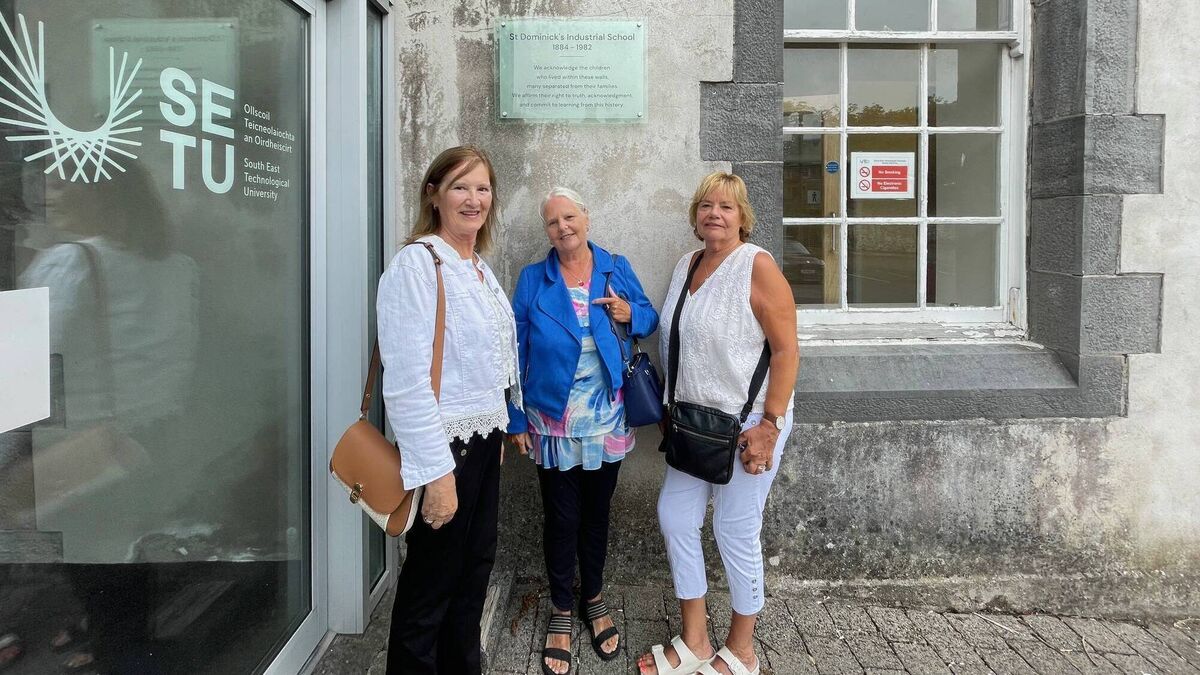
Noreen, Kay and Teresa
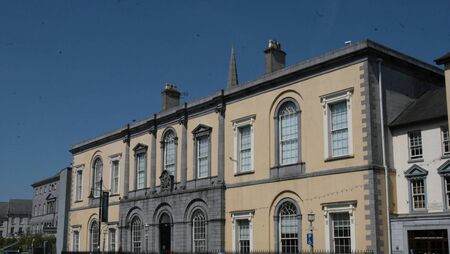
At the corner of Manor Street and Cork Road in Waterford City is the former Magdalene Laundry, Convent of the Good Shepherd and Saint Dominick’s Industrial School.
The Waterford Memories Project described the school and laundries as part of a nationwide network of ‘coercive confinement’.
The buildings now form the College Street Campus of South East Technological University (SETU), but for most of the 20th century, they were ‘home’ for many children and women.
Saint Dominick’s Industrial School operated between 1884 and 1982. The Good Shepherd Sisters raised girls as young as 3 years until they reached their late teens. Many of the girls boarded there, did not receive a formal education, and spent most of their time doing manual labour under the harsh surveillance of the nuns.
In early 2026, SETU installed special wall plaques commemorating the children and women who lived inside these walls. The plaques recognise the residents who once ‘lived and laboured here without consent or recompense’.
One plaque ends with the statement: ‘We recognise their lives, resilience, and humanity, and commit to learning from this history.’
In mid-August 2026, I met with Teresa, Kay and Noreen. All three women were former inhabitants who grew up in St. Dominick’s Industrial School. Each woman had a similar and sad story to share about how and why they found themselves living within the confines of The Good Shepherd Convent.
In 1958, Noreen, aged four, lost her mother. Two years later, she and her brother were made wards of the court in Co. Waterford. On that same day, Noreen was escorted from the courtroom by a social worker and taken to live with the Good Shephard nuns. She would remain there until the age of sixteen.
Noreen said: “If you lost your mother, your chance of a family life was slim. For me, it felt like a punishment being there because my mother had died.”
Teresa
lived in Tyrone with her mother and other family members. A priest abducted her and her mother from their home and brought them to Newry, in the North of Ireland. It was in Newry where mother and daughter were separated.
Unknown to each other, they were sent to The Good Shepherd Convent in Limerick. Teresa’s mother was sent to work in the Magdalene laundries because she had given birth to Teresa out of wedlock. Unknown to her mother, her daughter resided on the other side of the convent for several years. At age five, Teresa was transferred to The Good Shepherd Convent in Waterford, where she would spend the next 10 years. Teresa wouldn’t get to see her mother again until she was in her teens.
Kay was separated from her siblings and father as a toddler following the death of her mother. Her own father continued to be present in her life. At the time single parents had no legal right to raise their own children. Luckily for Kay, her father visited her regularly at St. Dominick’s.
Thankfully for the women, they went on to have their own families, jobs and homes while trying to overcome their traumatic pasts.
Walking around the remnants of their fractured childhoods was not an easy experience. Meeting up with each other brought back a flood of emotions. Several years ago, they had reconnected on the internet after decades of silence.
Two of the women travelled from Dublin. It was a very special journey for them as they were eager to view the newly erected wall plaques. They were cognizant of the importance of seeing their own stories being recognised.
Saint Dominick’s Industrial School closed in 1982, the same year Kay gave birth to her first child. The last Magdalene Laundry in the country closed in 1996.
For most of her adult life, Noreen didn’t speak about her upbringing in the home, not even to her family or closest friends.
In recent years, however, she wrote and published a book titled, ‘Ward of the Court’. The story recounts her childhood detailing life inside the institution.
Walking through the red cloistered halls, Noreen pointed out the first time she saw a nun. It was Mother Teresa. Noreen remembered how only her face and hands were visible.
Mother Teresa walked her to a steam-filled laundry room with six wooden tubs lined up against a wall. She introduced her to another nun, Mother Cyra.
Noreen recalled how the nun in charge of bathing her, told her to remove the donated clothing and the treasured red coat her grandmother’s neighbour had given her. She was handed a long, heavy grey serge pinafore to wear before climbing into a small wooden tub. She never saw her red coat again.
“You come from the country, so, you’ll be needing a good scrubbin’,” the nun
said.
“She was unnecessarily
heavy-handed and rough,” said Noreen.
“After my bath, she chopped all my hair off.
“The day of my arrival at St. Dominick’s was a long and confusing one; a day embedded deeply in my memory.
“After my bath and haircut, I was taken into the refectory for supper. A short, wiry nun, named Mother Concilio was in charge.
“She
had
a long skinny black whip hanging from her leather waistbelt. Seeing her unfriendly facial expression and whip, petrified me. The refectory was large, and at least 50 girls stood around laminated tables; pink, blue and green, and curiously gaped at me.”
Teresa remembered the brutal treatment doled out by numerous nuns. Recalling one incident, she got thrashed over a comment she made about a mint the nun was sucking on.
“‘Lovely smell of your mint, Mother’…well, the hell I got because I caught her chewing a mint,” said Theresa.
Meanwhile, Kay said children had to address the nuns as ‘Mother’.
“When we were children, we didn’t call the nuns, Sister, we called them, Mother, which was weird,” she said.
“Some of the nuns could be extremely cruel. They just seemed to take pleasure in beating us and tormenting us.”
Noreen then added: “Besides the intimidating habits, wimples and long black veils the nuns wore, it was their hands I feared most. They used whips, belts, sticks, and fists to control us, and made us feel useless with the condescending words they spoke to release their frustrations.”
The church was the most prevalent part of the girls' daily lives. They attended mass at 7am every weekday morning, Sunday to Friday. Saturday was the only day the girls weren’t required to attend mass. It was used as a cleaning and bathing day.
All 50 girls bathed on Saturdays. Sometimes the bath water was so dirty, it made no sense to bathe in it. They
were issued a toothbrush once a year on New Year’s Day. For those that lost their toothbrushes, they had to resort to using their index fingers to clean their teeth with the red carbolic soap provided.
To make up for the free mass day, they had to sit through two Latin masses on Sunday. This was followed by religious instruction for the older girls and Benediction.
Mondays at 5 pm all girls who had made their First Communion, lined up to confess sins they committed in the previous week. While waiting, they discussed the sins they were going to tell the priest, making sure not to confess the same ones. As they didn’t have any sins to confess, most of the girls made them up; laughing and talking in the church, forgetting to genuflect, or forgetting to say prayers; these were the ‘sins’ most told to the priest.
Kay talked about the strange liquid concoctions that filled a third of their teacups, served before breakfast every second Sunday of the month.
“After saying the ‘Grace Before Meals’ prayer, we were required to swallow the liquid [laxative] as one of the meticulous nuns checked the bottom of our teacups. We were not allowed to sit down until the cup was emptied,” Kay recounted.
“This foul-tasting liquid
was ostensibly to ‘clean out the bowels, resulting in desperate rushes of all 50 of us to get to one of the three toilets on the first floor.
The line was long and the wax toilet paper was scarce,” added Kay. “It had the most disgusting poisonous taste; I’d never forget it.”
They were served the same food most days, usually cabbage and mashed potatoes. Sometimes they would find dead slugs cooked amongst the cabbage. The girls nicknamed one dish, ‘stringy meat.’ It was salted mutton and had a thick ring of yellow fat around it. It was very hard to chew and gave off a strong gamey odour.
“If you didn’t eat what was served, you went without,” said Noreen.
The first black and white TV was introduced to the girls upon the death of JFK in 1963. In the rare times when they were allowed to watch television in the TV room, girls were told by a supervising nun to stare into a wall lest a ‘kissing’ scene come onscreen.
Across the way from the children’s home was the Magdalene Laundry, a place for ‘fallen’ women and girls. Girls as young as 12 were living in the laundry.
Kay said: “There were young girls put away for doing nothing at all, maybe they had said hello to a boy.”
The inmates of the Laundry, known as, ‘Penitents,’ were kept separated from the children of Saint Dominick’s. The stigma of being an unwed mother, often resulted in families shunning their daughters.
Noreen stated: “Every two weeks, the nun in charge of us waited inside the cloistered doors of St. Dominick’s for the delivery of several white sacks of laundered linen and clothing. They were brought there by two Magdalene girls. The same girls never dropped the laundry off. One girl was usually much younger than the other.”
The Magdalene girls had their own closed-off area for receiving Communion and giving confession.
Teresa said: “They were told they were sinners that needed to repent.
“My mother was told if she told anyone about me, she’d be stoned, in a big field, like Mary Magdalene.”
Kay then commented: “Imagine a nun telling a mother that when her child is still alive.”
Ironically, although these girls were considered ‘fallen women’ they, like the children of St. Dominick’s were never told anything about the facts of life.
Sex was a sin and the word was never uttered. Due of the lack of love and tenderness in their childhoods, many girls fell pregnant after leaving St. Dominick’s and ended up once again institutionalised inside the walls of The Good Shepherd Magdalene Laundries.
Noreen said: “I was a scaredy cat and tried to avoid getting in trouble at all costs.
“Because of what I had seen happening to certain older girls, I was aware there was an intolerance for insubordination. If reported to the head nun, chances were you might possibly be sent to a reformatory school. Bad behaviour was labelled ‘insubordination’.
The three women remembered one kindly nun, Mother Goodcounsel. She would sneakily hand out sweets through the window when the head nun wasn’t looking.
After walking around the buildings, the ladies went to the nearby graveyard to pay their respects. As they looked at the graves, they reminisced about the kindness and good nature of only a handful of nuns. All three of them spoke highly of Mother Theresa. They remarked that of all the nuns who supervised them, Mother Theresa was the most civil and loving towards the younger children. Alas, they couldn’t find her gravesite.
Kay said: “You couldn’t paint them all with the same brush.
“Some of the nuns were really nice. It couldn’t have been an easy life for them either.”
Teresa agreed: “Let me tell you, at the end of the day there’s always a number of rotten apples in the barrel.”
Teresa, Noreen and Kay then acknowledged SETU for erecting the plaques, commenting: “We would like to sincerely thank SETU for kindly erecting the plaques in recognition of both institutions at the former Good Shepherd Convent - St Mary’s Magdalene Laundry and St. Dominick’s Industrial School.”