A ‘Monster meeting’ in the city, July 1843 – the biggest gathering in Waterford’s history
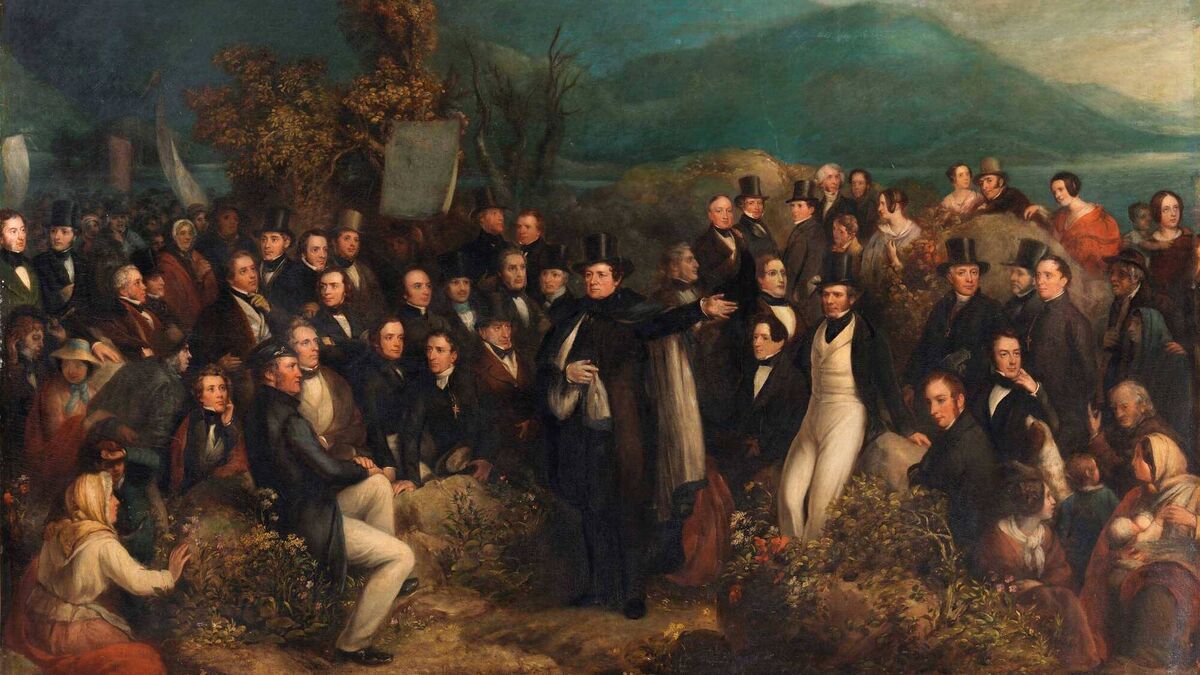
In 1843 Irish artist Joseph Patrick Haverty painted a scene from a ‘monster meeting’, with Daniel O'Connell pictured centre, at Clifden, Co. Galway.
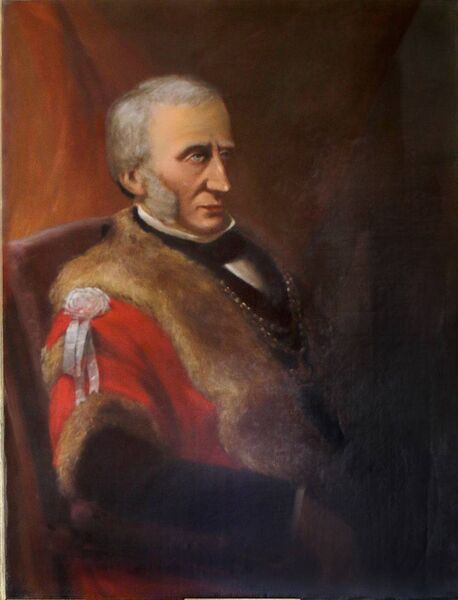
Last year marked the 250th anniversary of the birth of Daniel O’Connell.
Born at Carhen, near Cahirciveen, County Kerry, on August 6, 1775, he was to dominate Irish politics from the 1820s until his death in May 1847.
His greatest achievement was securing, after many years of political campaigning, Catholic Emancipation in 1829, by which Catholics were admitted to offices of state from which they had been excluded because of their religious beliefs.
These offices included senior government positions, judgeships and membership of Parliament.
It was an important milestone in the attainment of equality by Ireland’s predominantly Catholic population and for this O’Connell was hailed as ‘The Liberator’.
In the 1840s, he turned his attention to Repeal – the restoration of an Irish Parliament, which had been abolished by the Act of Union in 1800. It was his deeply held conviction that only a native Irish Parliament could address the country’s many economic and social problems.
O’Connell declared that 1843 would be the ‘Year of Repeal’. His intention was to intimidate the British government into conceding his demands by organising a series of huge political gatherings around the country. This would show the queen’s ministers the immense popularity that he and his cause enjoyed.
Between March and October, he spoke at 31 of them. They quickly became known as ‘monster meetings’, such were the crowds in attendance.
Waterford was the venue for one of these assemblies on July 9, 1843. It was, almost certainly, the biggest gathering ever witnessed for a single event in the city’s long history. The inhabitants of city and county were joined by vast crowds from adjoining counties. Boats of every description ferried people from New Ross, Duncannon and Carrick-on-Suir. Representatives from Kilkenny City arrived with three bands. They joined people from Callan, Stoneyford, Carrigeen and Mooncoin.
Five thousand men came from Castlecomer, led by a band. Supporters from Wexford Town arrived in very large numbers.
The city was en fete, with decorations and displays throughout. Triumphal arches of the most colossal proportions were constructed at the principal entrances and thoroughfares. One stood at the entrance from the Manor to Beresford (now Parnell) Street. Two enormous trees composed the pillars, which were wreathed from the base upwards with laurels, relieved at intervals with garlands of roses and flowers. On the Hill of Ballybricken, the actual site of the meeting, stood a splendid may-pole, over 100 feet high, on top of which there was a green flag with the word ‘REPEAL’ emblazoned on it.
Historian Gary Owens has described every monster meeting as “nothing less than a dramatic performance in three acts”, the first one of which was a huge procession. At the Waterford meeting, such a procession left the city to meet O’Connell halfway between Waterford and Kilmacthomas, from where ‘The Liberator’ had set out at 10 o’clock that morning. The vast concourse was led by the various trades of the city, including bricklayers, stone cutters, coopers, tailors and ship wrights. Each group marched behind a banner with an inscription on it. The salters, who played a pivotal role in the bacon trade, had a banner of green satin, trimmed in white, on which was written this (unexceptional) verse:
The procession also included over one hundred vehicles of many sorts and 30 bands. On meeting O’Connell, the crowd marched back to the city. Such were the crowds and attendant excitement that O’Connell did not arrive at the meeting place in Ballybricken until five in the afternoon.
The overwhelming majority of those who participated in the procession, either as participants or observers, did not have the right to vote. In the 1841 general election, there were 2,040 (male only) electors in Waterford, in a city and county recording a population of 198,187 in that same year.
In a pre-democratic age the procession allowed non-voters to engage in the Repeal campaign and thus show their support for O’Connell. The procession was street theatre, with a serious purpose.
Politics met ‘Spraoi’ in a dramatic and massive manifestation of loyalty to the Liberator. By such manifestations, did he intend to intimidate the government into restoring Ireland’s Parliament.
The meeting at Ballybricken was the second act in the drama that was a monster meeting. A number of local speakers addressed the crowd. The most important was the mayor, Alderman Thomas Meagher (father of Thomas Francis Meagher). In his speech he repeated a key message of the Repeal campaign: the poverty and degradation of Ireland would only be mitigated by the restoration of an Irish Parliament.
Unsurprisingly, O’Connell was greeted by enthusiastic and prolonged cheering and applause when he rose to speak. In the course of his words to his adoring followers he emphasised another key element of the Repeal movement: the strict adherence to peaceful means. There could never be any recourse to violence, declaring that “the surest way to carry Repeal was to be always in the right”.
When the meeting was over, it was time for the third act of the political drama of the monster meeting – the banquet. This was held in the Large Room (now the Dr Mary Strangman Large Room) of City Hall.
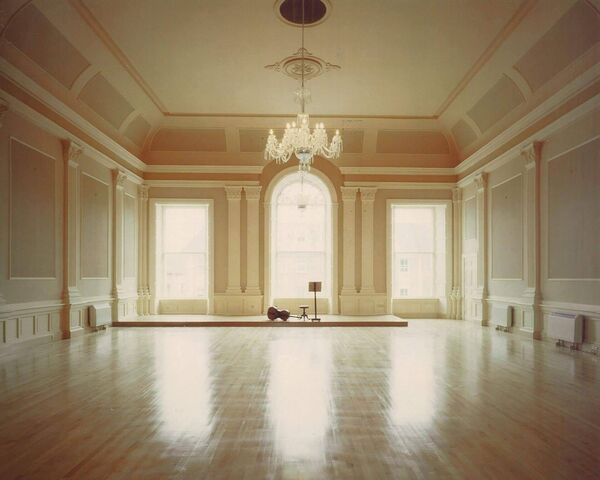
This venue was lavishly and dramatically decorated for the occasion. Laurel arches, festooned with roses, lilies and other flowers stood along the walls. And from these same walls hung banners. Over the door were huge flags bearing various inscriptions, including: ‘Waterford 1826’, a reference to the famous election of that year in which Henry Villiers Stuart, a supporter of Catholic Emancipation, defeated a candidate in opposition to it, Lord George Beresford. ‘Clare 1828’, remembered O’Connell’s election to Parliament, while another inscription proclaimed, ‘Repeal 1843’.
The Liberator sat beneath a canopy of laurel wreaths and roses, bearing the word ‘Repeal’, and constructed under the room’s great window. He once again delivered a speech, affirming that 1843 would see the restoration of an Irish Parliament.
The banquet had, by far, the smallest attendance in comparison to the other elements of the monster meeting – the procession and the gathering in Ballybricken. It was composed of the principal middle class supporters of O’Connell in Waterford and adjoining counties. In a time before universal suffrage, men engaged in land ownership, the professions and business, and, crucially, with the right to vote, gave leadership at local level to the Repeal movement. Their involvement was crucial to any prospect of success.
Without them, and the Catholic priesthood, there would have been no meaningful political structures that were essential to the organisation of monster meetings throughout the country.
The banquet afforded an opportunity for local cadres of middle-class leaders to engage with The Liberator and for him to affirm the importance of their role.
However, 1843 was not to be the O’Connell’s self-proclaimed ‘Year of Repeal’. A monster meeting planned for Clontarf, near Dublin, in October, was banned by the British government. Fearing bloodshed, and consistent with his belief in peaceful methods, O’Connell called it off. The government’s action confirmed its resolution, reiterated at intervals during the year, not to concede Repeal. Such a concession would have altered dramatically the constitutional architecture between Ireland and Britain, constructed by the Act of Union. This was a vista the queen’s ministers considered too appalling to contemplate.
How many people actually attended the monster meeting in Waterford on July 9, 1843? According to the , 500,000 people were present. This is an extraordinary and exaggerated figure. The is not an entirely reliable source: it was an ardent supporter of O’Connell’s Repeal campaign and consequently partial in its coverage of all matters relating to the Liberator. It stated that eight hundred attended the banquet in the Large Room.
While the newspaper admitted that the event was “inconveniently crowded”, this number is also an exaggeration. Figures were inflated to present O’Connell and the support he enjoyed in the most favourable light.
The actual number in attendance was certainly very significant. It attracted attendees not only from Waterford City and County, but from Kilkenny, Tipperary and Wexford. This made the meeting a regional affair.
A more reasonable and correct figure for the attendance at the monster meeting is one likely between 250,00 and 300,000, though it is still an estimate. The fact is that the actual number will never be known.
Whatever the exact attendance, the monster meeting in Waterford attracted the greatest crowd in the city’s long history.