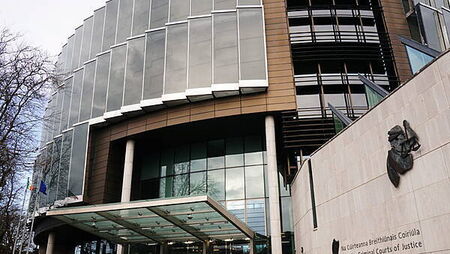
High Court to rule on legality of detention accused left without legal representation
High Court reporters
The High Court is expected to decide next week on the lawfulness of the detention of several accused persons who were remanded in custody after appearing in the District Court without legal representation due to a dispute over the new legal aid payment model.
The court has been dealing with more than 20 cases brought by accused persons in recent weeks, arguing that their detention was unlawful because they did not have a fair hearing at the District Court. Some of the accused have since been granted bail by the High Court.
The proceedings arise in circumstances where many solicitors working in the District Court are refusing to work under the revised legal aid scheme.
The new legal aid payment scheme provides for a once-off legal aid fee of €520 irrespective of how many appearances solicitors make to represent a client in the District Court. Previously, solicitors were paid per appearance.
Minister for Justice Jim O’Callaghan, who introduced the scheme earlier this month, has defended the reforms. He indicated this week that he will meet the Law Society to discuss concerns with the new model.
Ms Jjstuce Mary Rose Gearty on Friday heard arguments from lawyers for the accused persons and several State parties in 11 challenges.
The cases are advanced under a provision in article 40 of the Constitution, which allows for a challenge to legality of a person’s detention.
At Friday’s hearing, barrister Michael Lynn, appearing with Keith Spencer for one accused person, submitted that one of the highest individual rights, the right to liberty, is at issue at a bail hearing.
“A denial of liberty is only in accordance with the law if it follows rigorous and fair procedures, and that did not happen in this case,” he said.
Counsel said the District Court judge herself stated his client’s rights were not vindicated at hearing, and agreed that the accused needed a lawyer to represent her.
“The judge herself says, ‘You do have a constitutional right, and I’m terribly sorry that your rights weren’t vindicated in that regard today’,” Mr Lynn submitted, referring to a transcript of the hearing.
The accused, who appeared in court on a robbery charge, told the District Court judge that she was worried she would lose her home and access to her daughter if she was not released from prison.
The facts of the client’s case was “crying out” for a lawyer to “stand up for this woman and assert her rights”, Mr Lynn submitted.
“In the absence of a lawyer to represent the accused, the hearing simply was devoid of the fundamental requirements of justice,” he said.
Colman Fitzgerald, appearing with Karl Monahan for several of the accused persons, said his clients are entitled to legal representation supplied by the State.
Without legal representation, he said the applicants are people who “simply are not going to be able to do themselves justice”, in a situation where the Director of Public Prosecutions (DPP) or the Garda is making a case for their detention.
Frank Crean, appearing with Paul Gunning for two accused persons, said their clients’ detention following a hearing where they were unrepresented was fundamentally unfair, and did not vindicate their constitutional rights.
The case of one of his clients in particular, Mr Crean submitted, “illustrated very clearly” the necessity of legal representation at such a hearing. He said his client was of limited means, was charged with two minor offences, has a right to the presumption of innocence, and was deprived of his liberty.
Michael O’Higgins, appearing with Kate Egan for another accused person, opened a transcript of his client’s District Court appearances, pointing to what he submitted were factors that stripped the hearing of “the bare minimum essentials that are required before a citizen’s liberty is taken from them”.
According to a transcript of his client’s District Court hearing, the accused responded to a warning by the presiding judge over interruptions with: “I give a f*** for that.”
Mr O’Higgins said this was a “very graphic illustration” of how poorly equipped his client was “to protect his own interests”.
Sunniva McDonagh, with Kieran Kelly for the DPP, submitted that a bail hearing conducted without a solicitor representing the accused does not, per se, mean a District Court judge has acted beyond their jurisdiction, or mean the hearing is fundamentally flawed.
She submitted there was no “gross unfairness” to the accused persons, based on District Court transcripts.
There was an argument before the court that any bail hearing conducted with the accused unrepresented was unfair, despite submissions to the contrary, barrister Eoin Carolan, for the Minister for Justice, submitted.
Insofar as this argument is pursued, Mr Carolan, appearing with Hugh McDowell and Davy Lalor, submitted that a judicial review challenge was the appropriate forum to consider those questions.
He said the article 40 challenge was a particular process directed toward particular issues, with narrow remedies.
Mr Lynn, responding to the State arguments, rejected the submission that their case should be advanced by way of a judicial review challenge. An Article 40 application was appropriate because, he submitted, his client wanted one thing – her liberty.
“There’s been a fundamental failure in due process in a court of law… that’s why an Article 40 is appropriate, not the finer points of a judicial review or bail appeal,” he said.
Ms Justice Gearty reserved judgment, and indicated she would deliver her decision next week.