Waterford's Blue Plaques: In Memoriam - The Lost Boys
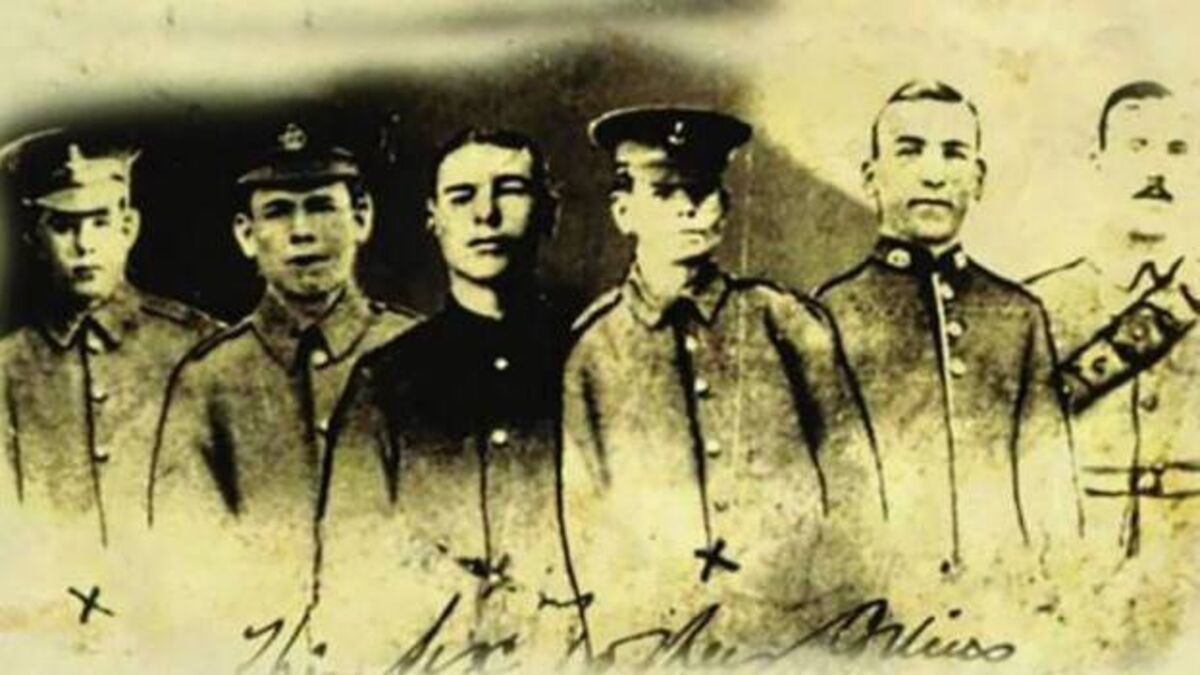
The Collins Brothers, Stephen, Joseph Christopher, John, Michael, Patrick and William.
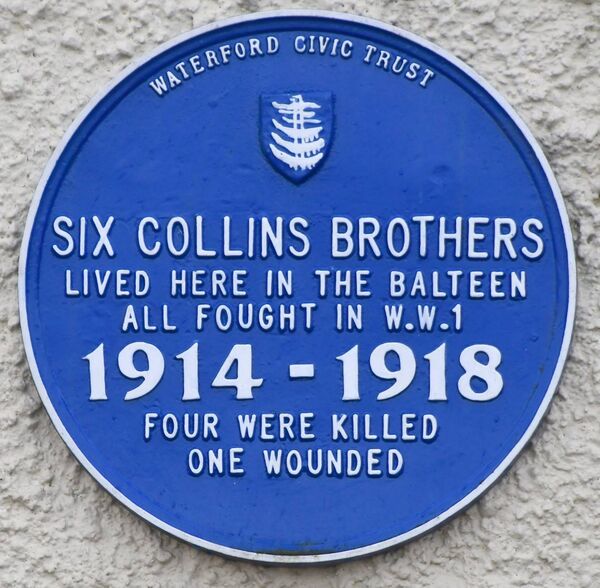
On November 12, 2016, a Heritage Blue Plaque was erected on the Collins family home, The Balteen, Philip Street, Waterford City. This Waterford Civic Trust event took place after a Royal British Legion memorial mass was celebrated by Father Michael Mullins at the Church of the Most Holy Trinity.
The day’s events commemorated the six Collins brothers, four of whom were killed in action – Stephen, Michael, John and Patrick.
Following the mass, a regimental colour party with flag and banner bearers marched towards Philip Street. These included the Irish Defence Forces, the Irish Naval Reserve, Civil Defence and the Royal British Legion. Also in attendance were sons of the Collins brothers – including Freddie, Jimmy, Bernard, Christy and Willie, together with other family members.
Officials in attendance included Colonel Max Walker (attaché British Embassy), Major Michael MacEwan (Royal British Legion), Lt. Elaine Leahy (Irish Defence Forces), Bishop Cullinan, Mayor Wyse, John Deasy TD, and Des Griffin, Chairman of Waterford Civic Trust.
Speaking to the on the day, Joseph Christopher Collins' granddaughter Theresa explained that the reception for returning soldiers in the British Army changed particularly after the 1916 Easter Rising. She said, “My great grandmother Agnes was given a King’s pardon because they thought that she had suffered enough, having lost four sons and at that time possibly five.
"When they repatriated William and brought him back home to her after the deaths of the other brothers, things had changed in Ireland by that time. William was looked on as a traitor for having joined the English to fight the war. He didn’t have a particularly nice time of it after he returned to Ireland, to say the least. It made the ceremony in Waterford all the more touching. It was very emotional and humbling.”
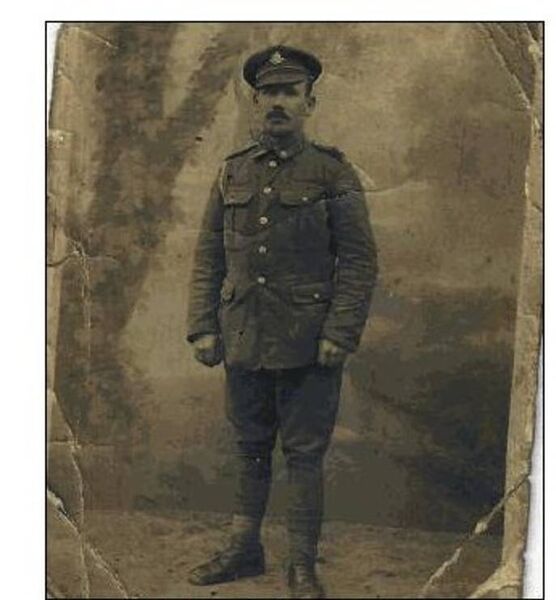
After the speeches, the plaque was unveiled by John ,Deasy TD, a lament was played by the piper Pat Murphy, a minute’s silence was observed, a lone bugle sounded the ‘Last Post’, and the national anthem was played. A fitting series of solemn events in honour of these brave young men.
The event was extensively covered by several other newspapers between November 8 to 17, including the , the , and the . The reported: "In terms of personal loss and anguish during the four years of the war, few suffered greater than the Collins family. In the midst of it all Agnes was abandoned by the boys' father."
William Collins’ son Jimmy said his father never spoke to his children about his wartime experiences.
Between 1914 and 1918 Agnes Collins received telegrams stating that four of her sons, Stephen, Michael, John and Patrick, had perished in some dreadful theatre of war in France and Belgium. William was sent home on compassionate grounds by decree of King George V, and Christy – though badly injured, survived, and was repatriated to Ireland after the war. Up to that point they did not know if Christy was alive. Throughout the war, Agnes looked after her remaining three children, Richard, Bridget and Thomas; thankfully, the boys were too young to enlist.
Stephen was the youngest of the four to die on October 19, 1914; he was just 16, one of the many underage boys who fought in the war. A private in the 2nd Battalion of the Royal Irish Regiment, he died in Flanders, and is remembered on the Le Touret War Memorial, in Pas-de-Calais, France. The memorial lists 13,389 names of soldiers with no known grave killed prior to the start of the Battle of Loos in September 1915. The Imperial War Museum records state that Private Stephen Collins was killed in action on the 19th. However, due to the confusion caused by the battalion being surrounded and wiped out the next day, it is just as likely that he died on the 20th.
Also with the Royal Irish Regiment, Private Michael Collins was the second brother to die. He had been in France since August 1914. He survived the effects of German gas attacks, but was killed on May 8, 1915, when his battalion was heavily shelled by German artillery. He was 24 years old. Michael is commemorated at The Menin Gate Memorial to the Missing in Ypres, Belgium. The memorial is located at the eastern exit of the town, and marks the starting point for one of the main roads out of the town that lead the allied soldiers to the front line.
The distinguished poet, Wilfred Owen, a soldier of the Great War, reflects on the horrors of these gas attacks in his poem ‘Dulce et Decorum est’:
Wilfred Owen was killed in action on November 4, 1918, one week before Armistice Day, the eleventh hour of the eleventh day of the eleventh month 1918 – he was 25 years old. The last line translates: ‘It is sweet and proper to die for one’s country’. Owens' poem suggests the opposite - war is horror, nightmare and loss.
The third brother to fall was John, a private with the 1st Battalion Royal Munster Fusiliers. Aged just 22, John, together with his comrades, charged towards the fortified village of Ginchy. Most of the Irish did not get further than one hundred yards. They were cut to pieces by five German machine guns. The Munster Fusiliers lost 81 men, including John, on that day, September 9, 1916. Private John Collins is remembered at The Thiepval Memorial to the Missing of the Somme, Picardy, France. 72,246 servicemen, with no known grave, died in the Battles of the Somme between 1915 and 1918.
Patrick, the eldest of the brothers (originally with the Connaught Rangers), joined the 173rd Tunneling Company of Royal Engineers. These troops undermined the German defences by excavating subterranean tunnels underneath the frontline. Patrick had risen to the rank of 2nd Corporal, but his fate was sealed when he was drafted in as an infantryman in order to stem the German advance. The Germans mounted their last great offensive. Allied positions were obliterated, and battalions destroyed in a maelstrom of artillery, chlorine gas and machine gun fire as German stormtroopers poured through the gaps in the allied line. Patrick lost his life there, March 29, 1918. He was 30 years old. He is commemorated at The Pozières Memorial in France. The memorial lists the 14,657 soldiers with unknown graves who were killed between March 21 and August 7, 1918.
I chatted with Richard’s son Thomas (Tommy) some time ago - he remembered his Uncle Christy. Badly wounded in Salonika, he returned to Waterford after the war. His injuries never healed, and he suffered for the rest of his life. Tommy said Christy and William never spoke about the war. This is not surprising, as I can well imagine that some Irish people harboured resentment towards Irish men who joined the British forces.
One can understand the attraction in joining – they were guaranteed training, uniforms, three square meals a day and wages too. One imagines there must have been excitement, camaraderie, a feeling of brotherhood. There was a goal, an aim, a greater purpose. The realities of the battlefield would change their minds on that score.
the late Tommy Collins, son of Richard Collins, for personal communication and Collins Brothers notes; Waterford Civic Trust; Greig Fairclough, Director, The Irish Post, Mayfair, London, November 18, 2016; Waterford News & Star November 8, 2016; William Collins; Imperial War Museum: Lives of the First World War; and Waterford City Library.
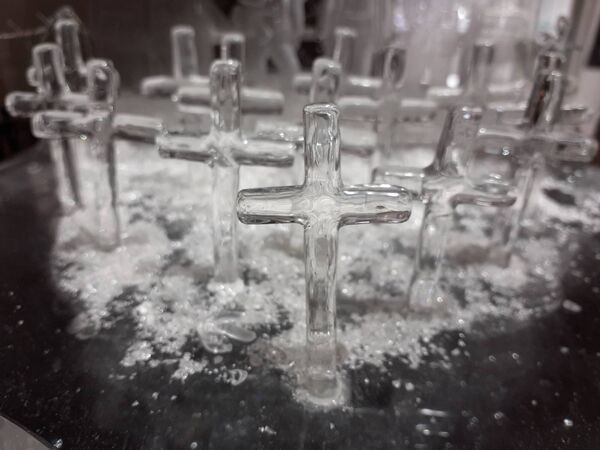
Collins Memorial glass case display with World War I medals, memorabilia, banner and Seán Egan crystal sculpture at the Bishop's Palace Museum, Waterford City. Also, the WWI Memorial Wall in Dungarvan, Co. Waterford, which includes all four brothers’ names.
Marcus Copley, Waterford Civic Trust, researches past recipients of the Heritage Blue Plaques that you see dotted around Waterford. He also presents talks on these to public and private organisations.
A Heritage Blue Plaque is a permanent sign installed on a building in a public place to commemorate a link between notable figures of the past and the buildings in which they lived or had some connection to. It is a unique way to highlight these special achievements and celebrate those who have helped to shape Waterford’s heritage and history. Waterford Civic Trust is a registered charity and has erected over 70 Heritage Blue Plaques in various locations across Waterford city and county.