Tom Barton, Bovril log roller – Déise’s first outdoor theatre performer
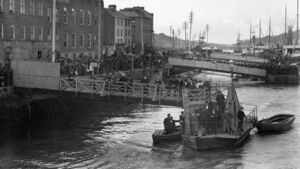
AH Poole captured this photo as a crowd gathered along Waterford's quayside to watch Tom Barton perform atop his Bovril log.
On a rainy July afternoon this summer we called to our friend Damien for a catch-up. Before him on the table was Ian Hannigan’s recently published book, Timeless Colours – Waterford, a beautiful and well-crafted colourisation of 19th and early 20th-century Waterford images. As it happens it was a Christmas present we had given him. But Damien had a question. The book was opened at a specific image that I knew quite well.
It is a Poole photograph taken from the deck of a ship, looking quay-wards towards the now demolished Adelphi Hotel. It’s a perspective known to countless generations of sea travellers of the city. In this view the quayside, the ferry terminal and the gangway to the London Hulk are festooned with Waterford folk in their finery. Taken by the renowned local photographer, AH Poole, I had always considered this photo depicting a group waiting for a special event trip on the Waterford Steamship Company paddle steamers. However, Damien had spotted something very curious with a magnifying glass.
On the ferry pontoon, where patrons alighted or boarded the row boat ferry to the Ferrybank side, was a tall crate of Bovril tins. What were they doing there, he wanted to know…the question I have to admit baffled me. For the ferry hadn’t taken freight across the Suir here since the opening of Timbertoes Bridge over 100 years earlier.
The answer, however, has nothing to do with freight or any special event trips. It is something much more peculiar, and the Bovril cans were the key that unlocked it.
In 1903, a man by the name of Tom Barton was travelling the country exhibiting a very unique commercial activity. Some say he was from Putney, London; others that he had Irish blood, while others said he was a Canadian lumberjack.
All or none might be true.

However, Tom had one unique talent – he was a log roller – a man who balanced on logs in Canadian rivers as they were steered down rivers or into sawmills.
Tom’s time in Canada was now being put to use with a commercial gimmick – Tom’s log was now made of Bovril tins, soldered together to about 10 feet in length, one foot wide and upon which Tom would perform an entertaining act.
Bovril was invented by a Scotsman, John Lawson Johnston, developed from beef extract and originally known as Johnston's Fluid Beef. This was in an era when fridges were just a dream, and keeping meat fresh was a challenge. In one of his early successes, he won a contract to supply one million cans of his beef extract to the French army. With clever advertising Bovril was identified with strength and stamina. These were further amplified by medical-backed marketing, which vouched for its immune-boosting qualities.
By 1888, over 3,000 pubs and grocers were serving it and it reached its peak in popularity in the 1930s.
The product has evolved down the years. I still drink it occasionally, I got the habit from my father, especially when fishing herring in the winter months of my youth.
In Barton, the makers of the Bovril product saw a real win/win. Barton was a wily, outdoorsman with a vigour and bravado that linked perfectly with their product. As Barton performed, the company sales people and executives promoted their product. The act was showcased around Ireland in 1903 from North to South and, according to the papers of the time, included exhibitions in Belfast, Derry, Dublin, Limerick, Cork and Waterford.
Dublin, it was claimed, hosted the largest crowd in June of that year – 10,000 were claimed to have lined the Liffey.
His act required the elements to co-operate, including weather and tide and involved him setting off from point A, drifting to point B, and doing a series of tricks as he balanced on his Bovril can log!
From different reports a full picture emerges. It was almost 10 feet long. It weighed 19 pounds. It was 12 inches in diameter, composed of nine Bovril tins soldered together.
Barton would balance mid-river on his log, sit on it and lie down prostrate. He could balance while sitting in a chair, he would call for a table to be added, and there he would sit, while reading a paper and smoking a cigar – all supplied from a support boat being rowed alongside. As he drifted along on the tide his performance drew gasps, applause and the adoration of the spectators.
Of course it was all about the Bovril, so to seal the deal he would pour a large mug of the beefy beverage for himself and replenish his energy. The act finished with some flag waving, as he stood on the chair, on the log, in the middle of a river.
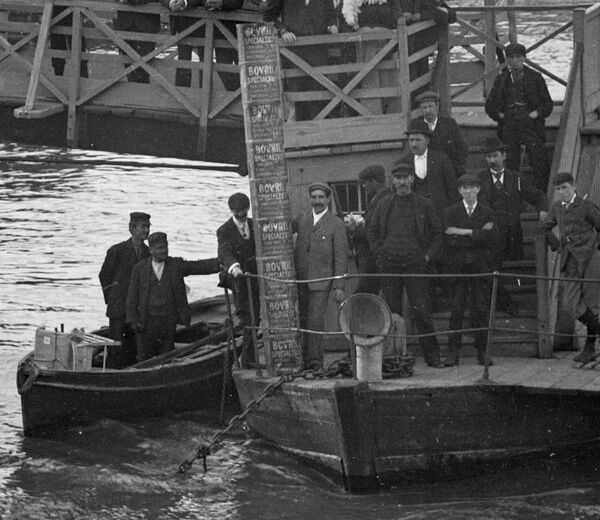
So Ian’s colourised image then is the awaiting crowd for Tom Barton’s performance on the Suir. But when? Well, here it gets a bit tricky. That year local papers were advertising the event – scheduled to take place on the evening tide of Tuesday, June 23, 1903, at 6pm.
On Monday, June 22, the Evening News featured a sketch of Barton, floating on his log and stated that the “Champion log roller of the World will give his unique and marvellous aquatic display”.
The plan was that he would start from Merchants Quay and float down under Timbertoes bridge and down along the quays. Two days later, it was reported that the act never went ahead, however. Tom Barton got ill, and the event was postponed at very short notice. Apart from the obvious disappointment for the Déise public, it must have also been a blow for the commercial association of the health-yielding benefits of Bovril!
Returning to the photo, however, the location is all wrong for the advertised spectacle in June…and not just that…the June event would require an ebb tide. The photo we have shows the river at flood – the tide is flowing up-river and rising. So our image is a different occasion entirely, it was taken later that year. Thursday, October 8, 1903 between 2 and 3pm in fact.
Reportage afterwards in the Cork Examiner states the following:
The last appearance that I could find in the newspaper archive was October 1907 when he appeared at a charity swim event in London. He entertained the crowd in his usual fashion, but offered another gimmick – a gold medal for anyone who could stand on his “log” for two minutes. Despite several attempts, no one succeeded.
He may have retired thereafter, the uncontested champion of the “Bovril log”. He certainly seems to have faded from public view.
Ian Hannigan’s colourised enhancement of the Poole photo of the day certainly captures the excitement that he created and the appeal of his act. Seeing all the people in their finery and the expectation on their faces brings to mind other events in Waterford, particularly Spraoi. Perhaps one of these years someone might consider a reprise of the Tom Barton act.