So near but yet so far for unlucky Ireland
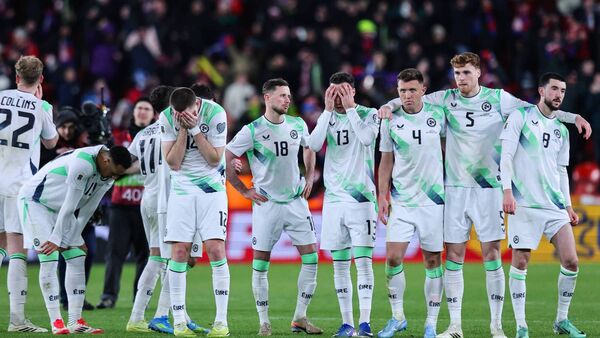
The Ireland team dejected after losing to the penalty shootout against Czechia. Photos: INPHO
So near but yet so far. There are defeats, but some linger and hurt more than others. Ireland’s penalty shoot-out loss to Czechia on Thursday night belongs firmly in the latter category. Losing a match of this magnitude is one thing, but to lose it after being two goals up, and then to see your World Cup dream being dashed from twelve yards, is a cruelty unique to football.
For long stretches on Thursday night in Prague, it felt like we were in control of our own destiny. The Irish side were fearless and played with real intent, something evident in the previous two qualifying games at home to Portugal and away in Budapest, when we beat Hungary 3-2.
We started so well, with Nathan Collins hitting the crossbar early in the game, and then we started to dream as the main man, Troy Parrott, stepped up to coolly slot home a penalty to give us a deserved lead. Four minutes later, we were in dreamland when a well-worked corner routine ended with an own goal and Ireland going 2-0 up away from home and already looking forward to the play-off final.
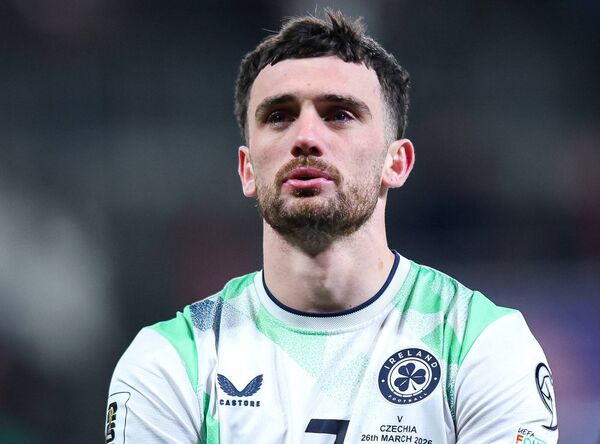
This is why the eventual defeat hurt us all so much. This was not a night where Ireland were outclassed and got lucky with things, but it was a night where they were, for long stretches, the better team. Football doesn’t reward promise, though, and it is a ruthless sport at times, and when there is a lapse in concentration at the international level, you usually get punished. A moment of madness from Ryan Manning just a few minutes after going 2-0 up led to Ireland conceding a penalty, which brought the Czechs back into the game, and when the equalising goal arrived late in normal time, you could almost feel the air leave Irish lungs collectively across the country.
Extra time beckoned, and it came and went, which left the horrible thought of penalties in front of our eyes. One of the greatest, if not the greatest, moments in Irish footballing history was David O’Leary scoring the winning penalty against Romania in the Italia '90 World Cup. Still, since then, penalty shoot-outs have not been kind to us. At the senior level, we have lost three of the four shoot-outs we have been in, and in the build-up to the game on Thursday, the Irish manager, Heimir Hallgrímsson, revealed that the side hadn’t practised penalties in preparation for the game.
This was a mistake, and even though it is impossible to replicate the scenario of taking a penalty in training in front of thousands of people, the mechanics and mental aspects of taking a penalty can be practised. The best international sides in the world are now treating penalty preparation as a science. England, a nation with a long history of penalty heartbreak, began changing the casual way they prepared for penalty shoot-outs when Gareth Southgate took charge of the national side, and they have transformed their “luck.” The FA ran an 18-month project studying technique, psychology, and preparation. Players practised run-ups, breathing and routines, while only confident, regular club penalty-takers were selected. Goalkeeper preparation and behavioural psychology were a huge part of it, also something the Czechs did the other night, as the goalkeeper handed the ball to their penalty taker every time, taking away precious seconds of thinking time for players when all they want to do is take their penalty.
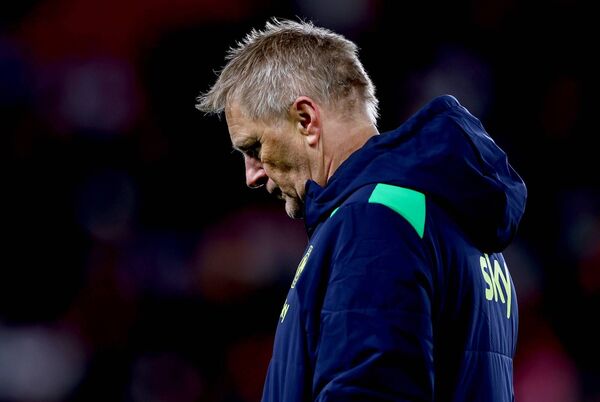
Of course, all of the above can take time to implement. Still, one thing from my career that really sticks out was the advice given to us by Lennie Lawrence, who was involved with us at Newport County and has managed or coached in over 1500 Football League or Premier League matches. He told us to make our decision about where we were going as we stood on the halfway line, and then to jog lightly up to the penalty spot. This was to get the legs moving again after a tough 120 minutes of playing time for some players, but also crucially, as I mentioned above, to take away thinking time from the player's brain, which doubles or triples when walking to the spot.
We were successful in a few shoot-outs when we followed this advice, and it is something I have always kept in mind when I have played for other teams and penalty shoot-outs have occurred.
There is no blame on anyone for the other night, either on the playing side or the staff. The last five months have given us hope again as a football nation. Yes, we are still a long way from where we would like to be, but we are competitive with nations ranked much higher than us, and there has been progress. Another thing the previous five months have done is give a lift to the country. The build-up to the game was the most exciting I have felt about an international game in years, and that sentiment seems to be shared throughout the whole country.
We may have missed out on the World Cup in the summer, but it wasn’t from a lack of effort or quality, and that is something that we now look to have in abundance. The 2028 Euros aren’t far away, and Ireland is a host nation, so there is the possibility of home group games ahead if we qualify. The thoughts of the atmosphere around the country, if we are there, excite me.
Thursday night brought heartbreak in many homes, including my own. My son watched the game and experienced his first real international heartbreak. There were tears at the final whistle, something he had been spared until now by Ireland’s recent run of positive results.
For all the pain of Prague, it seems Irish football is now starting to move in the right direction once again. If this generation of young supporters stays as invested as they are now, then the next great night for Ireland might not be too far away, with the new heroes like Troy Parrott and Caoimhin Kelleher leading the way. Hopefully, more new heroes are still to come.