Pursuit of perfection proving problematic
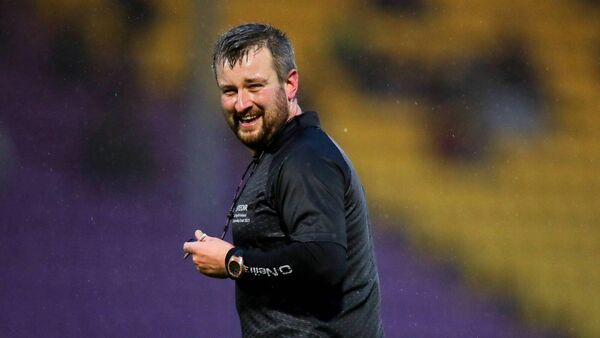
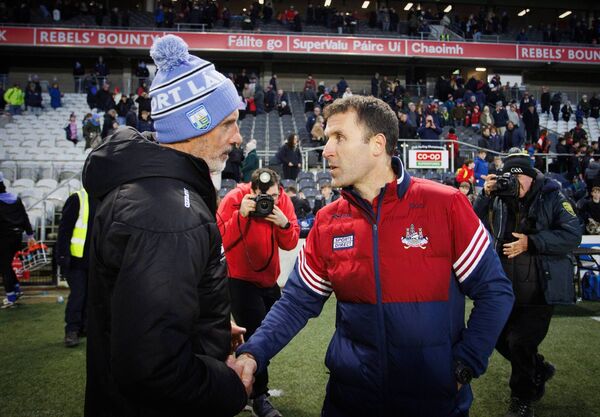
Waterford referee Thomas Walsh received some stick for his late decision in the recent Allianz National Hurling League match between Wexford and Antrim. Photos: INPHO
There’s a creeping fear around hurling at the minute. Not about its skill level - that has never been higher. Not about its athleticism - the game is played at a pace that beggars belief. The worry is something else entirely.
It’s that in our bid to perfect it, to sanitise it, to iron out every crease and magnify every minor infringement, we’re in danger of stripping away the very thing that makes it beautiful.
Hurling has always thrived on its chaos. On its speed. On its natural flow.
It is, and I don’t think this is up for debate, the fastest field sport in the world. Blink and you miss it.
A sideline cut becomes a score in seconds. A turnover at one end turns into a goal chance at the other before you’ve caught your breath. That raw, breathless joy is the product.
Now, we’re trying to officiate it like a spreadsheet.
The introduction of black cards and more stringent penalties - yes, broadly speaking, welcome developments.
Nobody wants cynical fouling rewarded. Nobody wants off-the-ball nonsense ignored. But the unintended consequence is palpable: referees look like men under siege.
Every pull, every tug of a jersey, every coming together is examined. Not just in the moment, but in the knowledge that it will be replayed, clipped, slowed down and dissected afterwards.
It feels like referees are under savage pressure to act. To be seen to act.
The pace of the game makes perfection impossible. That isn’t an opinion; it’s reality.
Decisions have to be made in split seconds with bodies flying, hurleys clashing and 30 players moving at warp speed. From the stand, with the benefit of slow motion and a second viewing on the phone, everything looks clearer. On the pitch, it isn’t.
We’re seeing questionable refereeing performances on the regular now. And before anyone jumps down my throat, this isn’t a pile-on. It’s an acknowledgement of how difficult the job has become.
Read More
To be honest, who in their right mind would be a referee?
You take abuse from the stands, you’re second-guessed by pundits, you’re replayed in high definition from six angles, and even if you get 95% of calls right, the 5% you miss defines you.
But here’s the bigger issue: we’re beginning to talk more about officials than about the hurling itself.
I walked out of a ground recently and the dominant conversation wasn’t about a brilliant score, a heroic block, or a tactical masterstroke. It was about the referee.
That should never be the case.
Officials are supposed to facilitate the spectacle, not become it.
Take the retrospective bans, the hyper-scrutiny after the fact. There’s a place for it, of course. Clear, dangerous acts that are missed need addressing. No one is advocating for lawlessness. But when games start being refereed retrospectively to the point where every minor flashpoint is reviewed and potentially punished days later, it shifts the feel of the sport.
Players start second-guessing. Referees start over-correcting. Flow suffers.
Hawkeye is different. Hawkeye is technology used as a tool, a safety net for objective decisions. Over the bar or not? Black and white. It adds clarity without interrupting rhythm unnecessarily. That’s sensible evolution.
What we’re drifting toward is something else.
Refereeing by numbers. Tick-box officiating. If X happens, the punishment must be Y, regardless of context, regardless of tempo, regardless of feel.
Ben O’Connor has had plenty to say about how hurling is policed. At times he sounds like he’s auditioning to be hurling’s version of Roy Keane - sharp soundbites, unapologetic opinions, the odd grenade lobbed into the debate. But between the blows, there’s substance.
He speaks about a game that is being boxed in by its own regulations, about a sport in danger of overthinking itself. He’s not entirely wrong.
Referees know their performances are graded. They know appointments to the biggest days hinge on perception. Nobody wants to be the official who “let it go” if that decision is later framed as weakness. Equally, nobody wants to be accused of losing control.
So what do you get? Overcorrection. Whistles blown early. Cards flashed quickly. Authority asserted sometimes for the sake of optics rather than necessity.
And yet, it’s an impossible balancing act. Some referees look like they’re mad to be the star of the show, inserting themselves into every passage. Others visibly shudder when they need to lay down a marker. Neither extreme works. The best officials are the ones you barely notice - firm when required, invisible when not.
I thought Chris Mooney was really poor when refereeing Waterford and Offaly recently. That’s my honest view.
But here’s the uncomfortable part: was he any poorer than what we’ve almost come to expect? That’s not a swipe at one individual; it’s a reflection of a system that feels stretched to breaking point.
Again, I’m in no position to criticise on a personal level. Who’d be a ref? Who’d volunteer for that microscope? It’s fast becoming an impossible and increasingly thankless task. And the more we demand forensic perfection, the worse it will get.
Human error is part of sport. It always has been.
A forward misses a sitter. A goalkeeper misjudges a high ball. A defender mistimes a tackle. We accept those as part of the theatre. Why are referees held to a robotic standard when they operate in the same chaos?
There’s a danger in trying to remove every blemish. Hurling’s beauty lies in how natural it feels. The constant movement. The ball in play. The absence of prolonged stoppages.
Nobody -and I mean nobody - wants hurling to drift toward the stop-start, whistle-dominated feel that frustrates so many in soccer. Keep the ball in play. Let contests breathe. Allow for the odd coming together without it turning into a symposium.
Yes, protect players. Yes, stamp out cynicism. Yes, use technology where it makes objective sense. But resist the temptation to dissect the game to within an inch of its life.
Because here’s the uncomfortable truth: the more we interrupt hurling, the less it looks like hurling.
It becomes a series of set pieces rather than a flowing narrative. It becomes about compliance rather than instinct. Players start playing the referee instead of playing the game. And supporters start leaving grounds talking about black cards and technical infringements instead of action itself.
We are blessed with a sport that is uniquely ours. Its speed, its skill, its physicality - all of it woven together in a way that feels organic. That organic nature is fragile.
Once you burden it with excessive scrutiny and fear-driven officiating, you alter its DNA.
Of course standards matter. Of course consistency matters. But perfection? Perfection is a myth, especially in a sport played at this velocity.
Expecting referees to achieve it is unfair. Designing systems that pretend they can achieve it is naive.
The answer isn’t in more layers. Maybe it’s trust. Trust in officials to manage games rather than micro-manage moments. Trust in players to adapt without every inch of contact being legislated. Trust in the sport itself.
I’d rather walk out of a ground arguing about a missed free in the dying seconds than sit through a sanitised, over-officiated spectacle where nobody dares breathe without checking the rulebook.
Mistakes will happen. They always have. They always will. But they are part of the fabric. Part of the conversation. Part of the drama.
Hurling doesn’t need to be perfect. It needs to be itself.
Fast. Fierce. Flowing. Flawed.
We’d do well to remember that before we referee the life out of it.