At what point do fans become foes?
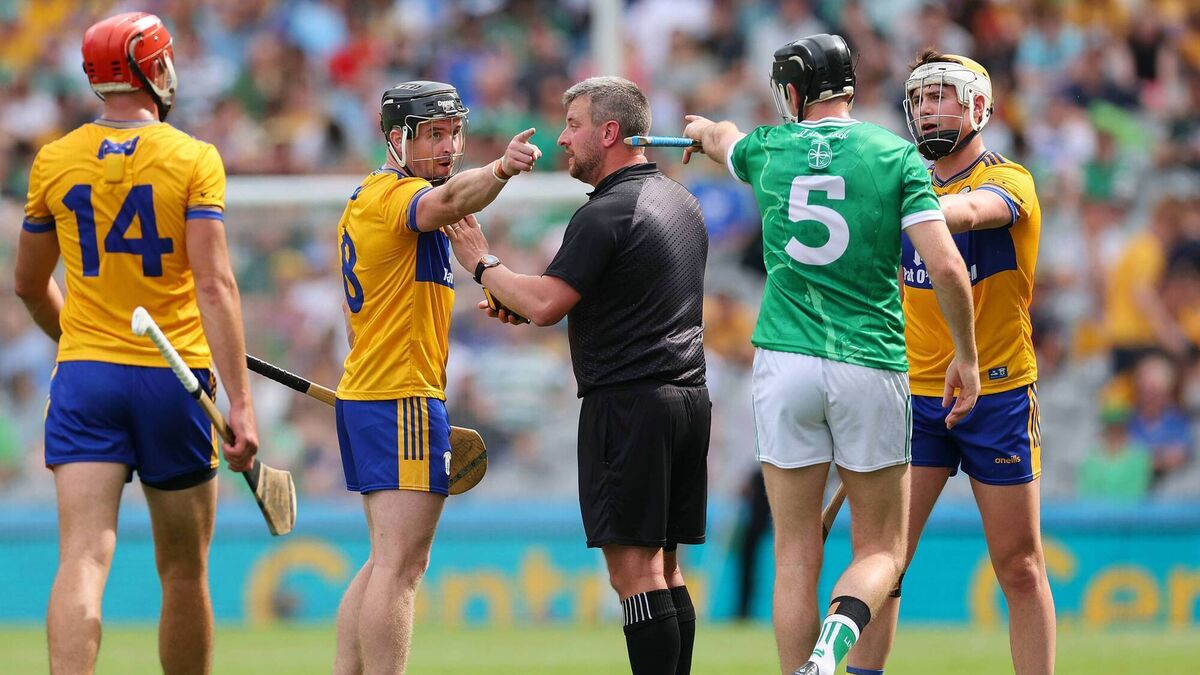
Waterford referee Thomas Walsh tries to calm down Clare's Tony Kelly as he argues with Limerick's Diarmaid Byrnes in the All-Ireland Senior hurling semi-final at Croke Park. Photo: INPHO/Ryan Byrne
The appetite for Gaelic Games has never been greater.
Whether it’s inter-county or club, exposure for our games has reached unprecedented levels.
Traditionalists still make the pilgrimage to terraces every weekend, but thanks to the likes of GAA+ and Clubber, supporters can now watch matches from every corner of the country without ever leaving the couch.
Don’t get me wrong, that’s a great thing. The more eyes on our games, the better. The unfortunate by-product, however, is that more eyes inevitably bring more opinions.
Somewhere along the way, we’ve become obsessed with analysing every tidbit, every passage, every attempt and every decision. Analysis has its place - it’d be fairly hypocritical to suggest otherwise considering I spend a good chunk of every week doing exactly that - but somewhere in the pursuit of endless content, we’ve lost sight of one fundamental truth.
This is still an amateur game.
The players we dissect on a Sunday evening are back at work on Monday morning. They’re teachers, electricians, farmers, students, factory workers and everything in between. They go home to their families, they collect their children from the school gates, they meet their friends for coffee and they’ll probably bump into the very people who spent the days prior questioning whether they should ever wear the jersey again.
That’s the beauty of the GAA, but its make-up is starting to smudge.
It’s also why we owe those involved a certain degree of perspective.
As someone who writes and analyses games every single week, I’m fortunate enough to meet plenty of the people I write about. I won’t lie if I feel strongly enough about something. If I think a tactical decision was wrong, I’ll say it. If a performance wasn’t good enough, I’ll say that too. That’s the job.
The difference is that analysis should always be backed by evidence, context and respect. The balance is actually very simple. 100% of coverage should be thoughtful analysis. 0% should be unwarranted criticism.
Unfortunately, that balance feels as though it’s drifting further away by the week.
One thing that has become increasingly noticeable is that there’s a growing societal inability to simply give people credit anymore.
When Galway produced one of the performances of the championship to cast Cork aside, how long did it take before the conversation became about Cork’s collapse rather than Galway’s brilliance?
When Waterford win, it’s often because “the opposition were useless” or “sure you’d be worried if they couldn’t beat them.” When Limerick lift another trophy, it’s apparently because of JP McManus’ money rather than years of extraordinary coaching, culture and excellence.
When Tipperary won the All-Ireland last year, how often did we hear that Cork “didn’t turn up” instead of acknowledging that the Premier peaked at exactly the right time and blew them away after half-time? There’s more than enough examples. Don’t get me started about the attitude toward Ballygunner.
We’ve become conditioned to explain away success instead of celebrating it. It’s almost as though somebody always has to be the villain.
The growth of podcasts has undoubtedly enriched GAA coverage. The Hurling Pod, the Irish Independent’s GAA offering, the Examiner Podcast and BBC’s coverage all provide thoughtful discussion and informed debate. There has never been more quality analysis available and that should be celebrated.
The problem is that quality has also been accompanied by a growing quantity of imitators.
It takes very little now to set up a microphone, a camera or a social media page and suddenly become a self-appointed authority on the game. Fan forums have their place and debate is healthy, but too many have become little more than vehicles for lambasting players, often from their own counties, with absolutely no accountability whatsoever.
Not every opinion deserves equal weight simply because somebody has a platform.
What I find even more frustrating is the increasing lack of original thought.
Supporters aren’t stupid. They can tell when somebody has watched a game, formed an opinion and put their name to it. Equally, they can spot when somebody has simply stitched together whatever was trending online after the final whistle, sprinkled in a few buzzwords and asked ChatGPT to formulate something that resembles analysis.
There’s nothing wrong with using technology to improve your writing. There is something wrong with using it as a substitute for having something worthwhile to say.
The race to produce content has overtaken the desire to produce insight. Being first has become more important than saying something worthwhile.
I was at club games locally over the weekend and truth be told, I came away more disappointed by some of the conversations afterwards than anything I’d seen on the pitch.
“So and so is useless.” “He hasn’t a clue.” “F***ing waste of time coming to watch them.”
These weren’t opposition supporters. They were talking about their own players.
Lads who had trained three or four nights a week for months, gave up evenings with family and friends and were doing their level best to represent the very people saying this.
Supporters have every right to be frustrated. I’d be more worried if they weren’t. Passion is what makes the GAA special.
Still, there comes a point where frustration stops looking like support.
This isn’t a moan or a ‘poor me’ - but I’ve had my fair share of criticism over the years. 80% of it has probably landed in my direct messages after 11 o’clock at night from accounts without profile pictures, and truthfully, that doesn’t bother me a whole lot. It comes with the territory.
I’ve also experienced it to my face, and I can assure you it’s a far less pleasant experience. That always leaves me thinking about the players.
If I find that so uncomfortable after just writing an opinion piece, how much worse must it feel for somebody who’s sacrificed months of their life, simply trying to put a smile on the faces of the very people now tearing strips off them?
The overwhelming majority of GAA supporters are exactly what they’ve always been - loyal, passionate and fair. That will remain the case, I have no doubt.
This piece is aimed at a minority, but it’s a minority that seems to be getting louder.
Debate is healthy. Analysis is healthy. Disagreement is healthy. Toxicity isn’t.
As our games continue to grow, perhaps the biggest responsibility doesn’t fall on players, managers or officials at all. Maybe it falls on the rest of us to ensure the conversation surrounding them remains worthy of the games we claim to love.
If ‘supporting’ your team means constantly looking for someone to blame, if your first instinct is to ridicule rather than recognise, and if criticism becomes more enjoyable than encouragement, then maybe it’s time to ask ourselves one simple question.
At what point do ‘fans’ stop becoming fans, and start becoming foes?