Catherine Drea: Space Oddity
Next year one of our own, Norah Patten from Ballina, County Mayo, is on the list for a stint in the International Space Station.
Space Oddity by David Bowie was first released in 1969. This month is the tenth anniversary of his death. Somehow the song lives on in my head and I found myself humming “Ground Control to Major Tom” after I saw the Space Station go over my house recently.
When Bowie wrote the song, Space Oddity, the first mission to land men on the Moon was happening. No-one in those days could have foreseen the everyday normality of the Space Station crossing over our night sky like an intrepid space angel. Always there, always on time, 16 times a day.
That first mission to the Moon was managed on a computer smaller than the capability of a current iPhone. I once visited the returned capsule, which is on display in a museum in Washington, and was shocked to find that it is tiny and weirdly homemade looking!
Never having studied science at school, I tend to be in the more romantic branch of space watchers. It’s hard not to be. Like everything else in the world, the future of space travel and the study of the universe is now in the hands of the billionaires, but the rest of us need not exclude ourselves from wondering and hoping.
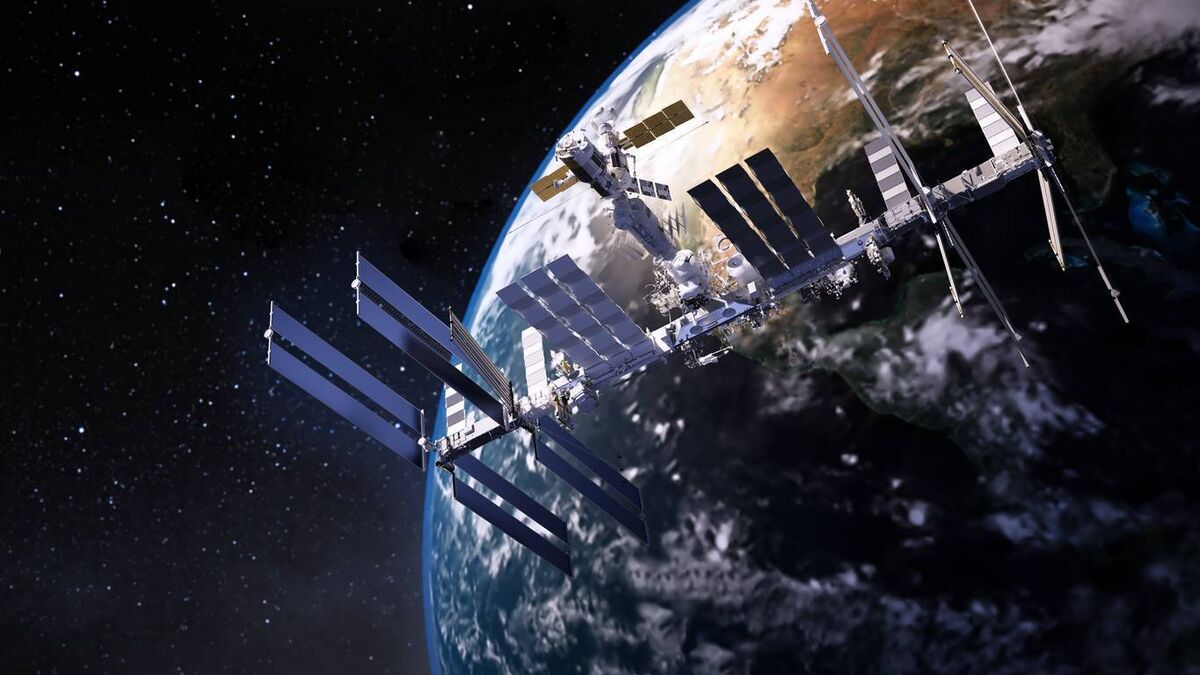
Do you ever see the Space Station at night or wonder about the six souls living there? I went down a rabbit hole of startling facts when I realised that the ISS has been orbiting around us for 25 years. That little speck of light that passes over every 90 minutes, at the speed of over 17,000 miles per hour, is now something that we take completely for granted.
This year I intend to follow more of the activities and musings of the current astronauts. Already I am hooked.
It was on one of the recent freezing nights, when the stars of the firmament were sparkly bright, that I again saw the Space Station hurtle past. That speed is the equivalent of five miles per second! The mind boggles at what that does to the human brain and body.
Never mind that, just to be fired up there on top of a bomb that puts the pressure of two black bears onto your chest would make you marvel at the fierce resilience of these astronauts.
For 25 years the Space Station has been continually occupied by over 300 souls. These humans are living together up there for months at a time. There are so many things about the 25 years of continuous orbiting of the Earth that defy belief.
First of all it’s much bigger than I thought; roughly the size of a football field. The interior living space is about the size of a six-bedroomed house.
Secondly, the Space Station operates as an experimental science laboratory working in cooperation with scientists on Earth, carrying out experiments and research for days on end. This includes astronauts and live mice using their own bodies to measure all kinds of effects and moods as they hurtle around the skies.
Thirdly and most extraordinary is that the crew members themselves represent many diverse countries and the whole project is owned and managed by five countries on Earth, including the United States (NASA), Russia (Roscosmos), Europe (ESA), Japan (JAXA), and Canada (CSA). Makes you wonder why if they can cooperate in space that they don’t seem to be able to do it on Earth? Just how long can that kind of cooperation last?
But of all the features that I have been exploring I think the most fascinating is that astronauts often experience what they call “the overview effect”. This is a new awareness of what Carl Sagan called the isolation and beauty of the Pale Blue Dot. Looking back on the Earth, astronauts are stunned to realise that there are no boundaries, countries or ethnic groups from that distance in space. Humanity shares a single, isolated, unique planet. In fact, from 250 miles up, Earth looks like a spaceship too; one with far too many passengers and not enough caretakers.
Just one small fragile planet. The only one we know of with life and multiple species on board.
The current crew passes over us through 16 sunrises and 16 sunsets. So it is vital that every morning according to our Earth calendar, they must put down a marker that a new Earth day has begun. I’m trying to imagine counting the days and managing to isolate the real and genuine sunrise of the Earthlings.
Thinking about 2026 and all that we are trying to muddle through here on Earth, I’m inclined to adopt this daily reminder that here is another morning and we are still here. Still muddling maybe but hanging on for dear life to hope.
It’s been a smooth ride for the International Space Station over the last 25 years. In fact next year one of our own, Norah Patten from Ballina, County Mayo, is on the list for a stint up there. I expect this will turn more Irish eyes towards the sky at night.
The next adventure for NASA will be the launch of Artemis 2, the first crewed mission to the Moon in 50 years. While some of Earth’s more aggressive males squabble over who owns what, Artemis will be exploring further into the Moon's landscape as a stepping stone to Mars.
Will David Bowie’s question, “Is there Life on Mars,” be answered? Watch this space.