Was the first Irish Tricolour flown in Waterford? Local historian unearths potential hard truths
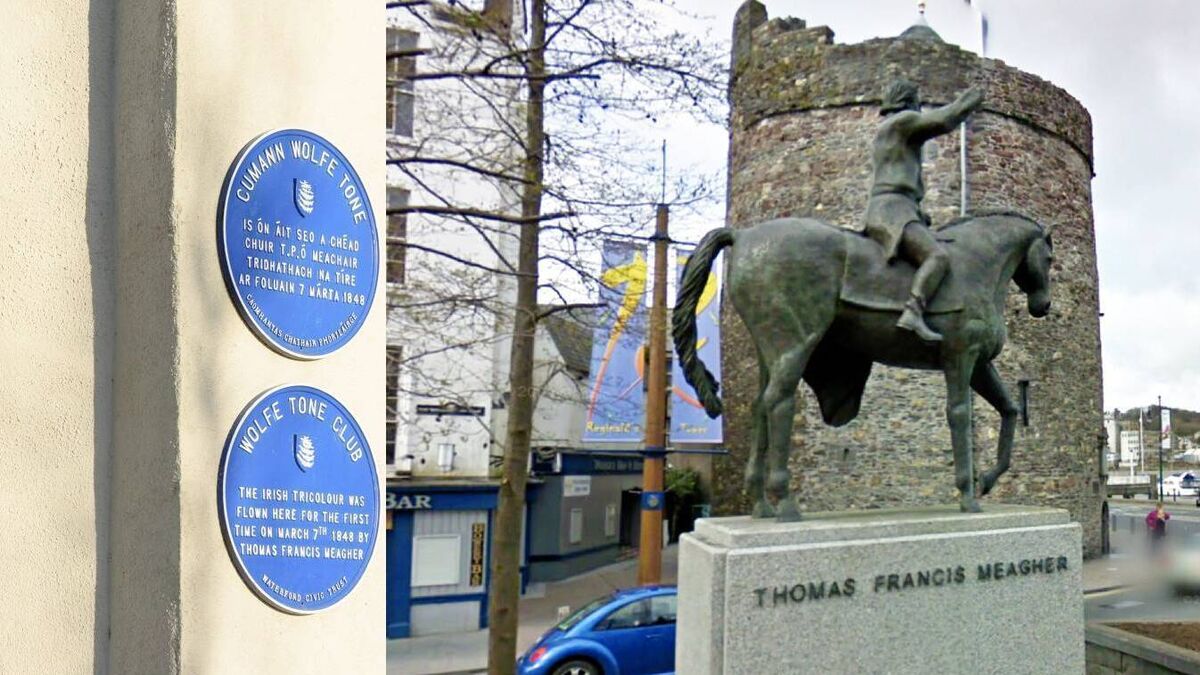
Thomas Francis Meagher was widely credited as the first to ever fly the Irish Tricolour in 1848, but local historian John Crotty has cast doubt on the claims
Since the 1990s, 33 The Mall, Waterford City, has been credited as the first ever location that saw the Irish Tricolour flown.
Thomas Francis Meagher, one of Waterford's most famous sons, was widely accepted to have hoisted the Irish Tricolour above the Wolfe Tone Club at the Mall.
It’s been accredited as the first time the Tricolour ever flew in Ireland, and has been hailed as one of the key elements of Waterford’s storied history.
Born in the Granville Hotel in 1823, Meagher was a driving force of the Young Ireland nationalist rebellion that was influenced by pan-European revolutionary politics and the birth of the French Second Republic.

Outside 33 The Mall, a plaque erected by Waterford’s Civic Trust reads: “Brigadier General Thomas Francis Meagher: Originator of the Irish National Tricolour, first flown in Waterford in 1848.”
But as local historian John Crotty puts it, his job isn’t to rewrite history, rather relay what he finds.
And one of his most recent findings may come as a major blow to Waterford - that the Irish Tricolour did not first fly in Waterford in 1848.
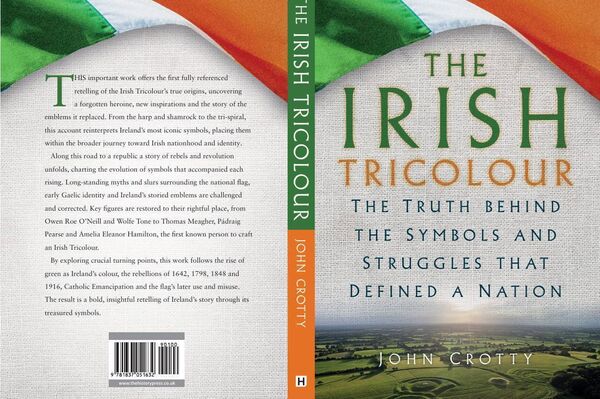
In his newest piece of work, “The Irish Tricolour - The Truth behind the Symbols and Struggles that Defined a Nation”, Crotty posits that the mythology around Meagher, Waterford and the Tricolour became misconstrued in the 1990s.
“Unfortunately, which I can state as a Waterford native, my research in this first referenced work on the Irish Tricolour clearly shows it did not first fly in the city, having emerged and been popularised in 1830,” Crotty said to the
“The symbol also did not 'return' to Waterford on March 7, 1848 - this was very clearly the flight of a French flag, misidentified in the 1990's as an Irish Tricolour.”
Crotty, a historian and former CEO of Spike Island, examined the origins of the Tricolour and other key defining symbols of Irish nationalism in his newest piece of work.
According to Crotty, the Tricolour first arrived in 1830 through the earthshaking politics of Daniel O’Connell’s ‘Repeal’ movement.
Seeking to establish a parliament in Dublin, O’Connell tried to court Protestants: “Let orange and green blend their colours henceforth… to render their country that place of plenty and happiness which God and nature intended.”
Months later, the first union of green and orange occurred in the form of a cockade, or rosette, which was recorded at a political event in Cork City.
When the French Revolution of 1830 began, a wave of French Tricolours were imported into Ireland.
These events inspired a first ever Irish Tricolour device, seen in a cockade crafted by a forgotten female patriot, Emilia Eleanor Hamilton of Annadale Cottage in modern-day Fairview, Dublin.
She created the symbolism of the modern Tricolour, alongside an accompanying poem: “Let orange and green, no longer be seen, be stained by the blood of our island.”
Her symbol was reported in the press and even proposed as a national flag in London’s Atlas newspaper.
It first saw the light when three months later, Daniel O’Connell’s followers reinvented their green-orange cockades to include white.
According to Crotty’s research, Irish Tricolours flew at an event to welcome O’Connell home from London at Howth Pier in December 1830. The Tricolour was seen in flag, banner and rosette form.
Tricolour streamers were seen at Saint Patrick’s Day in Waterford City in 1831, while a flag was unfurled in West Waterford in July 1832. Cappoquin, Lismore, Aglish, Dungourney and Castlemartyr nationalists combined with a flag of "white ground, tastefully bound with orange and green" to protest tithes (church taxes).
So what was the historical significance of Meagher and the events of March 7, 1848?
Crotty’s research points towards Meagher’s flag likely being a French Tricolour.
In an article published on March 11, 1848, The Limerick Chronicle reported that "The French Republican flag has been hoisted at the Young Ireland Reading Room in Waterford".
A Waterford Standard article, published on February 27, 1943, also recalled the flight of "French Republican Tricolour flag from the windows of the Wolfe Tone Club".
“Meagher and the Young Irelanders did not invent or fly the first Tricolour. Nor were they involved in its initial return on March 7, 1848, which demonstrably took place in Enniscorthy, influencing the group,” says Crotty.
“However, their re-adoption and popularising of the symbol played a very important role in the flag's later adoption by the generation of 1916, who assured its ascension to national flag.
“Meagher’s true involvement lies in the speech he gave to an assembly in Dublin around April 15, 1848, when he said ‘The white in the centre signifies a lasting truce between the orange and the green.’
“Had the group not adopted the Irish Tricolour and created a link to Ireland’s independence movement to the liking of later Republicans, it is unlikely it would have become the national flag.”
Chairman of Waterford Civic Trust Eugene Broderick said the Trust will discuss what to do with the plaque on 33 The Mall following Crotty's latest research.
Broderick said he is currently reading Crotty’s book, and enjoying it.
“I think it is an extremely well-written book… I always welcome serious research on any topic, and John Crotty’s book is a serious piece of research on this matter.”
Local historian Dermot Power said he still believes the Irish Tricolour flew on March 7, 1848 outside of the Mall.
He explained that while there can never be a definitive answer to the question, and that contextually at that time the French Tricolour would have been far more common, sightings of the Irish Tricolour in Enniscorthy on March 7, 1848 prove there were exceptions.
Crotty also believes that the Irish Tricolour was in Enniscorthy that day, and believes its presence is backed by far more substantive evidence.
Crotty says a fleeting reference to the Tricolour in the 1840s in Waterford, which was then unearthed in 1998, led to Meagher’s unveiling of the flag becoming accepted as the universal truth.
“Unfortunately, the work hadn't been peer reviewed. It hadn't been published or anything,” said Crotty.
“If it had been, I think people would have pointed out fairly quickly that, well, there was actually a lot of French Tricolours around. So, it's very possible that's what that was, or actually, much more likely, that's what that was.”
He once again reaffirmed his belief that Meagher was integral to Irish independence: “With Daniel O'Connell, [the Tricolour] was a symbol of Home Rule, it was a symbol of staying part of the United Kingdom, but having a parliament.
“That was never going to appeal to the 1916 generation.
“History doesn’t sit still.”