The significance of a cornerstone in an idyllic Waterford town

Author Kieran Fanning
If you’ve ever visited Cappoquin, a small town situated on the Blackwater River at the foot of the Knockmealdown Mountains, you will probably have seen the famous Cornerstone on the east corner of Castle Street and Main Street. It is an old sandstone boulder, which has become an emblem of the town.
Where it came from, nobody really knows, but there is a mysterious legend that connects the stone to a curse that destroyed Fitzgerald Castle and all who lived inside it. The story goes something like this… A cold wind whistled around the ivy-clad castle where, in the Great Hall, Thomas Bán Fitzgerald threw another log on the fire. The flames glinted off tarnished weapons and off his dusty, untuned harp. The fire warmed his body, but his heart remained cold; he had not sold a song or poem in years. His dying mother had left him the estate, but now the cattle were diseased, the crops failing.
she had warned.
Most of the servants had gone; only the old housekeeper remained. Her shuffling footsteps approached.
“Sorry to disturb you, Master Thomas,” she said. “But there are two hounds at the front door.”
When he opened it, rain lashed down, and lightning illuminated two soaked dogs. Their ears drooped, their eyes downcast. One held up a paw, begging. Thomas caught a whiff of sulphur but saw no fire.
“We can’t leave them out,” he said, letting them in, though the housekeeper disapproved.
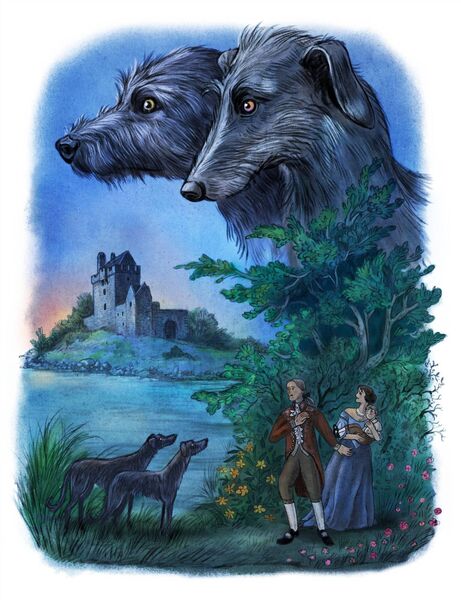
Down in the Great Hall, the dogs shook themselves dry. The limping one held up its paw; Thomas saw a thorn lodged in it. He fetched salted water, bathed the wound, and gently plucked it out. The dog whined but did not bite. Its companion watched protectively. In the firelight their eyes glowed red, like flickering flames. Thomas dismissed it as imagination.
The dogs ate hungrily and stretched out before the hearth. Uneasy, Thomas left them sleeping and went to bed. That night he dreamed of Hell and ruins. By morning, resolved to drive the dogs away, he found them gone. No door or window had been opened, the housekeeper insisted.
On the flagstone before the fire, words had been carved:
Thomas stared. Who but the dogs could have left the message? He was unmarried, unlikely to have children. He imagined his hall full again, as in his mother’s time. Kneeling on the stone seemed an easy choice. He did so, though nothing happened, then dragged a rug over the words.
Soon his fortunes changed. Cattle thrived, harvests grew bountiful, money flowed. His poems and songs became popular, and banquets filled the castle once more. He told himself it was talent, not sorcery. Still, the stone preyed on him. One night he prised it from the floor. It proved to be a heavy boulder. Straining, he rolled it out the door and down the hill, where it came to rest among trees. Ivy and moss crept over it, and Thomas forgot, attributing his wealth to his own skill.
Years later, his travels brought him to France, where he fell in love. They married, and soon a son, Maurice, was born. The memory of the bargain haunted him, but as years passed without sign of the hounds, he grew easy again.

One May evening, Thomas and his wife sat watching six-year-old Maurice pick primroses. The sunset stained the sky orange, and a blackbird sang. Thomas closed his eyes in contentment – until thunder cracked and rain poured suddenly down. Then came the smell he remembered: sulphur, brimstone.
Through the downpour stood the two hounds, eyes glowing red. Thomas pushed his wife and son behind him. “You cannot have him! Take me, take everything – but not my son!” The dogs only looked at each other, disappointed, then turned away into the rain.
Relief turned to terror as Maurice went limp in his mother’s arms. His breath was shallow, then ceased. By the time the doctor came, the boy was gone. His mother, broken with grief, shut herself in her room and soon followed him to the grave.
The ruins of Fitzgerald Castle fell into decay. The boulder Thomas had cast out lay hidden until the town of Cappoquin grew around it. People came to know it as the Cornerstone. Its inscription wore away, polished by the countless who sat upon it, following the tradition that to sit upon the stone meant one would return to Cappoquin. During Famine times, emigrants chipped off fragments to carry abroad, reminders of home.
In 1779, Fitzgerald Castle was replaced by Cappoquin House, which still stands. But the Cornerstone remains on its corner, a silent witness to a tale of ambition, bargain, and loss.