One of a kind internationally important site found in Waterford
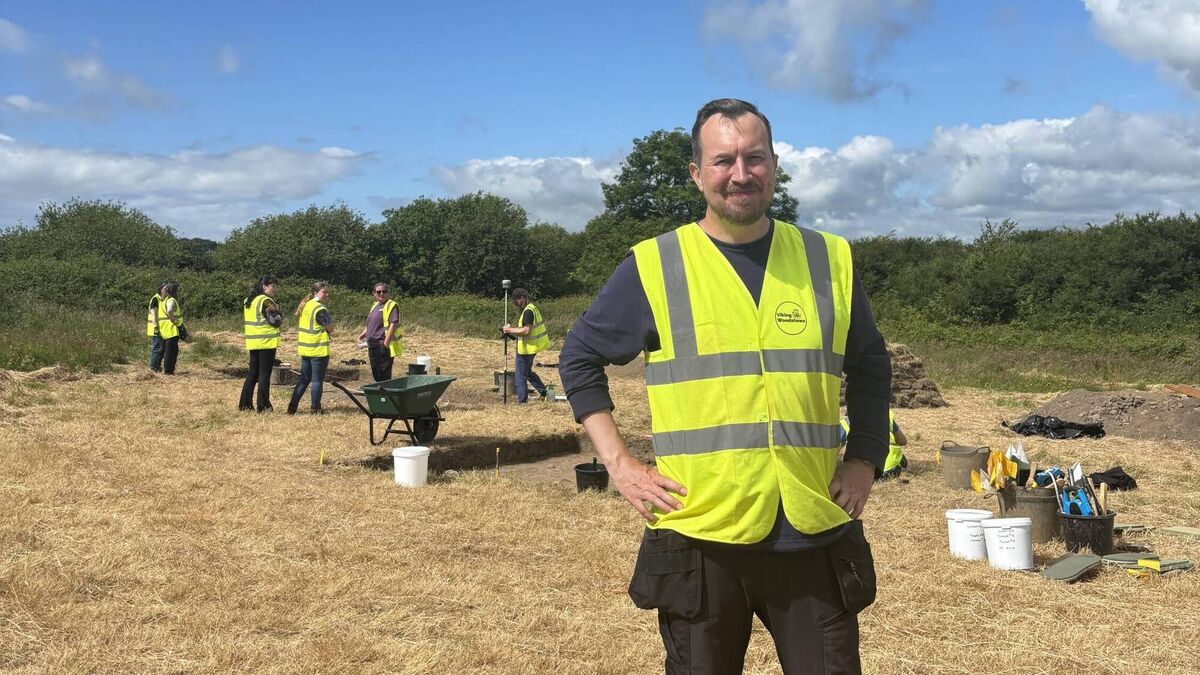
If confirmed, the structure that Neil and his team excavated may be the largest Viking structure identified so far in Ireland.
To get to the Woodstown Viking site, you have to drive down a very strange road indeed.
Despite being surrounded by trees and fields, the two-lane road is wide, with footpaths on either side. Tall grasses and weeds spring from the cracks in the footpath and just as you trundle around a bend, the road just…stops.
You are confronted with a large, high wall and a left turn into a field – although the recent convoy of jeeps and trucks means that the grass is at least well flattened.
You must park in this field and make your way by foot across it. When you reach the far side of the field, you will find a gap in between two hedges. The gap is in fact a path of about fifty meters where the hedges are so tall and wide, you get the sense you are in a forest clearing rather than between two fields. Once you emerge, you will see another vast, empty field. On the occasion I was there, the field was a hive of activity. Various steel-booted individuals wearing high-vis jackets scurried about with all manner of implements that I hadn’t the faintest idea of how they would be used. Among them is a very cheerful man named Neil Jackman, co-director of the week-long research dig taking place at the site.
I comment on the strange journey I took to get here, and his eyes light up. Neil explains how the very patch of grass where we currently stand was planned to be a ring road, but because of the discovery of the Viking site in 2003, the road was abandoned, and a different route was built. Neil said: "I think it's the only time in Irish history that archaeology moved a road."
As for the strange path between the hedges, there’s a good chance that it is actually the remnants of an old Viking street, according to Neil. Using geo-thermal survey techniques, (which can essentially map out what lies beneath the surface of the ground by differentiating between soil types) the team of archaeologists at Woodstown believes there could have been as many as 61 houses in Woodstown at one time.
What makes the discovery of this site so important internationally is that for some reason (Neil and his team aren’t yet sure why) the site was abandoned. Unlike Dublin and Waterford city, the Viking settlement didn’t develop into a major urban area. Instead, it lay untouched for centuries with nothing being built on top of it.
“It got left in time," explained Neil.
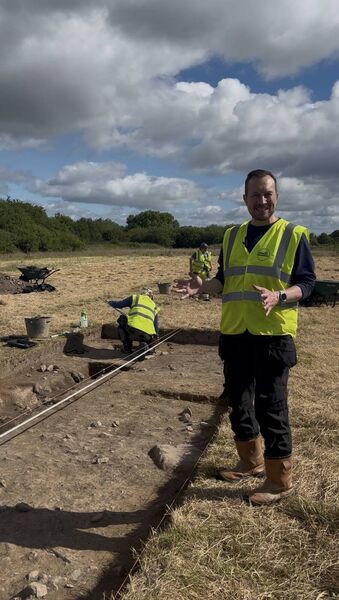
In a way, the discovery is almost akin to that of Pompeii. Where other Viking sites have been contaminated with hundreds of years of buildings and human lives literally built atop the sites, Woodstown has not been inhabited since the Vikings, meaning the entire original settlement is completely preserved, just a few inches below the surface.
Rather than excavate the entire site – which could leave it vulnerable to damage, the team, made up of archaeologists from Ireland and Norway, dug two trenches in the largest building on the site to get a cross-section of the settlement.
Because the Vikings built their structures using wood, which has been lost, but what remains are the foundations.
“This would have been a thriving, bustling settlement. There would have been the noise of metalworking going on, there would have been chickens and pigs roaming around, kids playing, families squabbling, all the usual things you’d associate with a busy village.” The team may have found the first long hall ever found in Ireland at the site.
“By Scandinavian standards, this is nothing too large, but it's eighteen and a half meters long, by Irish standards, that’s a whopper.” At 127 square metres, “I think it’s a pretty good semi-detached house by our standards today.”
Neil showed me some of the artefacts that they found over their week-long dig. They found a metal strap that would have been used on a belt. Although it's not too impressive when I see it, Neil explains that it's important the metal objects are cleaned and polished in a lab rather than on-site. He said: "that bit of corrosion, that bit of earth adhering to it, that could actually be trapping things like textiles or bits of fur, which are really important. Sometimes you want to clean it yourself because you're so excited by it, but you gotta hold back."
The team found a weight that would have been used as a way to measure currency. The weight would have sat on one side of the scales, and then silver would have been put on the other side until it balanced to determine how much money you had.
Speaking of money, they also found a silver coin originally probably from Iraq. "This shows the trade extent of the Vikings."
"It probably travelled a long way and travelled through many, many hands before it ended up in a wet field in Waterford about a hundred years after it was made."
“Woodstown is uniquely positioned to be really special”, according to Neil. As well as an internationally important archaeological site, it’s also right next to the Greenway.
Together with Waterford City and County Council, Neil and his team wrote a conservation management plan where they proposed to use an experimental form of archaeology, whereby, using only the tools and materials that would have been available to the Vikings at the time, the team would re-create the historic site.
Not only would this be useful for the field of archaeology, Neil believes it would also be an opportunity for the local community to get involved and learn skills such as carpentry. Neil explained that this has already been done in France, but it took over twenty years to achieve.
He said: “We’ve got to tread carefully with such an important site, but every year just adding a little bit more to the picture and the story.” “You can imagine what a landmark that would be – an authentic Viking village, built exactly as the evidence tells us – this isn’t a Viking Disneyland by any means – built right on the water. That’s the vision.”