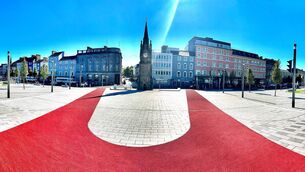
Meet the people taking shelter in Waterford City Marina
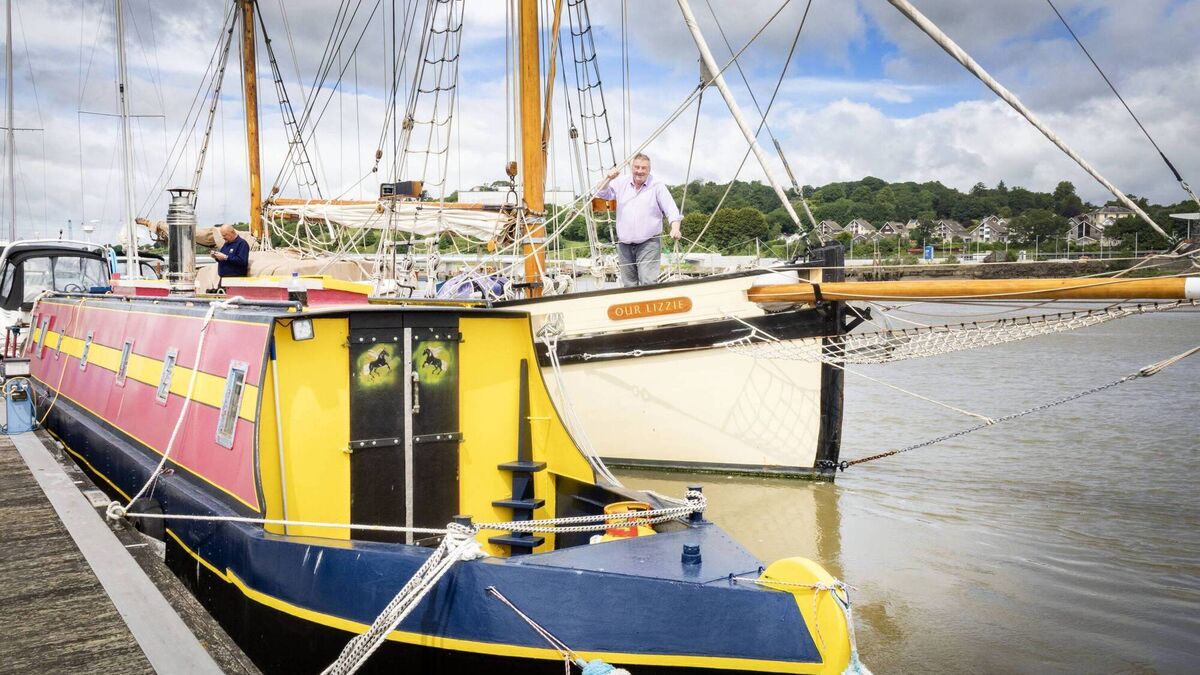
Staying over at Waterford City Marina. Photo: Joe Evans
I arrive at the gate and wait to be collected by Michael Beihill, my guide for today, who’s going to show me around his neighbourhood. It's small enough, everyone knows each other, even the people just passing through. There are no cafes or supermarkets in this neighbourhood but there is free communal running water and electricity.
I’m being facetious, of course, the ‘neighbourhood’ is in fact Waterford City Marina, but in other ways it does feel similar to the old housing estates and villages that you come across in Waterford. Everyone knows everyone and they spend their days going to each other's houses for tea.
Micheal takes us to Njord because he quite admires its aluminium hull, designed for long journeys, especially up north of Ireland and the UK where ice in the ocean can damage typical fibreglass hulls. A steel hull gives NAM a kind of Bauhaus aesthetic, totally grey and utilitarian except for the rainbow hammock just in front of the mast.
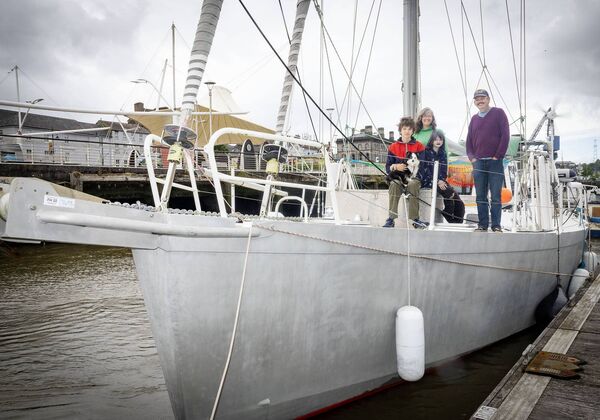
The first crew member we are introduced to is ‘Skipper’, a gorgeous little black and white dog who seems as happy on the boat as he does on land (it always surprises me how comfortable dogs are on boats).
Next, we meet Charley and his wife Kate, a couple in their early fifties who sold a few businesses, bought a boat and have been living between harbours and marinas ever since.
They’ve been docked at the Waterford marina for “about a month” having sailed from Padstow. Their next stop is Cork and then up the west coast of Ireland but for now they are trapped in the Déise due to the unpredictable weather.
The family like the Waterford marina, though, because it's right in the heart of the city centre, which isn’t the case with a lot of other places in Ireland. They can go get a coffee and some groceries, and in the evening head to Jordan’s for a pint without needing to get a taxi or bus.
During the day, they homeschool their children, Dutch who’s 15 and Lorelei who’s 11. They think taking their kids around the world on the boat is good because “it exposes them to different cultures”. Charley “grew up on the lakes of east Tennessee” and has always loved being on the water. He is planning to cross the Atlantic Ocean over to the Caribbean single-handedly later this year while his wife and children fly back to the US for some “land time”, as he refers to it.
This epic journey began three years ago when they bought a boat in Greece. They sailed it to Turkey, then Malta, onto Sardinia, the South of France and then Cornwall. And now here – with even more stops in between!
Charley says that a lot of his time is spent fixing things around the boat.
“Everything on a boat is always one of three things: brand new, broken or nearly broken,” he said.
I let him get back to his tinkering and am brought over to meet Andy, Peter and Geraldine who are aboard Our Lizzie, a beautiful historic wooden boat.
I chat away to Andy Cox on the deck, who says they’re in Waterford “hiding from a storm”. They are sailing back from Killarney, from a wedding they attended there, to Wales.
Andy loves being on the water and spent his life working for the Navy. Now he’s retired but he still spends his life aboard a boat. Andy spends around six months of the year aboard Our Lizzie. He met the owner, Peter, at his local pub in Ramsgate. He had been admiring the boat in harbour for quite a while and was delighted to happen to meet the owner in his local, and since that evening, the rest is history.
It seems Our Lizzie has quite an effect on boat enthusiasts because Peter was similarly bewitched by her almost 20 years ago when she went up for sale.
“I was too slow and she was gone,” Peter tells me with all the regret of a man talking about the one who got away. Thankfully, five years later, Our Lizzie was back on the market.
Our Lizzie is 106 years old and when I went inside for a quick cup of tea, I had to admit, she’s looking well for her age. The boat is considered a “Dunkirk Little Ship”, it was commandeered by the British Navy in 1940 and brought to Dunkirk to rescue soldiers during World War II. That wasn’t the only role it played in World War II, the owner Francis Bevan was asked to go on a spy mission to Iceland to see if there was a hidden German submarine base there. It has also been featured in the TV show the Onedin Line and the films Summer of Love and the French Lieutenant’s Wife, among others.
“She was quite a film star,” Peter said.
Peter and Geraldine don’t see themselves as owners of this historic boat, “we’re custodians”, Peter tells me.
Finally, I get around to asking my new friend Michael about his story. We climb aboard his barge, Aonbharr named after the horse Oisín and Niamh rode to Tír na nÓg. Michael has hand-painted horses on the doors. Inside, the barge is half construction site, half artist’s studio. Michael has painted the table and countertops in gorgeous splashes of different hues of blue and the walls are whitewashed, giving you the sense that you are in an art gallery of sorts.
Michael told me that he “jumped in with both feet” when he bought Aonbharr. He is still in the middle of renovating, doing all the renovations himself with the help of a few friends. Now retired and an artist, Michael was a carpenter as well as a stone and wood carver, he also worked on medieval restoration.
“I’m pretty good at fixing things,” he said.
He was drawn to the idea of the barge because he finds life on a boat “is simpler”.
He likes to cook and likes that the boat doesn’t have a television and that “out here, everything is movement”.
“One of my favourite parts of the Irish culture is the chaos.”
Michael told me about how, recently, “it was ad hoc, a few friends and musicians, there was one guy who hadn’t played in a long time, he got better and better as the night went on, and it was brilliant.
“We gathered at Alan’s boat, we brought some drinks, some food and some chats, there’s a lot of falling together with these people.”
I walk past the marina every day on my way to work, who knew what a patchwork of experience and culture that little floating neighbourhood has. But then I suppose I shouldn’t be surprised. People have found shelter, community and craic on that same patch of the River Suir for over a thousand years.