Housing the Déise: When an overheating market abruptly turns tight?

Regina Mangan of Liberty Blue Estate Agents. Photo: Patrick Browne
Property is a main staple of Irish newspaper headlines. Almost on a daily basis because it is assumed that we have an obsession with owning property or land.
And that obsession, whether a myth or not, apparently dates back to the struggle – intermittently violent - against British rule, as in taking back what was once rightfully ours from the cruel, absentee landlord.
So far, so false. It is neither inevitable nor innate to have a wanton desire to spend a small fortune on a thousand square feet of bricks and mortar.
In fact, it is a falsehood, handed down from one generation to the next, that you absolutely must get a foot on the property ladder.
And the problem with a falsehood presented as a lifestyle choice – owner occupancy is the only way, rent is dead money – is that it prejudices those who cannot afford a mortgage, and their number has been on the increase for years.
If rent allegedly is throwing good money after bad (Europeans view it differently), it is understandable why young Irish workers can feel under immense pressure, familial or societal, to save 10% for a deposit on a house.
Bearing in mind that the median price paid for a home currently is €396,000 (outside Dublin), that’s €36,000. A tall order for anyone on a gross annual salary of €40,000 to €45,000. It is not unheard of for the income of a single first-time buyer to be closer to €80,000.
If a peculiarly Irish fixation with owning property in this country still persists, we should lay the blame at the door of an over-priced, volatile property market, and not dodgy landlords of old.
The obsession, however, with ownership is no longer financially tenable.
A primary reason is cost. On average, according to the ERSI, a household will fork out one fifth of net income on housing payment bills: energy, property tax, insurance, service charges etc. It is a growing list.
And the pain isn’t dissipating. After energy driven inflation in the Eurozone rose to a three-year high this month, an interest-rate rise by the European Central Bank is on the cards.
How will it affect buyers? If a rise in the ECB rate materialises as expected, for every €100,000 borrowed over 30 years, a 0.5 percentage point hike is the equivalent of a €30 per month increase.
(When was the highest mortgage bill recorded in the past five years? Last month. In fact, mortgage rates are at their highest since 2008.)
Approaching the end of a whirlwind 2026, the times they are a changing, and changing fast. According to the latest quarterly report from Daft, fluctuating marketing conditions have resulted in the rate of growth in the asking price for properties for sale being halved. In a year!
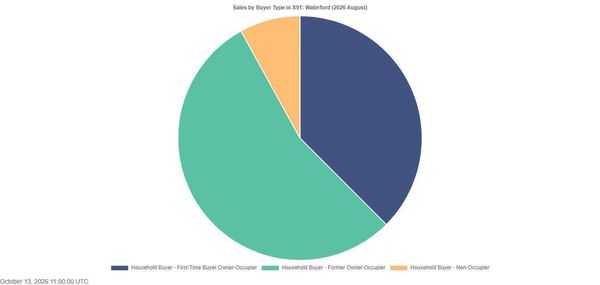
Pre and post Covid figures remain miles apart: for example, house prices are 44% above pre Covid although below the heady years of the Celtic Tiger peak: price rises in 2026 are less than they were 12 months ago.
“The market has changed, there is no doubt about it, but I would describe it as a more normalised market,” said Regina Mangan, Managing Director, Liberty Blue Estate Agents in Waterford.
“When we think post Covid, all the economists predicted that the housing market would flatline, but it did completely the opposite. A lot of coastal properties, like Dungarvan and Kinsale and scenic areas, those prices went through the roof. A house in Dunmore East this summer went for over a million.
“What we saw up to a few months back were bidding wars, very prevalent, large numbers of people going to viewings, but now the market has eased. I would say it has normalised. Typically, over the years, leading up to Christmas, it is not a time when people are looking to rent or to buy.”
How many 25 to 34-year-olds bought a house in the years climaxing with the Celtic Tiger? 60%. What is that percentage today? 27% to 30%. As recently as Wednesday last, figures released show that the number of properties bought by first-time buyers have been on a gradual slide for three years in succession: 30,480 (2024), 30,750 (2023) and 30,710 (2022).
And while a 12.5% increase in second-hand house availability in the past year is a green shoot of positivity, it is still half when compared to 2015 to 2019.
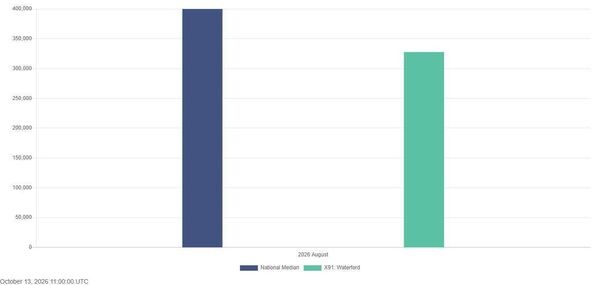
What can be extrapolated from the 2026 data so far? Since summer, a softer demand by buyers is pushing the housing market into a cooler phase. List and transaction prices have eased.
The peer pressure in the mid to late 1990’s to buy a three-bed semi when new estates flourished like mushrooms, or to build a dormer on a half-acre with a herd of Friesians for neighbours, was extreme.
From every source.
From government after government - gambling the nation’s bank balance on an overheating housing market - to banks offering 100% mortgages to anyone over 20 with a pulse.
And boy did we go for it hook, line and sinker: at the zenith of the Celtic Tiger, the year with the Midas touch - 2006 – when 90,000 new homes were built. Property was the rock Ireland’s economy was built on.
90,000 in a single year. Contrast that with a decade once considered a great building boom, 1948 to 1962, when 118,000 houses were delivered.
The pressure to acquire and to own in 2006 (for some, one house wasn’t enough) was relentless until the crash. Twenty years later, and while 100% mortgages of lore are six feet deep with the likes of Anglo Irish Bank, that mind-set of having to be an owner-occupier hasn’t gone away.
The legacy of Celtic Tiger excess is still with us. While Ireland has the fourth highest rate of home ownership in Europe by people aged 40 or over, it has the tenth highest for households owned by someone under 40, one of the biggest gaps in ownership rates between two side by side generations.
All of which explains why one in four Irish sons and daughters between the ages of 25 and 35 continue to live with their parents. No surprise then that the average age of a first-time buyer is 36, ample proof (source, Central Statistics Office) that the age profile of first-timers is rising in tandem with prices.
The CSO’s data for the age of first-time buyer “is in line with our numbers, which are probably 35 to 40 but there are a whole lot of reasons for that, not just affordability,” added Regina Mangan. “When people finish university, they go travelling and they are gone for a few years, and all of that has an impact.”
Behind the accumulating data, another story is brewing.
The property market is cooling, is shifting to tight, which basically, in auctioneer parlance, means uncertainty. And that isn’t good because a property market achieves optimum results on certainty.
Fiscal certainty should not be conflated with the illusion of certainty, which prevailed for much of the Celtic Tiger.
An illusion of certainty is almost always detached from reality, such as a housing bubble driven by easy credit and low rates (the banks, again).
In August, the Irish Institute of Professional Auctioneers and Valuers started the ball rolling: a higher level of caution was definitely entering the market.
Then the Central Statistics Office waded in: higher borrowing costs and concerns about the Iran war was cooling the market so that house price inflation slowed to its lowest level in three years. (Last week, the CSO’s Residential Property Price Index revealed inflation slowing to 4.7 per cent in September, actually the slowest rate of growth recorded since 2024.) What can it mean? In October, Daft.ie was unambiguous: houses, old and new, were staying on the market longer. In simple terms, buyers were slower to take the bait and still are.
To add fuel to the fire, last week Eurostat revealed that the growth in property prices here in a decade was double the EU average (14% to 6.8%). In layman’s terms, growth in income in Ireland has fallen 14% behind the price of a home.
And yet, even when property prices are sky high, you will find a cloud with silver lining. Who benefits is debatable. According to Geowax, the home valuation company, new homes are selling for thousands more than second-hand properties.
As usual, there is a discrepancy between the Dublin property market and the rest of the country, with fluctuations from one province to the next.
List-price (not net) inflation in September was 3% - compared to 5.8% this time a year earlier – but the growth in house prices is far more noticeable in cities like Waterford (plus 11%) and Cork (plus 6%) than Dublin (plus 2.7%).
In an ideal world, price pressures for new mortgage holders should ease because of supply and demand: the supply of second-hand houses has been increasing but not quickly enough. What determines a soft market is when available stock isn’t budging as fast: in other words, sales of houses, new and old, have fallen.
A soft market creates market heat. How come? For years, until recently, new buyers felt compelled to pay above the asking price, but the mood has changed.
This divergence between list and sale prices is significant. For much of 2024 and early 2025, buyers routinely paid above asking. That trend has now reversed, falling from 6.8% to 2.6% in 12 months.
The sharpest turn in transaction prices is being acutely felt, not in Waterford or Cork, but in Dublin, 5.2% year on year, the largest drop in 12 years. Why Dublin specifically? There are any number of reasons.
Besides rising costs, which affect everybody no matter where you reside, Dublin has almost exclusive ties to multinationals and the tech industry, both unfortunately synonymous with the threat of job losses because of investment in AI, and not employees. Over 1,000 let go in one year (TikTok, Meta, Amazon).
Would be buyers are hedging their bets.
Explained the estate agency, REA, “buyers were now slower to bid for any properties that require upgrade works due to uncertainty over future costs.”
Another factor for someone working in Dublin is the perfect storm of a contraction – or stagnation - in income and a hike in borrowing costs.
What are the consequences for cities like Waterford? Crystal balls in the property market are two a penny and economic indicators are exactly that, suggestions. While the market is currently in flux, trends point to a greater resilience in Waterford and Cork than Dublin and adjacent commuter counties like Wicklow (no price growth at all).
With the pace of growth slowing and buyer behaviour oscillating, it is a truism that new homes, even if they are more expensive, will sell quicker than second-hand because of their turnkey condition: they don’t require budget-draining remodelling.
List price inflation is cooling, nothing surer, and the biggest price rises nationally are no longer in Dublin but in the provinces and yet, as Genevieve McGuirk, chief executive of the Institute of Professional Auctioneers and Valuers has noted, as long as supply of housing remains problematic, prices will remain elevated.