Ambulance workers set for Labour Court talks with HSE following beginning of industrial action
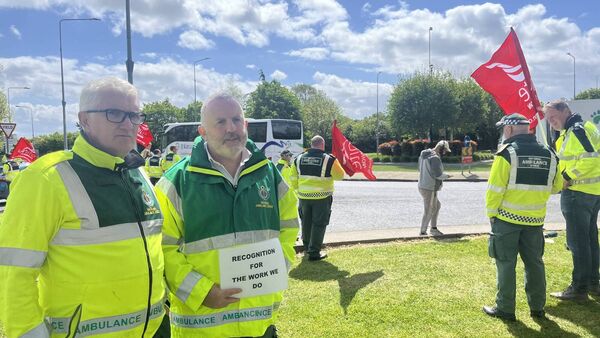
Tony Maddigan and Sean Wade on the picket line this morning outside University Hospital Waterford. Picture: Darragh Murphy
Unions involved with the National Ambulance Service are set for crunch negotiations with the HSE in the Labour Court tomorrow morning.
The developments follow the commencement of nationwide strike actions centred on demands for a salary increase.
Unite the Union and Siptu members voted overwhelmingly for industrial action in April 2026, with calls for the implementation of an independent 2020 review, which recommended an enhancement of pay scales across the ambulance serice.
Union representatives have argued that the job requirements have expanded significantly in recent years, which have yet to be fully accounted for.
It's understood that a planned 48-hour work stoppage will still go ahead next week if unions and the HSE do not reach a satisfactory conclusion.
Ambulance service members protesting outside of University Hospital Waterford spoke to the about the increasing responsibilities that have been placed on ambulance service workers over the years.
Sean Wade said that traditionally, the ambulance service would have been a patient transfer service which attended emergency calls to transfer people to hospitals for treatment.
Nowadays, ambulance service personnel diagnose and treat patients on the road, making vital medical decisions to save lives.
Mr. Wade added: “In the past twenty years there has been a huge emphasis on upskilling all the practitioners. Every emergency technician, paramedic and advanced paramedic you see in an ambulance have advanced all their skills and the job has completely changed. The only thing that has not changed is the level of pay and recognition."
Another worker on the picket line today was Tony Madigan, who has been in the ambulance service for 25 years.
He said: “In the past, we would place patients into an ambulance and drive them to the hospital. Now we do most of our interventions on the road and try to help or revive people as we go, because it can lead to a better outcome.
“In the past we would have brought patients to whatever the nearest hospital was. Now we diagnose on the road to determine what is the most suitable hospital to bring patients to. If it’s a brain injury we bring them to Cork, if its cardiac we bring them to the cath lab in Waterford. All these clinical decisions are made by the people on the road, and we have already started treatment in the ambulance before we even reach the hospital.
"We fight against nature every day, trying to bring people back to life, trying to save people, and its not reflected in the recognition we receive."
Workers on the picket line in Waterford are advising the public that cover is still available and to still call 999 if they encounter an emergency.
Mr. Madigan said: “We still have ambulances on the go and we don’t want the public to suffer. We want people to still ring 999 if they have an emergency.
“If we were told there was no ambulance available, any of the people here today would come off the gate and go out straight away. We want to go out and make sure the public are safe.”