Phoenix: An unhappy realisation?
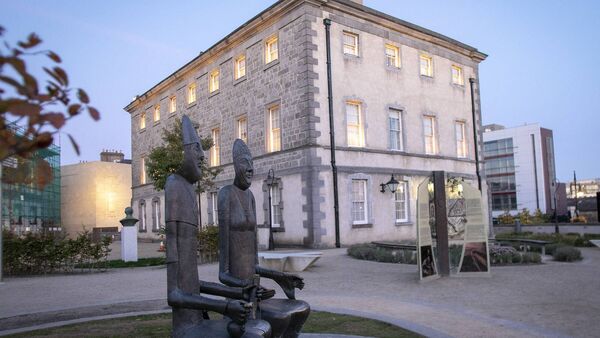
The disastrous closure of Peter Street severed all nighttime connection between The Cross at Michael Street and the Viking Triangle, pictured.
The “town is dead boy”, says Fianna Fáil councillor Jason Murphy, who proposes late-night shopping for working families, quite forgetting internet shopping, click and collect, home delivery etc. Waterford city needs to change, but expecting struggling retailers to extend working hours is hardly the answer.
The centre city has had footfall and retail issues for decades and is at a crunch point. Policies followed by council (albeit with the best intentions) over the past century, yes, that long, often worsened the problems they sought to solve.
After 1922, the estimated population of the area around Arundel Square was 5,000. People mostly lived in tenements. The city boundary at the time was very tight with nothing beyond Manor Street, Morrison’s Road/Military Road.
Council slum clearance moved hundreds of families “up the roads” to semi-rural areas like Griffith Place and Ard na Gréine. Clearances emptied the city centre of people and no coherent attempt was made to redevelop the cleared areas. That continued after WWII.
In 1949 the council decided to drive a new “boulevard” from Ballybricken to The Mall, via Peter Street. As a result, the bottom of Patrick Street and most of Peter Street was destroyed. Demolition stopped at St Olaf’s Church and the Widows Apartments but continued in Colbeck Street.
Redevelopment came in the 1950s, as a single-storey Arundel Ballroom in Peter Street. This added nothing to day-time urban vitality.
The present Café Nero site became a prosaic garage. No attempt, except for a handful of houses in Stephen Street and Patrick’s Street, was made to develop dense housing in the cleared areas.
In Dublin, for instance, small blocks of council flats were developed in many inner city areas. Waterford city centre was simply emptied of people. Areas like Jenkins Lane and Arundel Square were cleared for car parking, further destroying the historic city centre streetscape.
Despite 40 years of the biggest Irish commercial success in Waterford Crystal, by 1986 dereliction was acute. Government initiatives helped to redevelop the area as City Square Shopping Centre. This included Peter Street, which council promised would remain open 24/7. It never did.
The disastrous closure of Peter Street severed all nighttime connection between The Cross at Michael Street and the Viking Triangle.
City Square, without a single residential unit, is an internalised centre surrounded by four streets. It has three public entrances. It was and is the wrong centre for the city. After dark it ruins its surroundings.
The late Nicky Fewer (architect) proposed a redevelopment based on the historic street pattern but this was rejected by council. City Square was developed by SISK. They subsequently sold the car park to separate management, thus preventing the centre from operating a coherent parking/shopping charges regime.
The present car park operators only seek to maximise their income. After 1985 much pedestrianisation took place in the historic city centre with little by way of apartment development. Most of the latter was completed around the Penrose Lane area without a master plan, with disastrous results.
Subsequent redevelopment attempts in Browne’s Lane, New Street, Stephen Street and Back Lane were unsuccessful. The resulting clearances are a massive scar on the city centre.
Sensible pedestrianisation has made much of the area between the Quays and Parnell Street/The Mall into traffic-free areas, while other works like closing Arundel Square have had very negative consequences for access.
The quays were reduced from four lanes to two.
Meanwhile, house building continued ever further from the city centre out to Ballygunner, Carrickphierish, Lacken and Ferrybank.
The latest play is the sustainable bridge and development of the North Quays. That bridge and associated works were designed for a Saudi company, which decamped. Any new developer must adjust plans to what currently exists.
The project should have always been delivered by a group like the DDDA in Dublin. Basic infrastructure should have been provided to ensure that any developer could use it and the wharfs developed sequentially. The big bang idea was a colossal misconception.
One could continue indefinitely describing the sometimes desperation planning that the council has attempted to change the city centre dynamic, but these were always well intentioned.
Our suburban retail product is very strong, but our city centre is outfought by smaller towns across the region in the retail and hospitality sector. That uncomfortable fact is unavoidable despite excellent work in the Viking Triangle and elsewhere.
Our city is doing reasonably well, but is short on the defining developments that characterize Galway city. Political and local business influence perhaps? We must change direction.
The “factory town” described by Dr Emmett O’Connor, albeit changing, has no current appeal. A seminal breakthrough was possible had full university status been granted in 2006. Since then Irish third-level has had an historic boom in admissions, course and campus expansion without a cent invested here. Waterford’s regional role was greatly diminished. Ask Fine Gael!
When did Waterford last host major conferences of nurses, teachers, gardaí, trade unions? Indeed, have we the hotel capacity to even host such gatherings? The IDA has taken to entertaining its guests in Kilkenny.
Waterford city centre faces an existential crisis. Jenkins Lane tells you why. Political leadership on both sides of the aisle, is non-existent, our business leadership, moribund.
People and footfall are the obvious answer. They came to Waterford in droves for Winterval. So, short term, make John Roberts Square into an event centre where children matter. What is there for kids to do in the city centre anyway?
Leave the merry-go-round and a number of other entertainment rides in situ. Put a skate park on the quay. Build a playground on the Quay. Reopen Arundel Square to through traffic. Open Peter Street 24/7 through City Square.
Prioritise tackling council-owned dereliction on Parade Quay, New Street/Stephen Street and elsewhere immediately. No one is waiting for bureaucracy to catch up manana. Lights in the People's Park being typical! Where is the urgency, the passion?
Alexander Street was quickly redeveloped 20 years ago with three-storey houses and apartments. Similar development happened in Ferrybank at Flynn’s pub and Ballytruckle at Garvey’s pub. If we can’t fill derelict central areas commercially, and we are sick of waiting, then fill them with housing. Bring people back into town.