Dublin hospital apologises for failings that lead to death of man from anaphylactic shock
High Court Reporters
St James’s Hospital, Dublin, has apologised for the failings that led to the death of a 53-year-old man who went into anaphylactic shock when he was given a steroid pain injection.
Father of five, Martin Staines, from Tallaght, Dublin, suffered a fatal reaction to an agent known as polyethene glycol, which was in the steroid injection.
The Staines family counsel, Michael Counihan SC, instructed by James McSweeney, solicitor, told the High Court that Mr Staines, who had a painful ankle after a fall on ice some years before, got the injection into a joint on July 31st 2015.
Counsel said, unfortunately, the hospital should have known Mr Staines was allergic to the ingredient contained in the injection.
“He went into shock and died immediately, to the complete shock and distress of his family,’
Counsel said. Mr Counihan said the case had been settled following negotiations, and that it was clear the hospital was contrite “over the tragic and unfortunate event.”
The terms of the settlement are confidential, and the case was before the High Court for the ruling of the €35,000 mental distress solatium payment.
In the letter of apology, which was read to the court by Declan Buckley SC for St James’s Hospital, the hospital expressed sincere condolences to the Staines family.
“The loss of your husband is deeply regretted by all staff and management at the hospital, especially those who were involved in his care,’ it said.
The letter added: “We apologise for the failings that led to the death of Mr Staines. While we cannot fully comprehend the ongoing impact this loss has had on your family, we are truly sorry for the pain and distress caused to you.”
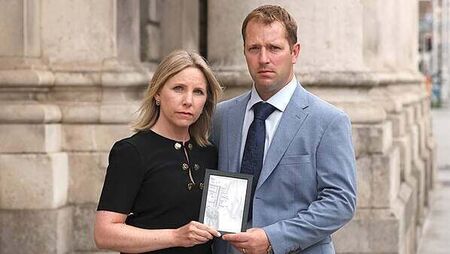
Mr Staines’ widow, Lorraine, told the court she had lost her husband and best friend of 35 years.
“He was a huge presence, someone who brought warmth, reassurance, endless laughter and love to everyone around him,” she said.
She told Mr Justice Paul Coffey her husband died of anaphylactic shock. “An allergy that was well documented. His death was and should have been completely preventable,” she said.
Since her husband’s death, she said their family has carried “overwhelming grief.”
The family, she said, had waited for ten years “for some accountability, ten years of reliving what happened on that fatal day and carrying a loss that never eases.”
She told the judge she hoped that, as a result of the case, change would follow and no family would have to go through what they did.
Nothing she said will ever give them the life and years they have lost or ease the pain they continue to carry.
In the proceedings brought by Lorraine Staines against St James’s Hospital, Dublin, it was claimed that there was a failure to manage, treat, or otherwise properly care for Mr Staines and, in particular, to consider or treat his allergy syndrome properly.
It was also claimed failure to clearly list and record properly all the known and or suspected substances to which Mr Staines was allergic which it was claimed amounted to substandard care.
There was also a failure to appreciate Mr Staines previous allergic reaction to the same steroid.
Noting the settlement and approving the division of the solatium, Mr Justice Paul Coffey expressed his deepest sympathy to the Staines family. The judge said it was an unusual and tragic case.