Cian Manning’s Tales of the Déise: A Greek odyssey
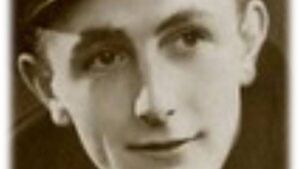
Alexander William (Bill) Anderson.
Born in Dublin on September 16, 1922, Alexander William (known as Bill) Anderson was the only child of Paul and Aileen Anderson. Paul was a civil engineer and had previously worked in West Africa in the service of the British government. He returned to his native Ireland around 1920, subsequently taking up residence at Mount Prospect in Ballymountain, Co. Kilkenny.
Bill’s mother Aileen (known as Eily) was the daughter of J. Ulick Bourke, Resident Magistrate. Ulick had attended Cambridge University in his younger days, competing for the university in the iconic Boat Race against Oxford in 1867.
Aware of public service and community, both Paul and Eily took an active interest and provided practical support to the Waterford and South Kilkenny branches of the Irish Red Cross Society.
A passion of Paul’s that he would pass on to his son Bill was sailing. Paul was a founder member of the Waterford Harbour Sailing Club and a fixture of their August meet at Dunmore East with his water wag and later with the . Many of the boats he built were made at Glasshouse.
In his early teens, Bill attended one of the oldest public schools in the United Kingdom, Sherborne School in Dorset. This historic educational institution can boast alumni such as Alan Turing, Cecil Day-Lewis, John Le Carre, Jeremy Irons and Coldplay’s Christ Martin. As a boarder, Bill was housed in The Green, where he membered the House Literary Society, as well as captaining The Green’s shooting team. In the 6th form, Bill was a member of the Army Class and studied subjects such as Chemistry, Divinity, Drawing, English, French, History, Mathematics and Physics.
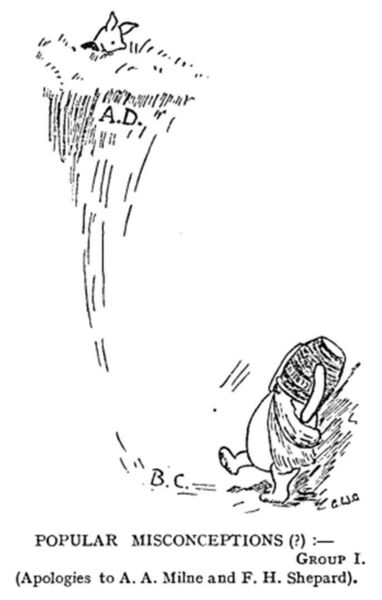
A talented and inventive mind, Bill Anderson contributed cartoons and illustrations to the Sherborne School magazine in 1939. Furthermore, he contributed illustrations to the 1939 Christmas Number. These accompanied a piece titled ‘Down River, 1913,’ which was a continuation of a story from the previous year. The article was published under the pen name ‘Wanderer,’ but one suspects the author was Bill’s father Paul.
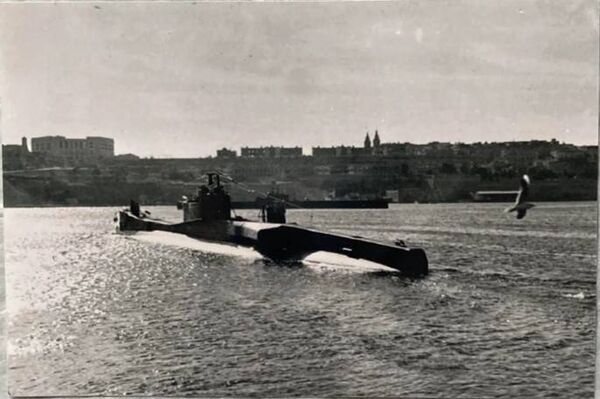
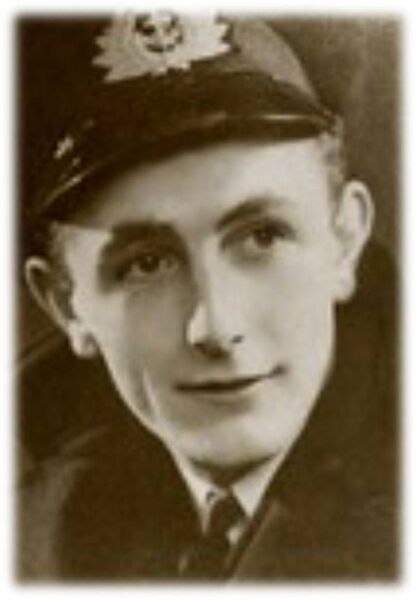
Around this time, Bill was preparing for a career in the Royal Navy. In 1940, Anderson came 8th out of 250 in the Royal Navy Exam. He went on to serve as a Sub-Lieutenant aboard the submarine .
Sadly, early into his naval career, Bill’s father died on October 10, 1942 at the Waterford Club in Gladstone Street. Paul was taken suddenly ill as he was conversing with friends before his planned cycle to Dunmore East. His cause of death was recorded as ‘Myocarditis Angina Pectoris’.
As the Second World War continued to rage, traversed the Mediterranean, monitoring enemy ships and disrupting the Axis powers’ movements and supply chain. On September 26, 1943, sailed from Beirut to patrol west of the Dodecanese in the Eastern Mediterranean. This was to be followed by a patrol to the east of the island of Leros. Failing to return on October 17, and with no messages received, the vessel and 64 crew were suspected lost at sea due to striking an enemy mine.
The fate and demise of the remained a mystery for around 80 years. On October 6, 2024, it was announced that a Greek search team led by Kostas Thoctarides had located the wreck of the submarine, north of Donoussa Island in the Aegean. The wreck was found in three sections, indicating a violent explosion. It is believed the submarine was running on the surface when the mine was detonated due to the forward hydroplane being in their stowed position and several hatches being open.
Of the discovery, former archivist at the Royal Navy Submarine Museum, George Malcolmson, stated, “Knowing the location of the last resting place of our submariners will help bring closure to surviving relatives and descendants and serves as a timely reminder of those special breed of men who made the ultimate sacrifice.”
Just a few months later, in January 1944, Bill’s mother Eily would also lose her life in tragic circumstances. While walking along a railway line with Violet O’Neill Power, Eily’s cocker spaniel inadvertently ran on to the permanent way as the Rosslare Express was coming. Attempting to catch her dog, Eily was struck by the right buffer of the engine, killing her instantly. An inquest at Mount Prospect saw O’Neil Power state that “it was not the engine driver’s fault; no one could have possibly avoided the accident”.
Eily was buried in the Abbey Graveyard, Ferrybank, where her husband’s remains were also interred. She died a widow and without the knowledge of her son Bill’s final resting place. In the space of a few years, the Anderson family of Ballymountain were no more.
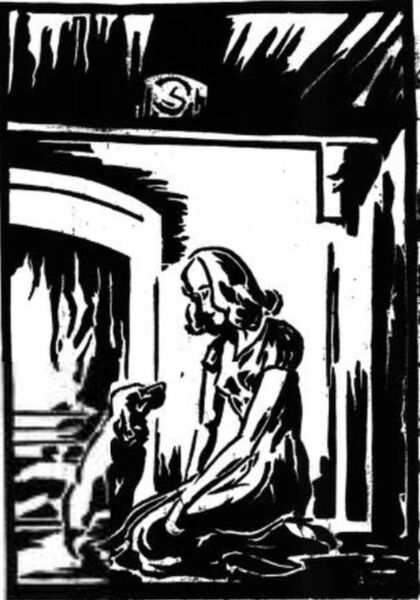
Posthumously, the printed a couple of Bill’s linocuts and later several of his poems. When looking at the cosy image of a woman petting a dog (which appears to be a cocker spaniel), one can’t help feel this print was a homage by Bill to his mother, Eily. It demonstrates the love between a mother and son, but also the poignancy of two lives lost in the most extraordinary of circumstances. The print and poems are vivid creations that have endured long after they were crafted, and the maker extinguished.
One of Bill’s poetic compositions concerned the River Suir of which he was undoubtedly familiar. Its brevity and naïve rhyming scheme is elevated in the knowledge of Bill’s young death and the triple tragedy of the Anderson family. It reads: