€7m spent on Luas bridge rebuild after metal girders warped in 1000 degree fire
Ken Foxe
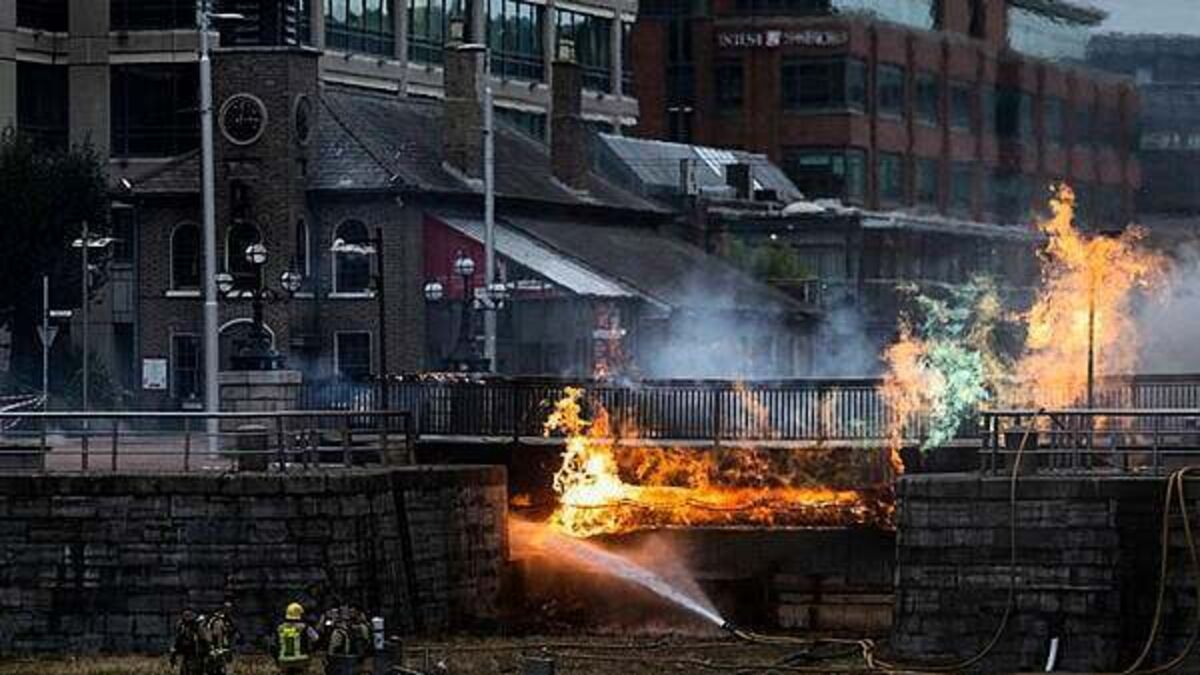
Metal girders warped and deformed in a fire that reached temperatures of 1000 degrees Celsius and destroyed a light rail bridge.
An inspection of the George’s Dock Bridge, which carries Luas trams in Dublin, showed visible buckling of steel while concrete lost most of its structural strength.
A report said bearings were exposed to direct fire as components melted and concrete bearing plinths were cracked and damaged in the August blaze.
The rails that carried trams also buckled from the extraordinary heat while handrails were “badly heat-distorted.”
The scale of the damage was so severe that it could end up being cheaper to rebuild the bridge entirely rather than trying to repair it.
A report by engineering firm Arup said fixing it up would be “highly complex and lengthy.”
It said the entire concrete deck would have to be removed and recast while steel girders would need to be heat-straightened or cut out and replaced.
More “severe distortion” of the metal would need bolting or welding, and all of it would need extensive stress testing.
The report said: “Arup estimated that the cost of repair could approach (or even exceed) the cost of a new bridge.”
It said repair, while technically feasible, would be slow, expensive and leave Luas with an “old structure with patchwork fixes.”
A scoping document from the National Transport Authority said it might also be possible to temporarily strengthen the bridge with a view to a full renovation later.
This would involve propping up the bridge from beneath and could have been used to get Luas services back in operation more quickly.
However, designing and installing the props would itself take time “reducing the advantage of ‘quickly’ reopening.”
The document said: “[It also] required the installation of props in the old George’s Dock (a water basin) which would be technically challenging and potentially require cofferdams or barges.
“It introduced its own safety and logistical risks.”
In the end, the National Transport Authority opted to build an entirely new bridge, ensuring full structural safety and a lifespan of over 100 years.
It was back open in late November, just over three months after the blaze, and in time for the busy Christmas season.
The report said: “Although building a new bridge sounds time-consuming, Arup argued it could be done relatively fast by using accelerated bridge construction methods (fabricating the new span off-site while preparations are made on-site).
“Arup pointed out that repair work might drag on longer than a replacement, whereas a replacement could be done in a matter of months if prioritised.”
It said costs were likely to be similar to repair while giving “peace of mind,” a longer lifespan, and easier maintenance.
The engineers said the replacement would be a more effective use of taxpayer funds than an “uncertain refurbishment.”
No definitive cause for the fire was provided in the documents.
However, a letter from Transport Infrastructure Ireland said a gas pipeline had ruptured during the blaze “and was apparently the source of the flames.”
Asked about the documents and the project, an NTA spokesman said while the final cost of the project was not known, it was estimated to be in the region of €7 million.
He said: “Transport Infrastructure Ireland (TII) has undertaken the demolition and replacement of the bridge structure with its contractors, and this work was funded by [us].
“Transdev, as the Luas [operator], replaced and reinstated the rail systems and funded this work themselves.
“The bridge was insured and Transdev and TII are in the process of submitting claims against the insurance policy for recovery of certain costs.”