VAR has simply changed what we argue about
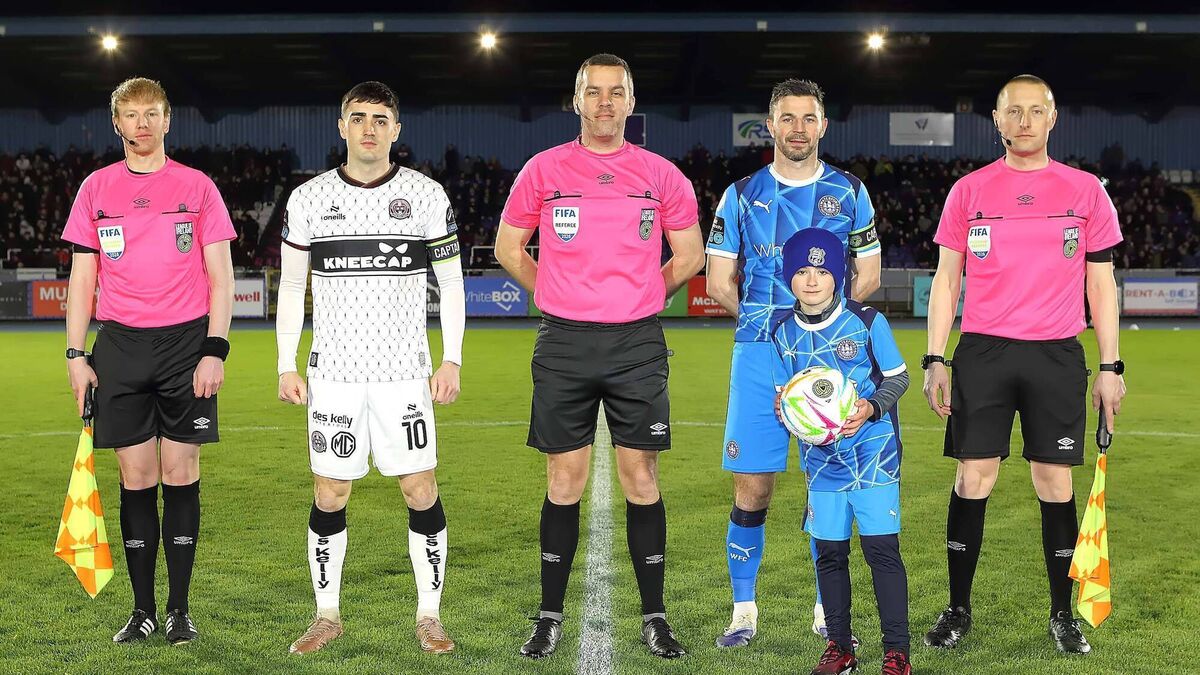
Referee Robert Harvey, his assistants Robert Clarke and Wayne McDonnell are pictured with Bohemian's captain Dawson Devoy and Waterford FC captain Padraig Amond with mascot Louis Fetat. Photos: Noel Browne
VAR. Video Assistant Referee. Three words that now strike fear into football supporters and divide opinion like no other innovation in the modern game. It was introduced just in time for the 2018 World Cup and adopted by the Premier League at the start of the 2019/20 season. Eight years later, the technology continues to cause arguments.
The idea behind VAR was simple: it gave referees the chance to correct obvious mistakes involving goals, penalties, red cards, and mistaken identities. The problem is that not all referees interpret the laws of the game in the same way. Even with multiple camera angles and slow-motion replays, officials still disagree on what constitutes a foul, a handball or interference in the build-up to a goal. The debate that was once aimed solely at referees on the pitch has now expanded to include the officials sitting in the VAR booth.
Data collected by BBC Sport, taken from the Premier League's Key Match Incidents (KMI) Panel, shows that VAR mistakes have increased from 10 to 13 in the 2025/2026 season compared to the 2024/25 season. For a system designed to eliminate mistakes, that statistic suggests the technology has just changed the nature of the mistake.
A week doesn’t go by anymore without controversy, and for a lot of supporters, it is ruining the game that they once loved. When a goal is scored now, it almost feels like supporters are not celebrating as much for fear of there being a marginal offside decision going against them or a foul in the build-up to the goal. Even when it is a tight decision, with a two-minute VAR check and the goal standing, the celebrations are muted by the delay.

I was an advocate for VAR when it was introduced. It felt like the match officials were missing too many big decisions. There are always teething problems at the beginning of something new, but it seems like in the past couple of years, everyone has had enough of VAR. Probably up until last year, I was still defending it because I felt VAR wasn’t the issue; it was just the decisions made by people using or in charge of the VAR. Now I have had enough with VAR, and I think of the old saying “be careful what you wish for”, as it seems as if the game was better before this bit of technology was introduced.
Throughout my career, 99% of my games were played without VAR, but what always struck me was how different some match officials’ interpretations of the laws were. At least in our games, human error was present, and it had to be accepted, regardless of whether you liked it or not. What is happening now, though, is that VAR officials are making decisions that are wrong, and then after the game, the PGMOL (Professional Game Match Officials Limited) have to come out with a statement and apology for getting the decision wrong when the whole reason VAR was brought into the game was to get the right decisions and to help the referees.
One piece of technology that has worked extremely well is goal-line technology; the reason it has been good is that there aren’t any interpretations to be had; it is black-and-white: over the goal-line or not. With that being said, in the 2019/2020 Premier League, the goal-line technology failed for the first time in 9000 games during the Sheffield United and Aston Villa game when Sheffield United scored a goal, only for it not to be given as the referee's watch didn’t alert him to the ball crossing the line. It ended up being a huge moment as Aston Villa actually were saved from relegation from the point they got, as the goal wasn’t given to Sheffield United. While the technology failed, the bigger issue at the time was that VAR officials failed to intervene in the decision.
Apart from that moment, goal-line technology has been excellent for the game, and it has helped officials with really difficult calls they had to make, especially assistant referees who had to see through a goal post and decide in a split second.
Technology was supposed to remove controversy from football, but instead, VAR has simply changed what we argue about. The game may never return to the simplicity of the way it used to be, but if football’s law makers want to win supporters back, they might need to remember that sometimes the human element was part of what made the game special and exciting. Do I think that VAR will be scrapped? No is the short answer to that. It may be tweaked, and it probably needs to be, but in the short term, I can’t see much changing.