Repair, refurbish, renew?
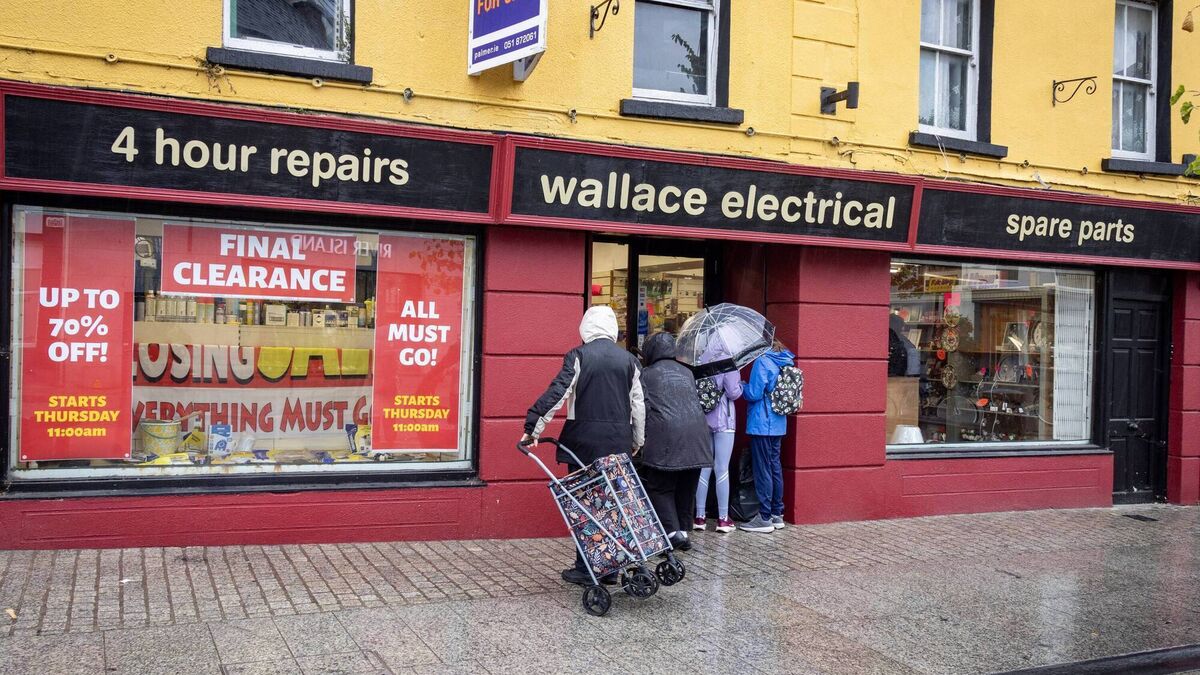
Wallace Electrical as it closed its doors after 45 years of service to waterford. Photo: Joe Evans
Last week Wallace’s Electrical in Arundel Square sadly announced they would close after 45 years. It was as if Harrod’s in London had closed. Hopefully the well situated premises will find a new tenant quickly. The closure of any family business is a tragedy, but even the owners might admit that the electrical spares business has changed. It was like the closure of John Hearne’s hardware on the Quay, a shock, until you see that Woodies, Morris’s, Chadwick’s, Screwfix or whoever each have huge shops around the city, offering the same products. We deny the reality of Kavanagh’s, Harvey Norman, DID, Soundstore, Curry’s, Kelly and Dollard etc, all offering electrical equipment, while rose tinted, dewy retrospection takes over and people who shop on-line question the future of our city centre. And then you read the Irish Times “almost one in seven commercial properties lies vacant” across Ireland, according to a GeoDirectory analysis to June 2026.
Of the Waterford urban areas surveyed, Dungarvan recorded the highest commercial vacancy rate at 20.4%. Tramore had the lowest at 12.1%. These two towns are not directly comparable as Tramore is in reality a growing suburb of Waterford city, while Dungarvan has its own independent hinterland. Waterford city seems to be at 19.1%, compared to Limerick City 21%, Cork City 14.5% and Galway City 21.5%. The figures for Limerick and Galway are hard to comprehend given the growth in their local economies, while the Cork city figures are unsurprising given the huge number of large MNC employers there and the reported salaries being paid. Apple, with something around 6,000 employees and anecdotal average earnings around €90pa, indicates real wealth, ergo: the national vacancy rate was lower in areas benefitting from population, employment and investment growth, particularly in the east of the country. That’s hardly a surprise to anyone.
Waterford has sought more higher-order retail for years, but town and city centre retail is under immense threat everywhere from suburban and on-line retail. People want top line retail names in Waterford city, while Harvey Nichols will close its Dundrum, Co Dublin shop in September with a loss of €28m, after years of loss-making activity. Dundrum Shopping centre sits on a massive and reasonably priced car park, in the most affluent part of Dublin. It’s hard to know what the solution is to the complex issues facing bricks and mortar retail or indeed any bricks and mortar businesses like pubs or restaurants.
Waterford city, (like Limerick city) has a particular socio-economic situation according to Pobal research, where relatively disadvantaged, lower-income and often welfare-dependent households are clustered in the older parts of the city near the city centre, while affluent areas are located in the eastern suburbs, Newtown and along the Dunmore Road. It is interesting that the former group has easy pedestrian and bus access to the city centre, whereas the latter group, with higher disposable income, constrained by distance and terrible traffic conditions, are literally marooned around Ardkeen. Traffic delays both ways along Park Road and the Dunmore Road can be horrendous. Public transport faces interminable delays. This issue is being utterly ignored.
Furthermore, our council has over-pedestrianized Waterford’s city centre thus exacerbating a general problem. The famous urban author and activist Jane Jacobs ('Death and Life of Great American Cities') warned against doing this in “small” cities. She argued that if you are going to pedestrianise anything, you should choose very narrow streets or alleys. (Shop Street, Galway, Main Street, Wexford, our George’s Street and Michael Street and even Spring Garden Alley). Narrow spaces naturally look and feel bustling even with a modest number of people, preserving the intimate, lively atmosphere necessary for a city to thrive.
Jacobs' warnings proved incredibly prophetic. During the 1970s and 1980s, hundreds of small and mid-sized American cities pedestrianised their main streets into car-free shopping areas to compete with suburban malls. Just as Jacobs predicted, without the density of a massive metropolis, these pedestrian areas turned into desolate "ghost towns" after 5pm. Jacobs argued: "It is a mistake to separate cars and people. When a wide street in a small city is completely stripped of vehicles, the pedestrian density is rarely high enough to fill it”. In all honesty we face those difficulties. We have paved Barronstrand Street, which has only minimal late evening businesses and closed Arundel Square, greatly inhibiting vehicular access to the historic city centre from the Dunmore Road area via The Quay and Exchange Street. A sensible reopening of Arundel Square would allow some traffic to flow from the Quay to Ballybricken through part of the historic city centre, mimicking the route from Ballybricken via Peter Street and Lady Lane to the Mall. A “wishful thinking” hotel in New Street with access to Michael Street and utilizing the old car park would have a huge impact.
The UK NGO 'Centre for Cities' research suggests the chief determinant of town or city centre footfall is disposable income. It’s reasonable to infer that condition affects Waterford city. The IDA announced 25,729 new jobs for Ireland in the 18 months from January ‘25 to July ‘26. Only 75, or a quarter of one percent, of those, were in Waterford. You can see the difficult landscape. Council’s focus on the North Quays has been incredibly problematic as is the abject risk-averse investment attitude of local business. Failure to complete the North Quays pedestrian bridge and the shocking delay in commencement of any private sector work by Harcourt Developments severely undermines local confidence and enables a horde of knockers and nay-sayers. The inability of council to execute “old” projects in the city centre at Bridge Street, Parade Quay, Lady Lane, Hanover Street etc, adds to the sense of inertia, malaise and lack of impetus which is greatly damaging the city’s image. Massive dereliction in New Street and surrounds, questions our ambition. Meanwhile we face challenges from some of the best-presented towns in the country such as Wexford and Kilkenny, which compounds local difficulties. Initiatives like the Church Yard Music, Cultural Quarter, Applemarket sessions and Waterford Walls underline the cultural and economic value of “soft” promotion. But the grittier process of driving physical renewal while restoring, repairing and rebuilding the city’s built heritage is appallingly far behind what’s necessary.