The parish on a mission to protect its children from drugs
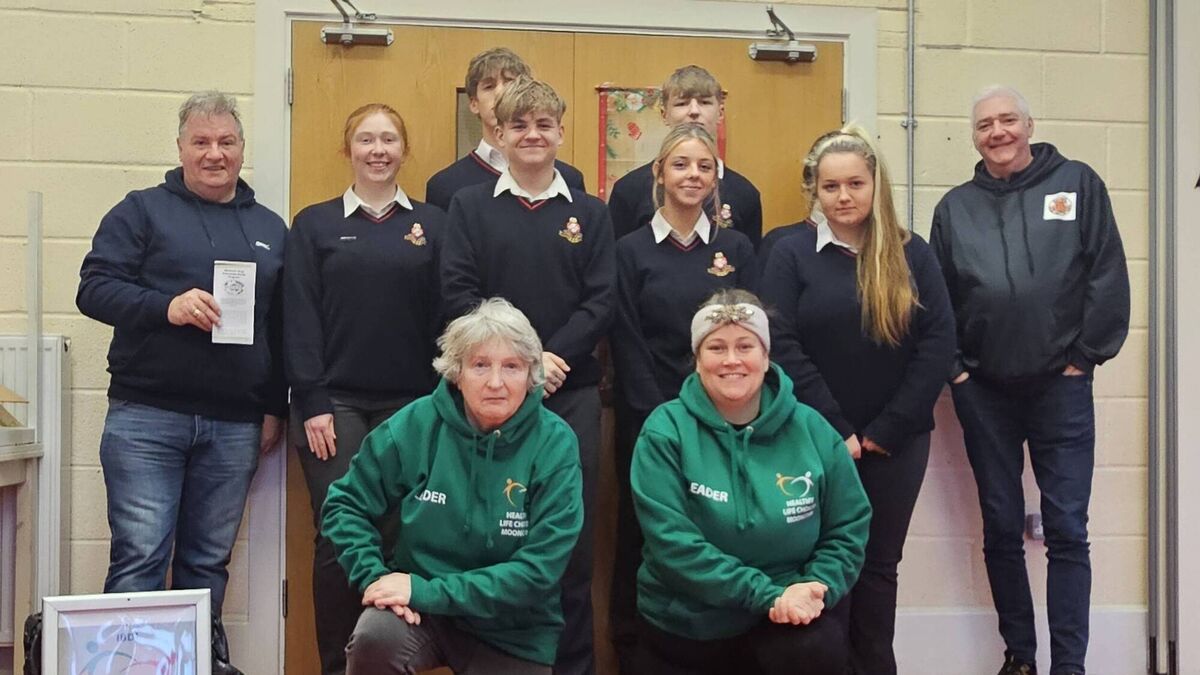
Mooncoin Parish Drug Awareness Programme with TY students from Coláiste Cois Siuire and Darren Butler, national coordinator for the Irish Bishops Drug Initiative.
What a wonderful thing it would be for a parish to be known for its work in keeping its young people safe from drugs.
Well, that is exactly what the community in Mooncoin in South Kilkenny is working on right now.
And it’s not just illegal substances this community is fighting against.
The Mooncoin Drug Awareness Parish Programme is training transition year and senior cycle students to deliver a programme to sixth class pupils in local primary schools.
They see nicotine and tobacco products, as well as alcohol, as “soft drugs” which are easy for young people to access but can be supported through education to make healthier decisions.
Now that the programme is being filmed and developed into an online resource for primary schools across the country.
And young people in Mooncoin, South Kilkenny, are leading the way.
The Waterford News and Star spent the afternoon at the Mooncoin Parish Hall with the group of transition year students from Coláiste Cois Siuire, volunteers and members of the parish, as they prepared to present their work to Minister of State for Public Health, Well-being and Drugs Jennifer Murnane O’Connor.
Before the minister’s arrival, the students told us about the programme, the issues young people face and what they think does and doesn’t help.
They said they got involved with the programme to help other young people, improve their CVs and to leave a legacy at their school and beyond.
“It’s nice to know we are part of something that will affect a whole generation, and our brothers and sisters might be watching the same programme we are doing now,” said TY student Simone.
But the most important thing to these students is that the programme is built in partnership with them and not just for them.
They said that the causes of alcohol and vaping use (as well as other products like nicotine pouches) were wide-ranging and may not be what you expect.
Adam pointed out that there is a mental health crisis among young people and substances like vaping and alcohol, provide a boost of serotonin.
He said conditions like depression are now affecting children as young as 10, and so while education is needed, so are other supports.
“If you can tackle the mental health issue, you can also tackle the issue of people needing other substances to make up for their lack of happiness,” said Adam.
Simone added that it’s not just about depression, but activities like vaping can be a form of stimming for young people on the autism spectrum or who have ADHD.
“It’s actually helping their head, and it’s not even nicotine. It’ s having it in their hand and being able to pull on it.
“So that’s the other side of it. Like with the mental health services and putting up the diagnostics, it would benefit everyone. It would also tackle the issue of kids and not just smoking the drug problem as well,” said Simone.
Simone also said that new products like vapes and pouches are easier to access and hide than cigarettes.
Nicotine pouches are small white pouches of flavoured nicotine.
They are a relatively new product in Ireland and although they contain very high amounts of nicotine are currently unregulated in Ireland and many other countries.
They are designed to be placed under the lip and the nicotine is absorbed through the mouth.
She said she was sceptical of the disposable vape ban, saying there is a “way around everything” and as juice becomes more expensive, young people are turning to cheaper alternatives like pouches.
“If you put up one, the other will be used more.
“Like when you think about it, people our age don’t have an income. So, the cheaper it is and it does the same thing, they are going to go for the cheapest method. Like, even if it does more damage, they are still going to use it,” said Simone.
But that is not to say the young people we talked to don’t believe in education.
They said that if children and young people knew what was in vapes, they might be less likely to pick them up.
“I feel the perception of vapes as well. We learned here that one reusable vape can have up to nearly 40 cigarettes of nicotine in it and I feel like some people have the perception that it’s just one reusable vape, but that’s like two packs of cigarettes and the amount of nicotine,” said Molly.
And when we asked if the group if they could choose one message they would like to get out there, they spoke directly to adults and in particular parents.
Jonah said to pay attention to what your child is doing, while Simone warned, “the kids you think are not doing it, are, and it could be your kid.” Adam said there is no one-size-fits-all solution to young people and substance abuse.
“It’s [the programme] not going to get all, but the whole point is you want to get as many people as you can to be healthy,” said Adam.
Programme trainer Orla said that she has learned so much from working with these young people.
And she said, while there are different challenges now around substances, there are also more ways to learn.
“The lads have given me some great insight and they are actually well informed because when I was younger, I was part of the generation where the internet was coming in and you were experimenting with it.
“Whereas they are on the internet and they are more informed. They are researching. They are listening to podcasts. So, like I have to say well done to you all and I’ve had a great time working with you,” said Orla.
Orla echoed Adam’s sentiment that it's not about telling children and young people what to do but giving them the information they need to make the best decisions for themselves.
She said the young people she and her colleagues train are getting a really important message out there.
“Be informed with what decision you make.
“We are not here to bully anyone into this is the right way, that is the right way, but at least if you are informed, you can consent to what you are doing every day, in every opportunity, in every social setting and that you make the decision that suits you the most,” said Orla.
Darren Butler is the national coordinator for the Irish Bishop's Drug Initiative, an organisation set up to provide a “pastoral response” to the problem of alcohol and drug issues in parishes and communities across the country.
Darren told us that he delivers the programme that the Mooncoin TY students are training to facilitate.
The programme used to be part of the confirmation preparation, but the need is there for everyone to participate. regardless of religious denomination.
And Darren is just one person, an adult at that, and peer support is a powerful thing.
“They are the process. I could do it myself because it’s a programme I am doing every day for months on end in numerous schools, but peer education is so much more powerful than an adult coming in and it feels like a lecture, said Darren.
Darren said that there are programmes around the country and the initiative has been lucky to have such an active team in Mooncoin.
“It’s the team, the Mooncoin initiative should be taking all the credit for it because I just couldn’t go into a parish and do these things.
“These guys make it easy for me. They are volunteers, but they make me look good. That’s for sure,” said Darren.
The Irish Bishops' Drug Initiative are planning to relaunch the pledge.
The pledge is a commitment confirmation children make not to drink alcohol or smoke cigarettes until they are 18 years old and to never take illegal drugs.
The pledge has been around for a long time, but times and substances are changing.
Now so too will the pledge.
Darren said that the pledge is to be relaunched in 2026 and will include vaping in the commitment.
“The reason was that we done a little bit of research around it and people found it was old-fashioned. It wasn’t relevant. I suppose the parents felt that if they were engaged with the church, it wasn’t something they came across or were part of,” said Darren.
If you are of a certain generation, the pledge might be something of a given in your coming-of-age story.
But young people today, the pledge and the planned support around might be a lifeline.
“What people don’t realise is that sometimes, is that some young people sail through that time, but for others, that summer between 6th class and first year can be really challenging for them.
“So, we do a programme including the possibility of cigarettes, alcohol, vaping and snus.
“So, you know it’s not just a window, it’s not just a church initiative, it’s for anyone in the classroom.
“If they are catholic and they have confirmation coming up, they use it as their preparation.
“For everyone else its important information they need to know, and if they are not making a pledge, then you challenge them to challenge themselves to live a healthy lifestyle and get to 18 just like the confirmation candidates,” said Darren.
Programme leader David Conway told Minister O’Connor during his presentation that the work that they do reflects programme founder Fr Eamon O’Gorman’s belief in the role the parish can have in the fight against drugs.
He said that in their 19 years, they are “blessed” to have the support of the local schools and the opportunity to help educate the community’s children and young people.
“We don’t want anyone from Mooncoin saying they don’t know what these substances do and the consequences of taking them, said David.
Minister O’Connor told those gathered that when she learned about the project, she was very impressed and was looking forward to future discussions on their work.
She said that since becoming the minister, she has seen that the problem is nationwide and tackling it will require the input from families and communities as well as experts and service providers.
For her part, the minister outlined her plans to ban disposable vapes and restrict flavours and marketing around vaping to better protect young people.
Darren, in his address, said that he was looking forward to speaking with the minister.
He said that the country is “in the middle of an epidemic in vaping” and it was great to see change.
Darren said that in addition to the national roll out of the interactive programme filmed in Mooncoin, a parish in Philadelphia has also expressed interest.
“We are making stars out of them for sure,” he said of the Mooncin TYs.
He praised Mooncoin as a welcoming place and “the first port to call” when the initiative needs anything and said volunteers and young people were “a credit to their community”.
Earlier this month, the Public Health (Single-Use Vapes) Bill 2025 went to the second stage in Dáil.
The bill will ban single-use vapes in an effort to address environmental and children’s health concerns.
The bill will make vaping more expensive and less attractive to children and will reduce if not stop the littering of the brightly coloured containers in public places.
But that’s not all.
The Public Health (tobacco and nicotine-inhaling products) amendment bill is expected in 2026.
That bill will introduce measures on nicotine pouches.
Following the presentation, we spoke to the Minister in Mooncoin and asked if she intends to ban them altogether or just place restrictions on sales.
But she said we would have to wait for the bill.
“The first bill will be on the banning of disposable vapes, but the second bill will include that, and at the moment, that is being worked on,” said Minister O’Connor.
Minister O’Connor also said in Mooncoin that the first draft of the National Drugs Strategy is imminent and could be in place by the middle of 2026.
The last strategy came into effect in 2017 and expired this year.
But the minister said that drugs are changing, so the strategy needs to as well.
She said that in developing the strategy, she wants to include as many people as possible.
“With the new strategy I hope to launch maybe in the middle of next year, we will review it and look at it every two years because you know drugs are changing. We can’t be in a position where it is ten years on, and we are doing the new drugs strategy.
“So again, yes, we are talking to everyone, we are talking to families, we are talking to everybody because it is important and we are at the moment looking at putting it out for public consultation. We don’t know on that, but we are looking at all avenues to see what we can do,” said Minister O’Connor.