'The magic is that the tutors delivering it are Travellers'
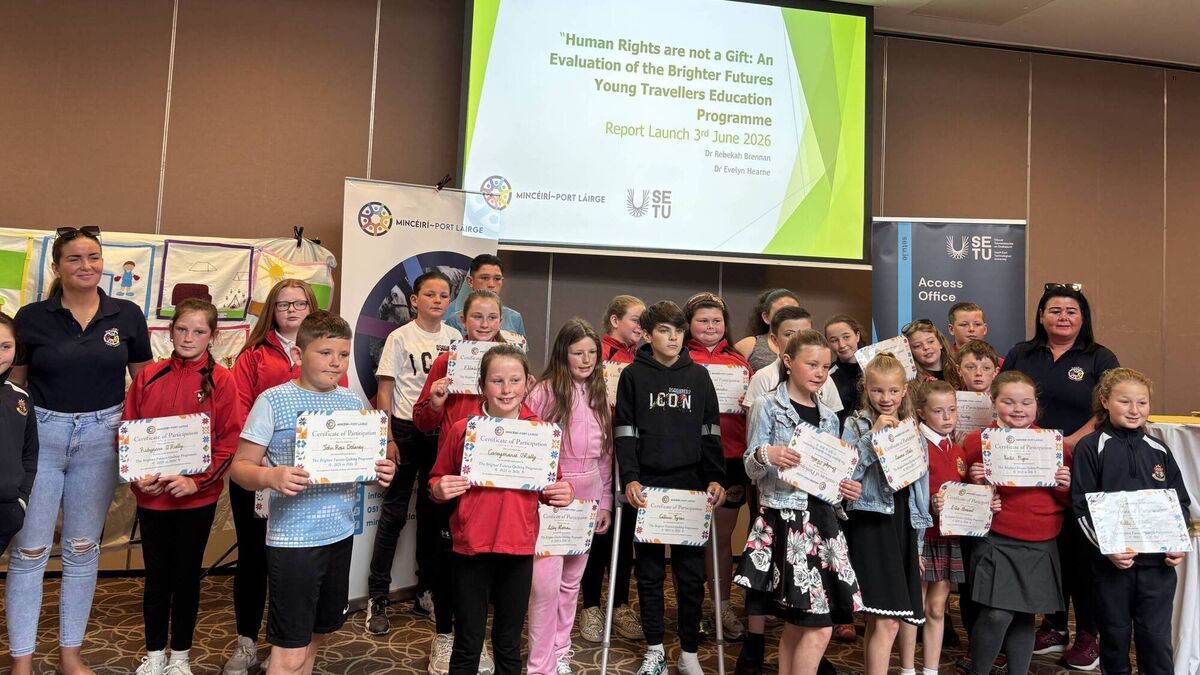
Students from the nine participating schools attended the event and received certificates.
The Brighter Futures programme is unique to Waterford. Involving nine schools and over 100 students, it is an educational programme whose mission is to centre Traveller history and culture.
One of the most progressive elements of this programme is that it is completely Traveller-led. Three Traveller women named Margaret Connors, Marylou Alcock and Anna Alcock went to various schools and met with Traveller children each week, providing them with what Dr Rebekah Brennan called a “sacred space”.
In a report published by Mincéirí and SETU and written by Dr Brennan, one of the teachers said, “The magic is that the tutors delivering it are Travellers.”
According to Ann Irwin, the National Traveller Partnership Coordinator, another positive aspect of this programme is that it “rebuilds trust across generations”.
Ann explained that, “Families carry the weight of their own difficult educational memories. Brighter Futures is changing that – for children and parents.”
SETU’s involvement with the project was applauded by both CEO of Mincéirí Mary Connors Alderidge and Dr Brennan. Through the access office, students participating in the programme had the opportunity to do a campus visit.
Dr Brennan said, “This gives Traveller children the opportunity to imagine themselves going to third-level education.”
In 2016, there were no Travellers at SETU and a decade later, there are 14 Traveller students at SETU today. There are also eight Traveller graduates.
One of the Traveller Education workers, Margaret Connors, spoke about how she never expected to be teaching in a school. She said, “When I was in school, I was left sitting at the back. There was no support there. We first talked about it in the [Mincéirí] office, we talked about how if we had that support, if we were told ‘right there’s going to be a Traveller woman coming into talk to you today and say that education is important’ or ask if we had homework – there was none of that.
"I left school at 13 years of age and it was a normal thing to do. I think for the children to see us coming each week, and supporting them and talking about the culture [saying] ‘it’s who you are’. If you’re proud from a young age and you’re able to walk into school and say ‘this is me, I’m a Traveller’. There’s a lot of schools where children hide their identity. Thanks be to God, they’re more proud than ever, especially in Waterford, we have a very proud Traveller community.”
While the programme is obviously highly valued by the schools, the Mincéirí project and the children themselves, Ann Irwin also made the point that more support is needed from the government to make this a long term programme. She spoke about the stress and uncertainty these women face year after year because funding for the project comes from the Department of Children, Disability and Equality’s ‘Dormant Accounts Fund’. This means that a separate application for funding must be made every year.
Independent researcher Dr Rebekah Brennan wrote a report on the impact of this programme. Among other things, she recommends that “a sustainable, multi-annual funding stream be established to protect continuity, staffing stability and quality assurance as demand increases.”
She explained that this money could also be used to train more facilitators of the programme, as several Traveller women have expressed an interest in getting involved as teachers on the programme.
Dr Brennan also said that simple things could greatly improve Traveller children and the parents’ relationship to formal education such as teachers communicating to parents via Whatsapp voice notes rather than email.
Mary Connors Alderidge said, “For generations, members of the Traveller community have faced significant barriers and discrimination within the education system, including exclusion, prejudice, cultural misinformation and low expectations.”
Indeed, Dr Niall Muldoon, Ombudsman for Children, made the point that reduced school days disproportionately affect Traveller and Roma children. At the post-primary level, Traveller children are 12 times more likely to be placed on a reduced timetable.
Ann Irwin said, "That’s not inclusion – that is managed exclusion."
Mary continued, “Traveller identity and voices [should be] recognized as an important part of the educational experience.”
All of the speakers raised the point that whilst other groups in Irish history are studied, Traveller history and culture is not formally a part of the Irish curriculum. This is despite Travellers being indigenous to Ireland.
At the end of the event, school children from the participating schools (St Saviour's, the Mercy Primary and Secondary, St Paul's, Mount Sion, the Ursuline and Scoil Lorcáin) received certificates commemorating their achievement. As each child made their way back to their seat, their pride and delight at getting a round of applause and a certificate was obvious, as was their anticipation of the table of snacks waiting to be devoured after the speeches.